


Ways of Seeing
The white expanse around the massif lay piebald, earth already rising through the snow.
We arrived at Helags on the verge of spring, and each time the crust broke under my skis, the same routine followed: calling back the drone, hauling the pulka uphill again.
By evening, we pitched our tent in sight of the massif where we had come to film, now digging anchors into the soft snow.
On the ground, Martin set up the tripod and prepared the camera for the time-lapse sequences. What we aimed at that evening was not the mountain, but the sky above.
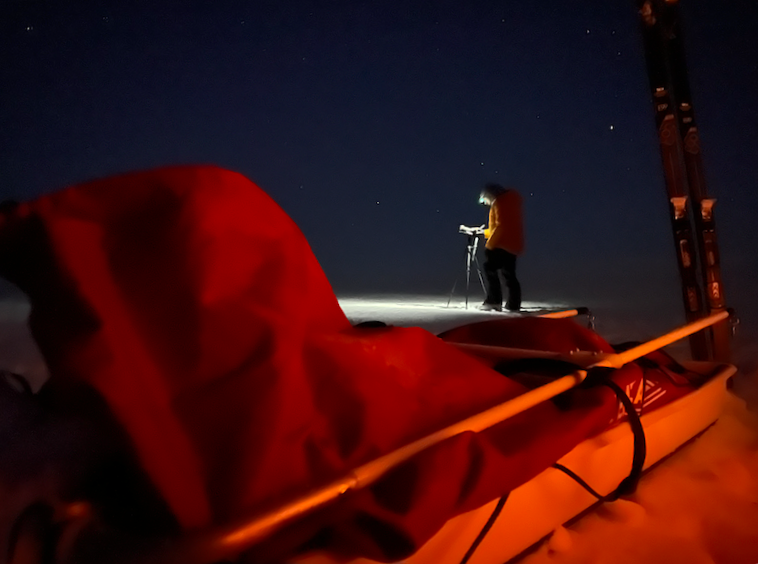
In the Blue Hour, two first stars appeared over the massif that the Sámi of the South call Maajåelkie.
Around me, I felt the open sky draw the last warmth into the void. In the morning, there would be a few hours of firm snow.
As darkness sank down over Helags, more stars soon followed Vega and Arcturus. By the time the Milky Way had poured its arc over the mountain, the sky was filled with points of light.
Intuitively, my eyes began to draw lines between them, connecting dots to figures from classical mythology.
There have been different ways of seeing this sky, I remembered, before these stories arrived from further south.
Where do their traces reach?
“They Are All Moose Hunters”
I followed this question to the Nordic Museum in Stockholm.
In its basement, this institution holds manuscripts and drawings by a person in whom the trail of Sámi constellations seems to end.
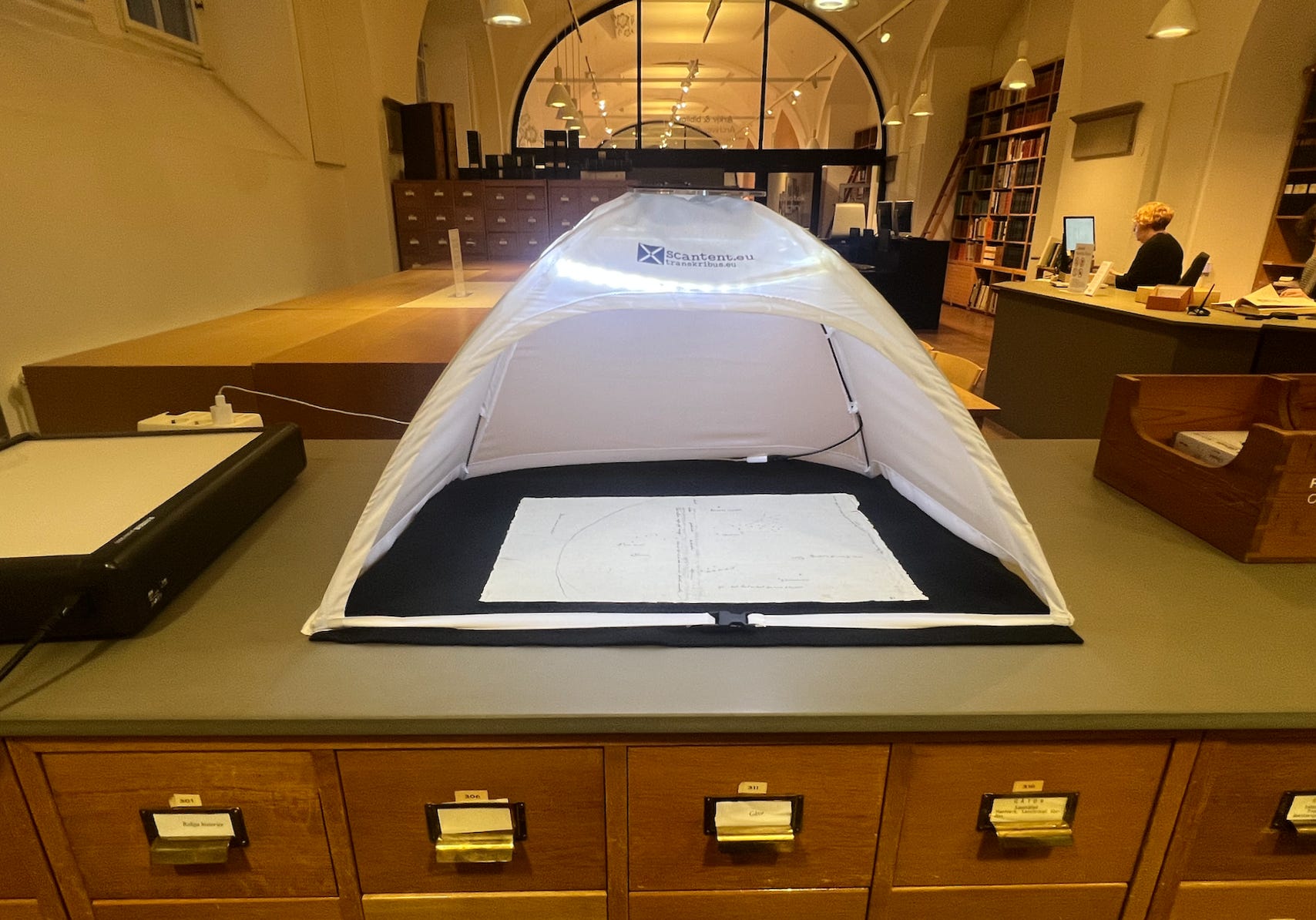
Around 1900, the first authors emerged from a culture that had passed on stories, skills, and rituals orally for many centuries. The person to whom we owe most of what is known about the Sámi ways of seeing constellations was a hunter and trapper from Northern Sweden.1
Johan Turi (1854–1936) spent most of his life in the area around Kiruna. In 1910, he published his Muitalus sámiid birra (‘Account of the Sámi’). In the book, he described their lives and migrations with the cycle of seasons.2
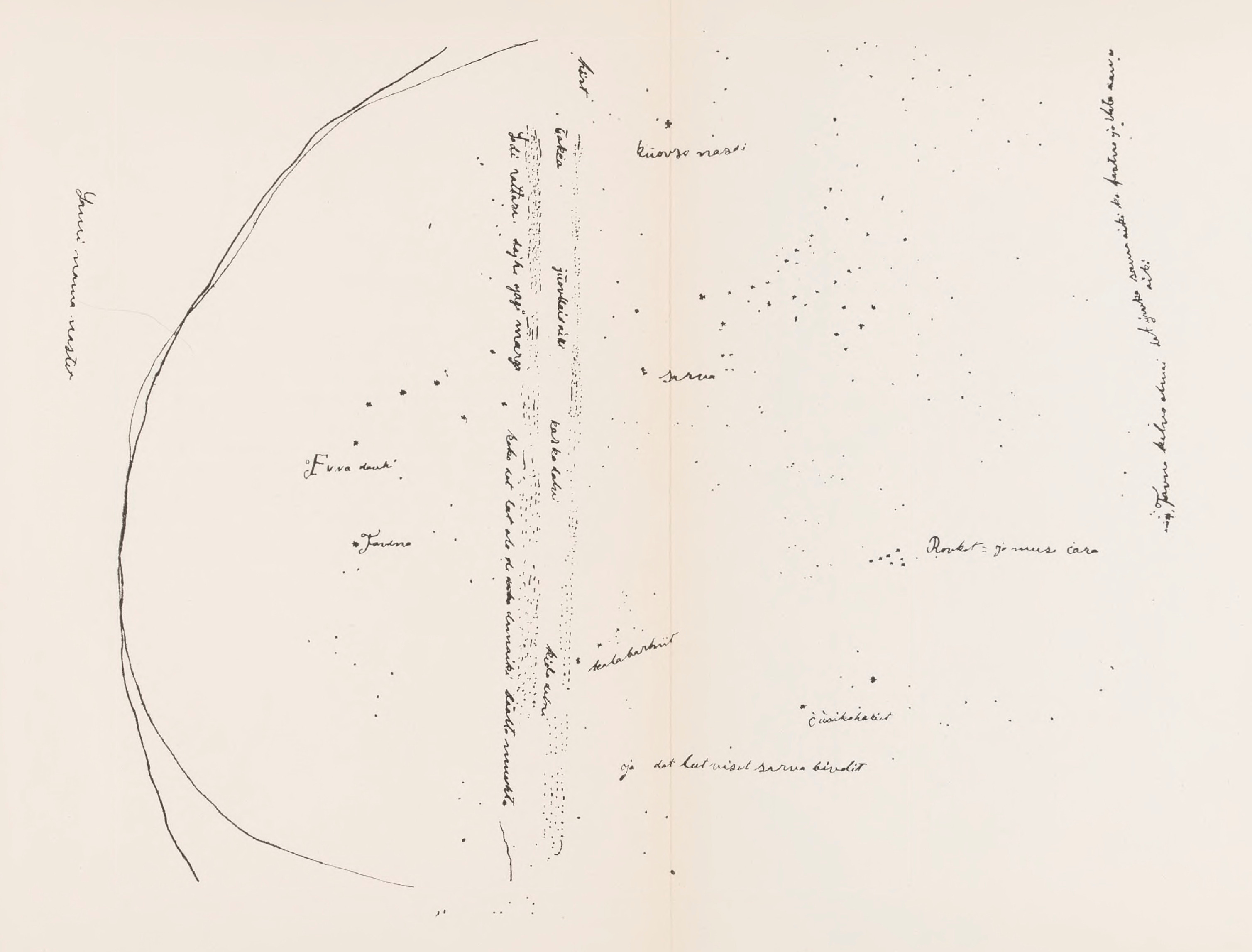
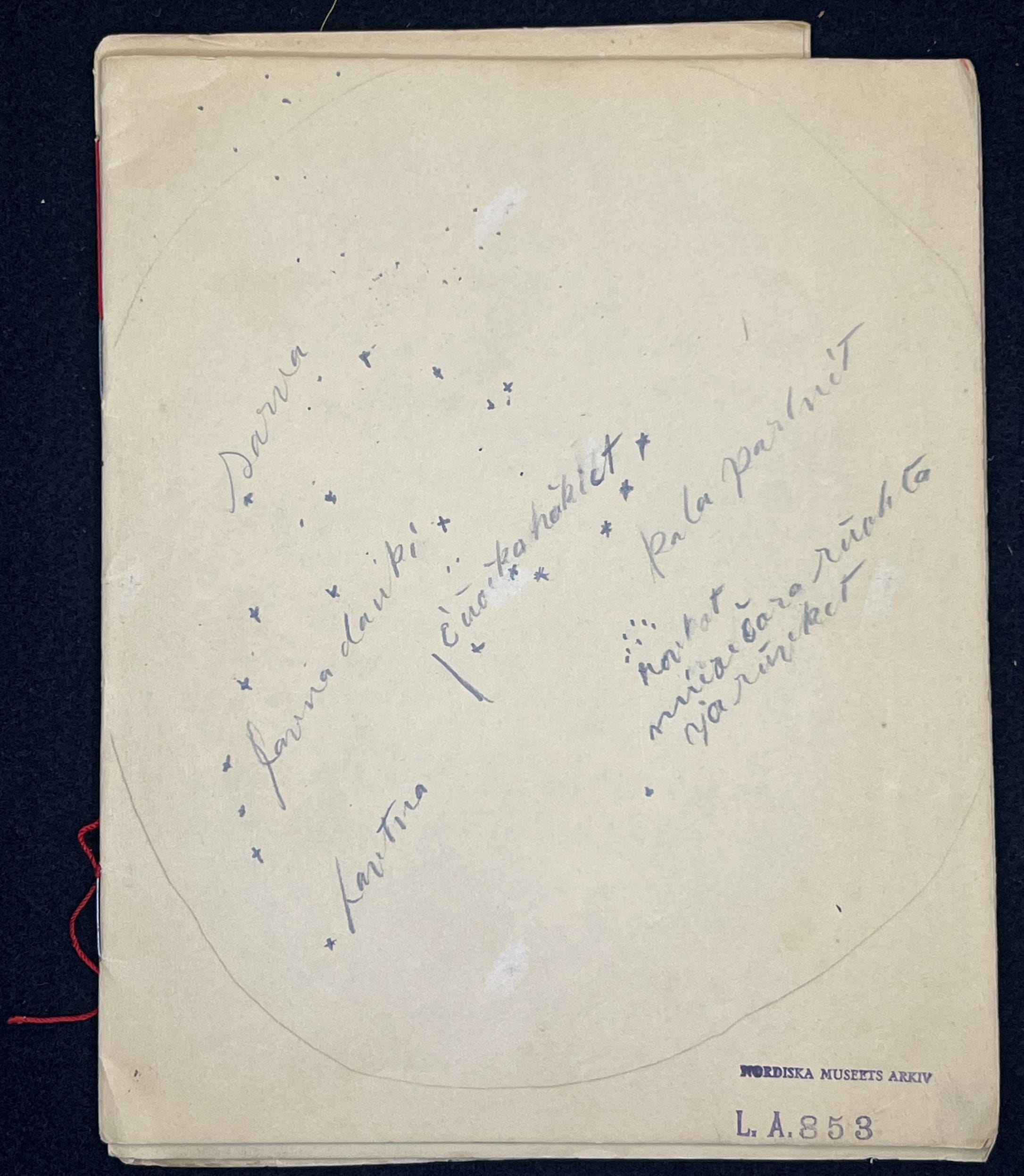
Turi was not only one of the first writers in Sámi language, but an artist as well. Muitalus appeared together with fourteen plates. Two of them depict the night sky as seen by the Sámi of the North.
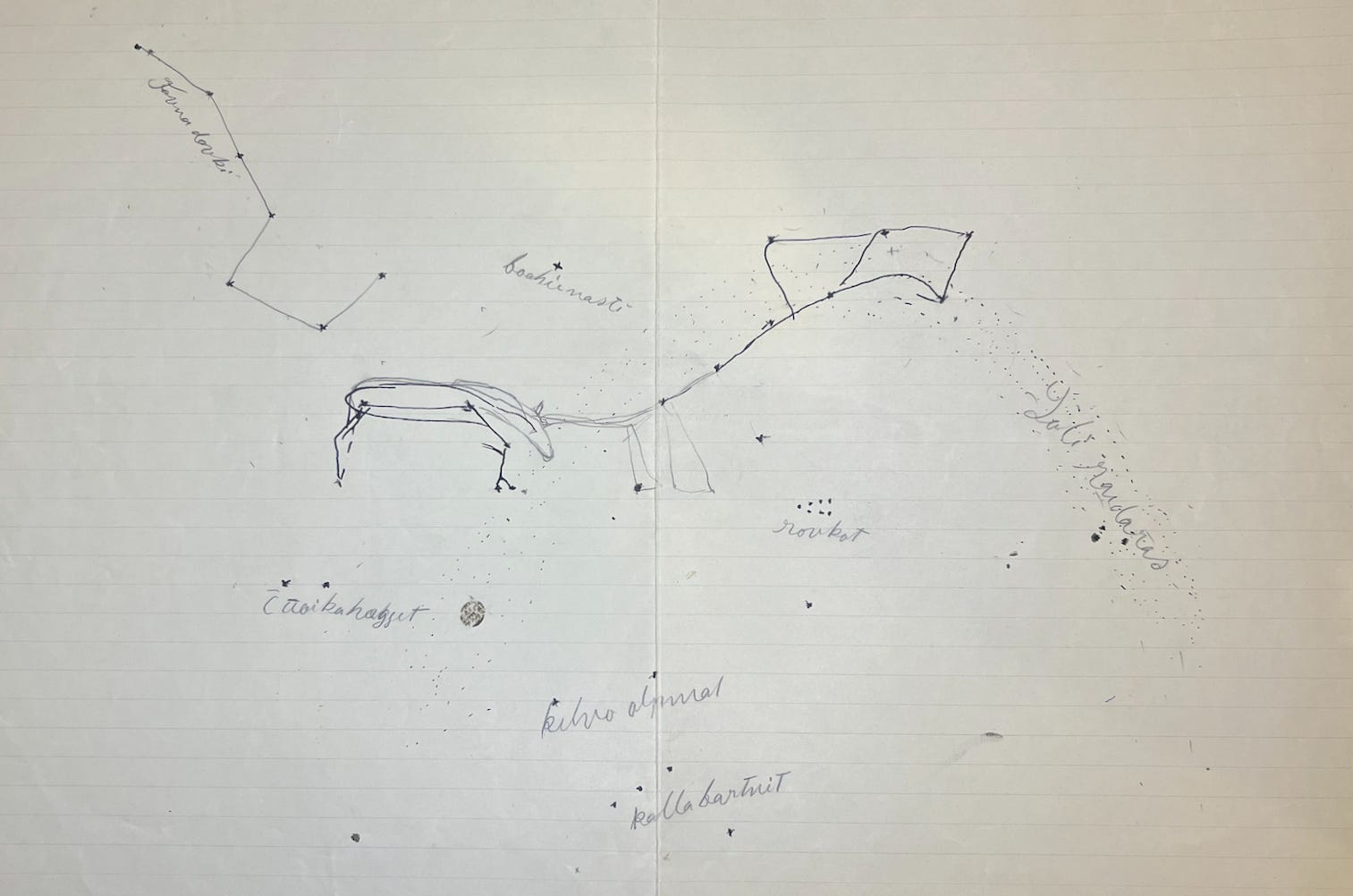
Most of them feature the moose (sarva), with the W of Cassiopeia forming its antlers, its front reaching into Perseus, its rear into Auriga.
Single stars and smaller constellations follow the animal across the northern sky: the skiers (cuoigahœgjek, Castor and Pollux), and the hunter Favtna (Arcturus) who tends his bow (Fauna daugge, Ursa Maior).
In his celestial maps, Turi declared all of them participants in a cosmic hunt:
“They all are moose hunters” (oja datlatvisat sarvabivdit).3
Written into the Sky
Across the largest of Turi’s sketches spreads the haze of stars we call the Milky Way.
Like lines of iron filings, Turi sketched the bands across a sheet, appearing in the months when dark returns. Along its segments, he noted seasons from the Sámi calendar – instructions written into the sky.
Next to the Belt of Orion, Turi wrote giđđa-dalvve – the spring winter in the weeks before Walpurgis (1st of May). At that time, he explains in his Muitalus, the Sámi begin their annual migration, when the reindeer are close to calving.
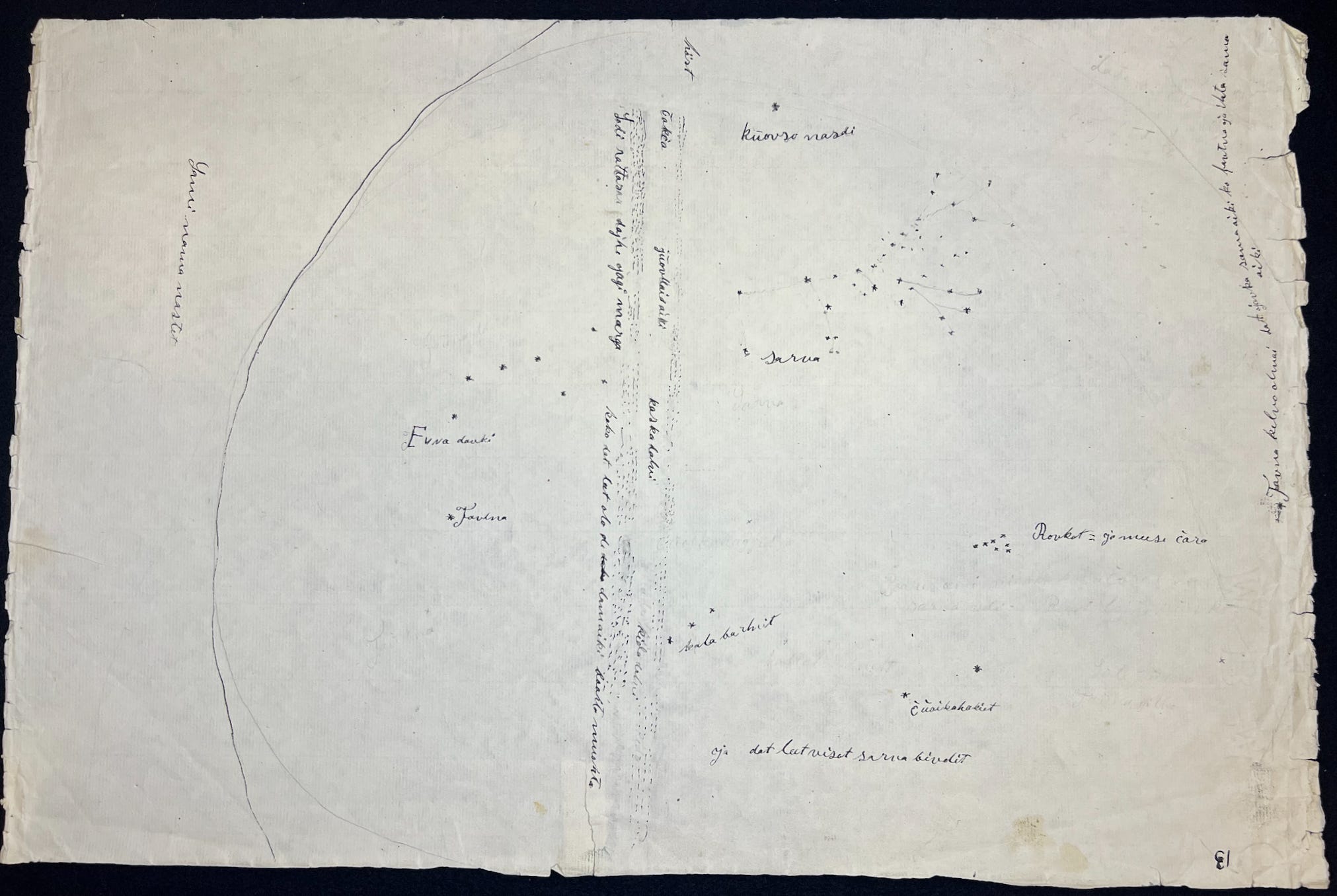
The shift of seasons marks a vulnerable time, Turi continues: the snow can thaw and soften and freeze over again, forming a crust (cuoŋu) that keeps the herds from grazing for lichen. In the weeks before migration, the Sámi observe the sky and elements closely: if cuoŋu is imminent, they rush their herds through days and nights to reach the mountains, where the snow is thinner and lichen within reach.4
What Was Still Remembered
Beneath the sky at Helags, the wind brushed around the ski tips we had fixed in the compacted snow. The clicking of the camera lent rhythm to the passing of time and the rotation of the stars, invisible to the naked eye.
What Turi had drawn on paper, we tried to capture in moving images. Yet the sky we recorded a century later would be a different one.
When Johan Turi wrote Muitalus more than a century ago, he did so to make Sámi life visible at a time when Swedish legislation was reshaping it. At the beginning of his book stands a chance encounter.
In August 1904, Turi met an art student from Copenhagen on a train to Kiruna. For Emilie Demant Hatt, the encounter with Turi marked the beginning of her life-long engagement for Sámi culture.
For one summer, Emilie Demant Hatt stayed with the family of Johan’s brother and began to learn their language. She helped bring the book into existence, encouraging Turi to write as he envisioned, in his own language and style, and facilitating its printing.
In 1910, Muitalus sáamid birra appeared. The book included a translation into Danish by Demant Hatt. Among its plates were two of Turi’s constellation drawings.
In her commentary, Demant Hatt already pointed to the fading nature of the stories he had drawn from the northern sky:
“Turi has drawn a part of the constellations that are best known among the Sámi. Their names point to old stories that today are partly forgotten.”5
Pencils of Light
A century later, what has connected human beings to the night sky is facing challenges beyond oblivion. A week after our return from Helags, I saw what the camera had gathered.
The computer stitched stills from the night into a few seconds of motion. On the screen, constellations began to turn in the celestial dome, around that hinge the Sámi described near Fatvna’s Bow.
Yet there was more the time-lapse sequences revealed.
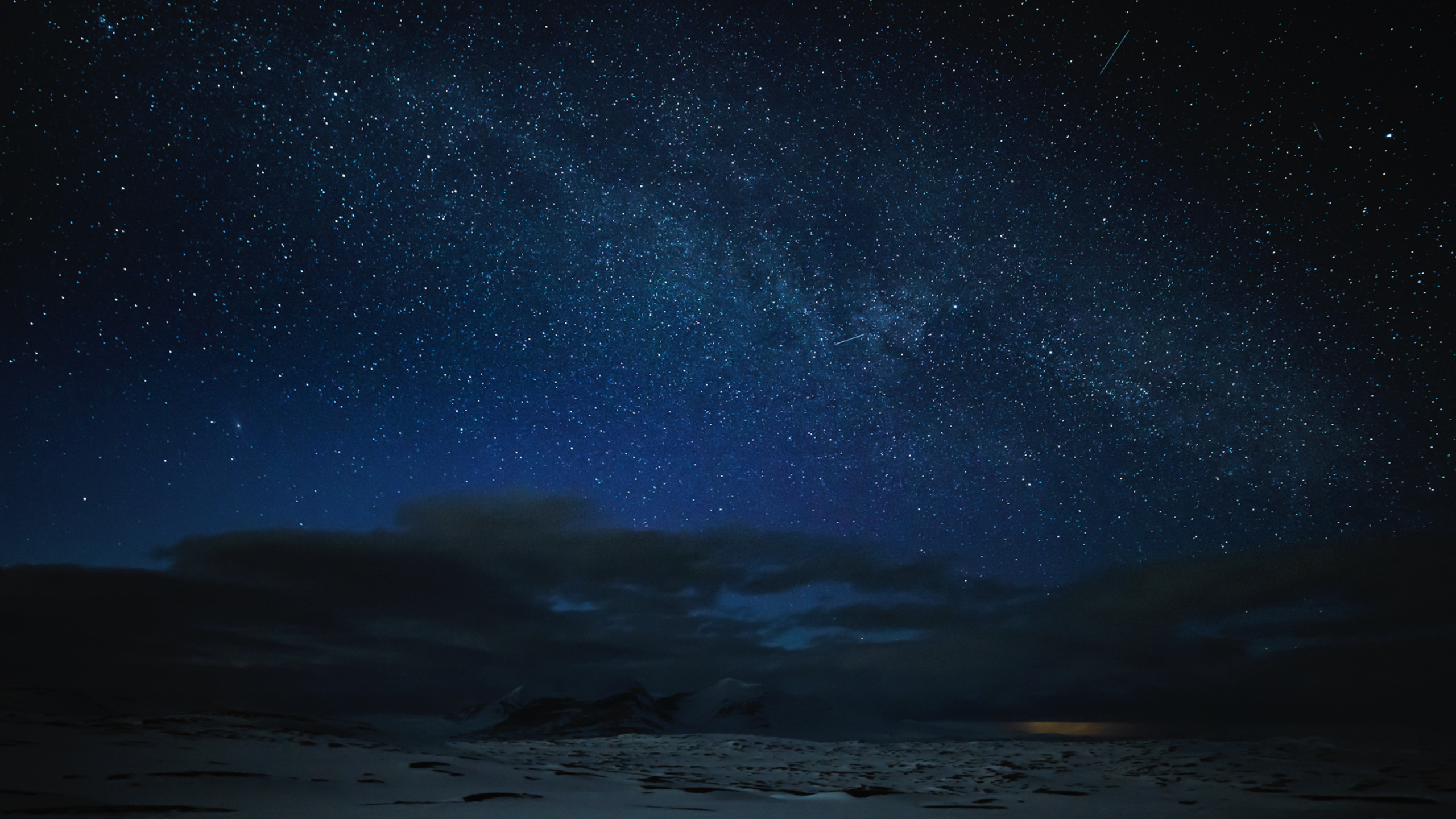
Light from the next settlements reflected in the dark clouds over Helags. Above, satellites drew their lines across the vault, innumerable streaks that whizzed across the sky like traffic on a celestial overpass, inaudibly.
Their multitude brought to mind a letter I had seen some years before. Written seven decades ago, it evokes a night sky at the brink of change.
In August 1958, the painter Bo Beskow wrote to Dag Hammarskjöld, then Secretary-General to the United Nations. Hammarskjöld had recently acquired the estate of Backåkra, close to Beskow’s own place on the southern coast of Sweden. From there, the artist sent an illustrated letter to his friend in New York:
Silently and endlessly the starry sky vaults over Rytterskulle and Backåkra. A little time ago we saw a Sputnik hull. It rose from Ernst Jon’s cow pasture and sank down in Tage Yngve’s beets. So even we had an idea of the big event.6
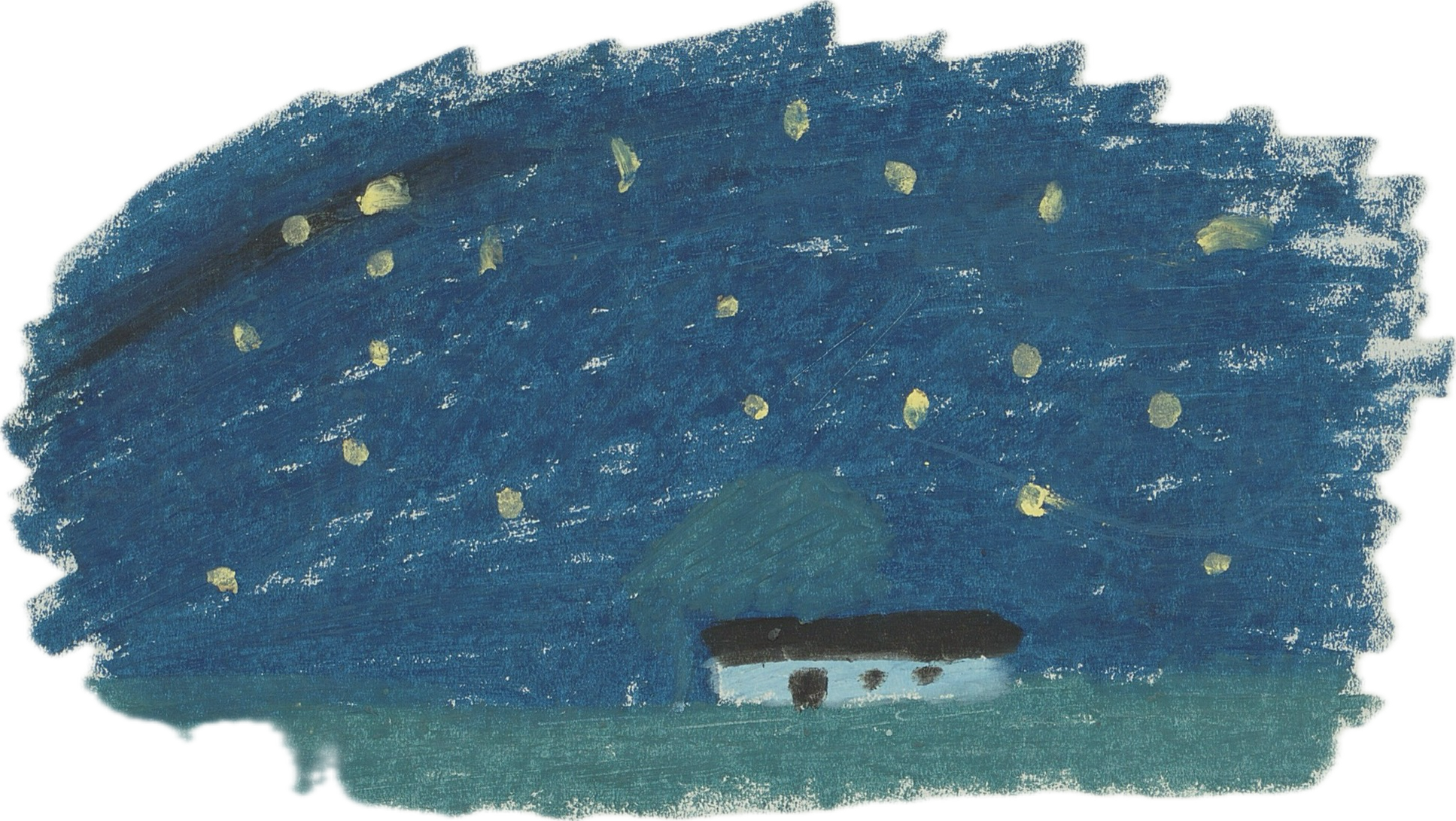
A new era led its pencil across the sky that summer.
The Big Event opening Beskow’s letter was the news of the Soviets launching a one-ton object into orbit. The year before, in October 1957, they had sent Sputnik into space. For months, the first manmade object floated across the night, together with the top stage of its R-7 rocket that the Swedes dubbed ‘hull’ (hylsa).
On 15 May 1958, Sputnik 3 kindled the cosmic ballet anew.
The flying laboratory and its top stage outshone the stars as they passed through the Earth’s shadow. As they carried out their orbits, citizens in Sweden gazed where the next window of visibility was calculated to open.7
Among them was Bo Beskow.
Rewriting the Sky
Watching the two points of light draw their lines across the vault, Beskow shared the wonder with his friend across the Atlantic, setting it against a new reality Hammarskjöld was already negotiating in New York.
A shadow lay over the awe this display of technological power inspired at the time. Soviet satellites turned the celestial dome over the US into a place of menace.8
Yet there were others concerns such objects in the sky did raise.
On Christmas Eve 1957, the Swedish newspaper Arbetet published a caricature on its title page. It showed the Three Kings on their voyage through the desert. In the sky above, satellites drew their trajectories with comet-like streaks, leaving the kings disputing which of the new stars would guide their way to the newborn king.9
The time-lapses I watched from Helags showed a sky changed for good. At night, ‘mega-constellations’ of satellites and space junk trawling the sky become visible. All around the globe, light reflected from these objects and light spill from the ground are eroding the night.
As light intrudes the dark, all creatures suffer. No animal’s body – including ours – has evolved for shifting skies and the loss of night. Insects and migrating species lose their bearings.10
Our own orientation, too, is at stake.
Stars are fading from constellations seen for millennia. As their visible number falls below a certain threshold, the sky itself begins to lose its depth – and with it, the sense of infinity it inspired across millennia.
The very texture from which people wove their stories is unravelling. Lodde-raiddaras – ‘The Bird Path’ – Turi still had noted next to the Milky Way in his maps. The idea that the routes guiding migrating birds were written into the sky arches over Finno-Ugric languages.
Stories further east make it appear as ski tracks that the mighty Tungk-Pok left as he chased a six-footed stag across the sky, and in the dark spots of the galaxy cultures in South America read the outlines of snakes and llamas.11
For more than a third of the world’s population, the Milky Way has already become invisible. Above our heads, one last arena of awe is fading.
As the associative landscapes of the past erode, new objects draw a different vision of the universe in the sky, overwriting what we once shared as repository of dreams, beliefs, and wonder with a story of private control.
32.000 objects are tracked in orbit around the Earth by 2026, a growing cloud disconnecting the Earth from open space.
By the end of this century, this number is estimated to double.12
The Last to See
Over Helags, satellites now drew their lines across the sky.
With his pencil, Turi fixed on paper what was already on the verge of becoming past: ways his community saw the night sky – stories his book carried into the future.
Much of what he did not map has already slipped beyond recall.
There will be a time – the thought sank in, a century later – when the sky itself from which Turi drew his stories will have no witnesses left.
That we may be the last to have seen it.
Further reading and references
All photographs and translations are my own unless noted otherwise.
In 2025, the Swedish Parliament integrated Turi’s Muitalus into the Swedish Cultural Canon. See “En kulturkanon för Sverige”, Statens Offentliga Utredningar 2025:92, p. 125 (online at regeringen.se).
Projects such as The World Atlas of Artificial Night Sky Brightness published maps of light pollution; see Fabio Falchi et al., “The new world atlas of artificial night sky brightness”, Science Advances 2 (2016), DOI: 10.1126/sciadv.1600377.
An explorable version with updated satellite data has been published by David Lorenz, see his Light Pollution Atlas.
Please note the general bibliography available here.
For an overview over the celestial beliefs of the Sámi see Bo Lundmark, Bæi’vi mánno nástit (Swedish title: Sol- och månkult samt astrala och celesta föreställningar bland samerna [Sun- and Moon-cult, astral and celestial conceptions among Sami], Umeå 1982.
A previous attempt to collect Sámi constellations (and mostly resorting to Turi) is found in the article by Per Collinder, “En försök på fjällkanten”, Svenska Turistföreningens Årsskrift 1950, 333–49 (online at runeberg.org).
As Collinder and others pointed out, Turi’s star maps somewhat distort the astronomical realities.
Johan Turi, Muittalus samid birra. En bog om lappernes liv, Stockholm 1910 (online at literaturbanken.se ; without plates).
A century later, Muitalus was re-edited by Mikael Svonni based on the original manuscripts, and re-translated by Thomas DuBois, see Johan Turi and Thomas DuBois, An account of the Sámi. A translation of Muitalus sámiid birra, based on the Sámi original, Karasjok 2012.
Lundmark, Bæi’vi mánno nástit, pp. 93–102.
Turi, Muittalus samid birra, p. 143.
Turi, Muittalus samid birra, p. 259, on pl. XIII.
On Hatt see the biography by Barbara Sjöholm, Black Fox. A life of Emilie Demant Hatt, artist and ethnographer, Madison, Wisconsin 2017.
“Stjärnhimmeln välver sig tyst och oändlig över Rytterskulle och Backåkra. För en tid sedan såg vi en Sputnikhylsa. Den stig upp in Ernst Jons kalvhage och gick ner i Tage Yngves [?] betor. Så även vi fick en känsla av det stora skeendet.” Letter by Bo Beskow to Dag Hammarskjöld, 15 August 1958. Stockholm, National Library, L1791_20.
More on Dag Hammarskjöld, his friendship with Beskow, and his hope to retreat to the nature around Backåkra in the article below:

The Swedish Ministry of Defence had the (diminishing) orbit times and cardinal points meticulously calculated by computer and published in newspapers; see Göteborgs Handels- och Sjöfartstidning, 04 August 1958, p. 6.
At the time of Beskow’s viewing, the top stage travelled at ca. 800km with an orbit time of ca. 103 min, with a characteristic blink every 7–8 seconds. Sputnik 3 was down to 500 km at the time with an orbit time of ca. 105 min, having fallen behind by 13 surroundings.
For the viewings over Southern Sweden / Skåne see e.g. Arbetet, 14 July 1958, p. 4: “Såväl Sputnik som dess rakethylsa sågs natten till söndagen passera över himlavalvet i nordöstra Skåne. Flera personer uppger sig ha sett de båda ryska ‘rymdfarkosterna’ som lyste starkare än någon stjärna.”
On the Sputnik shock see Alice Gorman, Dr. Space Junk vs. the universe. Archaeology and the future, Cambridge, Massachusetts 2019, p. 82.
In the States, the launch of Sputnik 3 catalysed the foundation of the central organisation that became NASA; see John Uri, “60 years ago, Soviets launch Sputnik 3”, 15 May 2018, online at nasa.gov.
Arbetet, 24 December 1957, p. 1. That month, a handful of satellites and final stages from the American Vanguard and the Russian Sputnik programmes were visible in the night sky.
See Paul Bogard, The End of Night. Searching for natural darkness in an age of artificial light, New York 2013.
For a selection of coverage on the increasing light pollution, including that from satellites, see e.g. The Guardian, 17 April 2019, 12 September 2020, 30 March 2021, 27 May 2023.
A lightscape growing in intensity and spectrum has tremendous effects on the human body – circadian rhythm, hormone levels, insomnia etc. See e.g. Dirk Sanders et al., “A meta-analysis of biological impacts of artificial light at night”, Nature Ecology & Evolution 5 (2021), 74–81.
Counter movements against light pollution are growing, including the Commission for Dark Skies by the British Astronomical Association.
Echoes reach as far as to the Altai people, who spoke of the Milky Way as the ‘duck’s road’ or the ‘southern birds’ road; see Uno Holmberg, Finno-Ugric, Siberian (vol. 4 of The Mythology of All Races, 13 vols), Boston 1927, p. 434 (online at archive.org).
On the Ostyak beliefs about Tungk-Pok see ibid., p. 434.
See Gorman, Dr. Space Junk, esp. pp. 121ff. The number of satellites may eventually block access to space itself.
On the growth of objects in space and the dangers of a satellite collision chain reaction see Frederick O’Brien, Ashley Kirk and Oliver Holmes, “‘This feels fragile’: how a satellite-smashing chain reaction could spiral out of control”, The Guardian, 31 March 2026.