


Lines of Sight
The view from there would end in the treetops.
At the bell tower of Torneå, my gaze wandered over the hatches beneath the gables tiled in wooden shingles. It was the day before Midsummer’s Eve, and even if I managed to gain access to the stairs, the view from the top would snag in crowns of pine and larch that grew from the churchyard.
Four centuries ago, a church had risen on one of the shifting islands in the Torne River. From the building clad in white wooden boards, I continued across the churchyard towards the northern tip of the island – until I stepped into the shadow of the water tower, a gilled concrete mushroom rising above the highest of trees.
Vesitornikahvila on avoinna koko kesän, I read – the water tower café is open all summer.
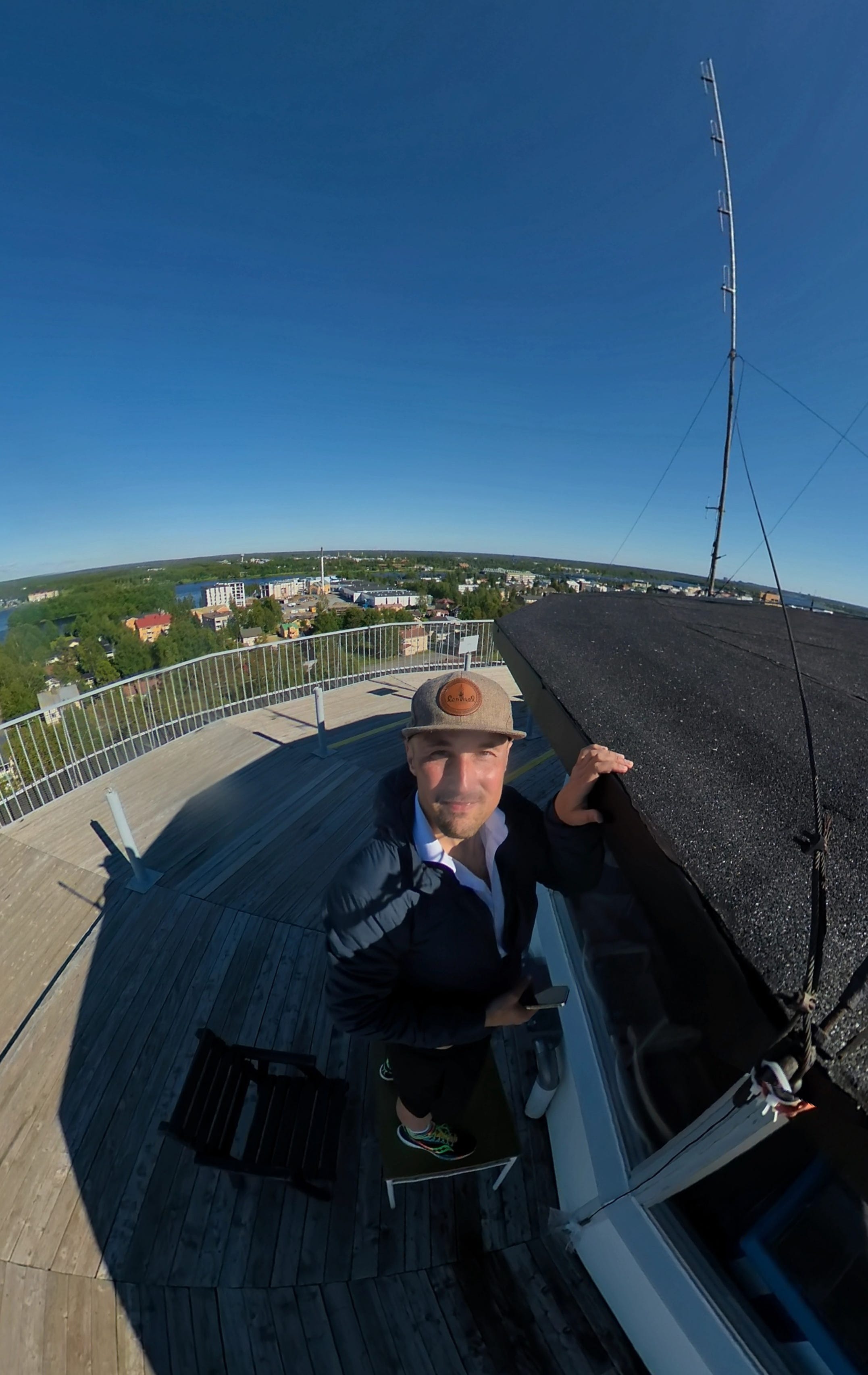
“No problem,” the young guy upstairs said when I explained my plan: to set up a 360-degree camera at the highest point overlooking the island to the north.
“The idea is to keep the camera running for twenty-four hours over Midsummer,” I added, “I’d pick it up the next day.”
“Oh, I see.” He paused.
“The thing is, we’re all on holiday for the next few days.”
I felt my enthusiasm sink.
“But let me check.”
Two phone calls and several hours later, the sound of a boxer engine announced the vintage VW Käfer that pulled up by the tower. A handshake, and I had the key for Midsummer.
On top of the café, I fixed the camera with cable ties and improvised an external power connection. I checked the memory card one last time, pressed ‘record’, and took the leap of faith:
It was now Phoebus Apollo who held the reins.
The Decisive Minutes
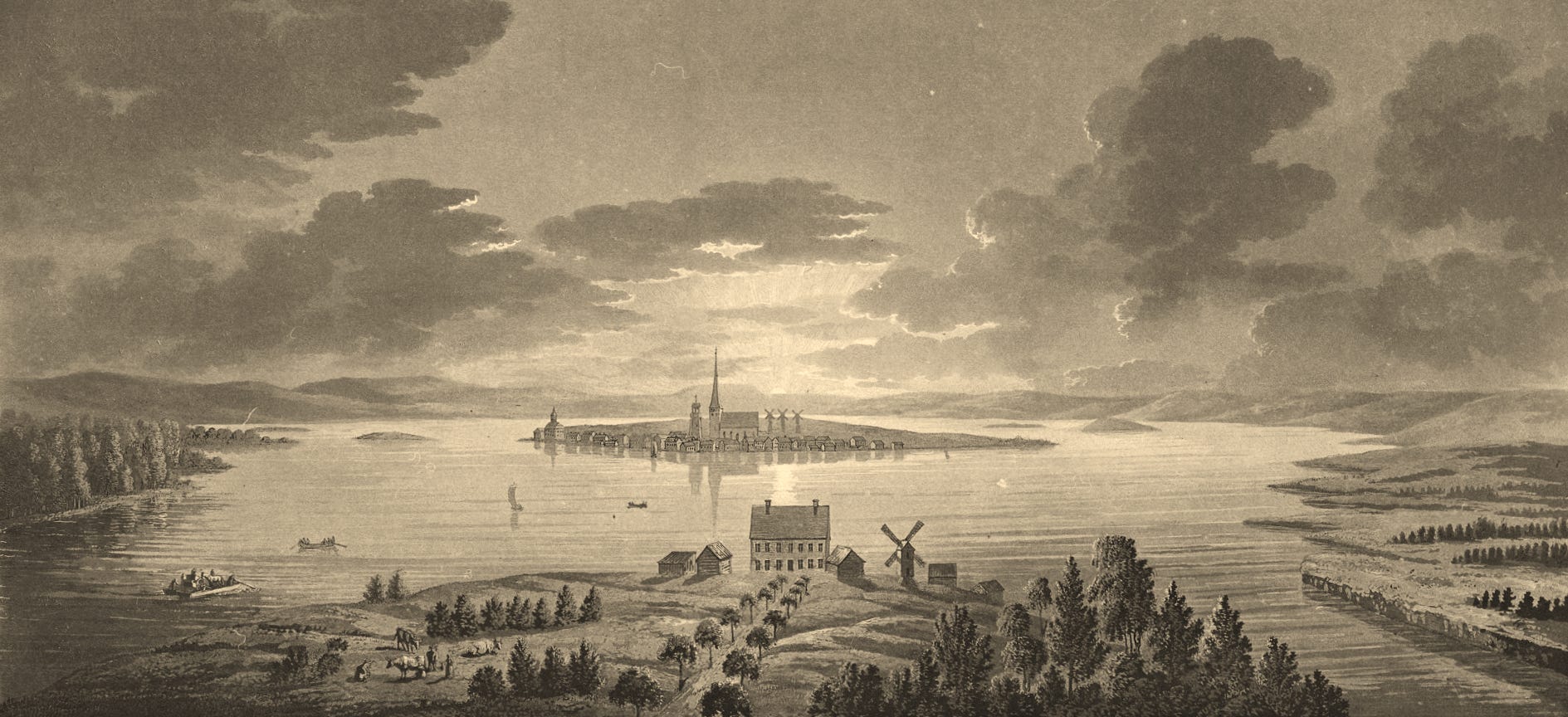
More than three hundred summers before, a group of Swedish aristocrats climbed the stairs of the bell tower at Torneå towards a similar view.1 In 1694, Governor Douglas, State Secretary Piper, and Counsellor of War Hoghusen had come together in the young town on the Baltic Sea to welcome their guest of honour: from Stockholm, Charles XI had travelled to the margins of his reign.
Just beneath the Arctic Circle, the Swedish king planned to witness what rumours claimed unfolded in the sky over the Torne River:
On the days around Midsummer, the sun was said not to set for an entire day.2
Mathematicians and astronomers had deemed the reports credible, yet none of the scholars at Stockholm or Uppsala had ever witnessed this wonder.
That summer, the Swedish regent led the way.
A warm light already poured over the wooden shingles when the party climbed the bell tower. At the end of the 17th century, most of the island of Torneå still was level ground, its northern tip splitting the river into two arms. Beyond its northern horizon, they expected the sun soon to near the forests and soft hills – scraping its line, yet its centre never sinking beneath.
After a ten-day trip covering many hundred miles, the point of the king’s expedition condensed to a few decisive minutes before and after midnight.
Conditions that day, however, were not ideal.
Charles XI had hastened north, yet when he arrived the astronomical solstice had already passed by several days. The sun had begun to lower its course again. Also, the men found the forests and hill lines covered more of the far horizon than expected.
To make matters worse, they saw rags of clouds gathering above the Torne River.
The Cradle of Astronomy
Only clear skies would allow the king to test, with his own eyes, what his mathematicians and astronomers had so far only discussed. Yet his journey ventured beyond mere curiosity.
In climbing the tower, Charles XI enacted a lineage. At least, this was the historical framework that Olof Rudbeck had prepared.
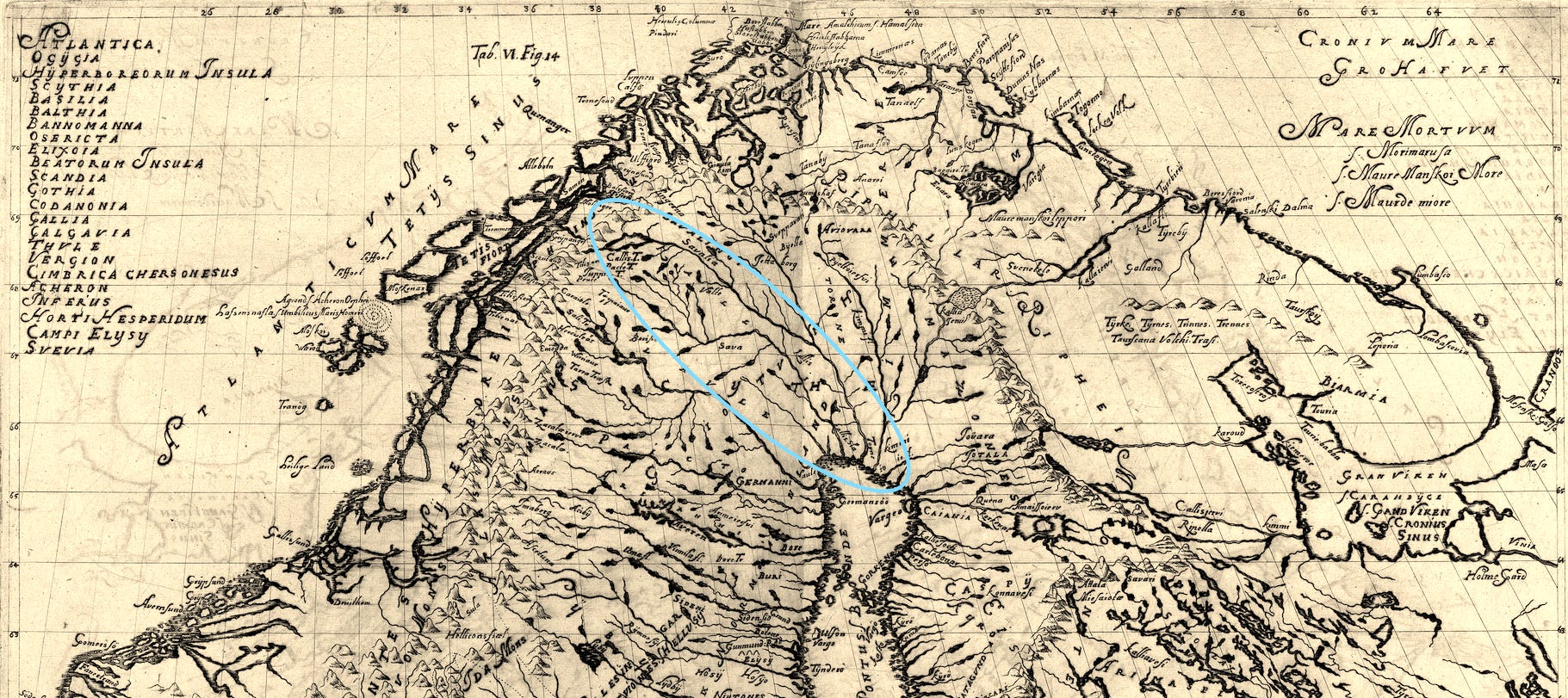
Five years earlier, in the second volume of this Atlantica (1689), the professor at Uppsala had inscribed the Valley of the Torne River with a story that linked the origins of astronomy to the early kings of Sweden.
As he argued, it had been around the Arctic Circle, in the landscape that widened around the Torne River, that they first observed the cycles of the celestial bodies four thousand years ago and ordered the year.
At the beginning of this tradition Rudbeck saw King Atlas.3
The dialogues of Plato had mentioned him as the first ruler over Atlantis, the island that carried his name – and that Rudbeck identified as the Scandinavian Peninsula. His name also echoed in the Atlas Mountains, a ridge that he identified as the one dividing Norway and Sweden.
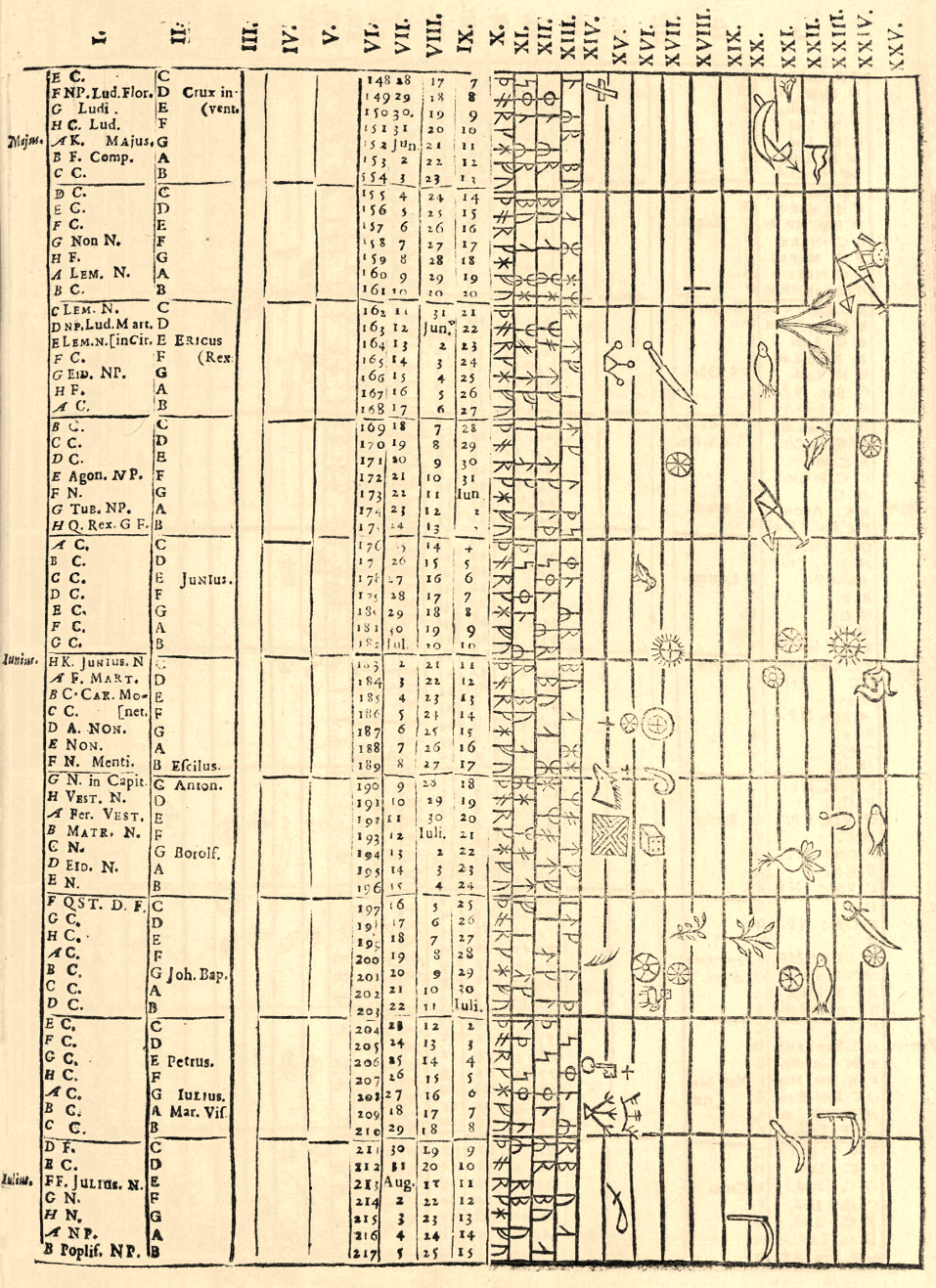
This Swedish king, Rudbeck argued, had been the first to observe the celestial bodies throughout the year. With the help of runes and by devising the early calendars, he pointed out, Atlas had spread the knowledge of the sky.4
The cradle of astronomy had stood in Sweden, Rudbeck was certain. In theory, he argued, the true Atlas Mountains could provide ideal vantage points to observe the sky. Their remoteness, however, and above all the winter conditions made them impractical as all-year observatories.
Yet there was a region in the High North that lured with better outlooks:
A river that reached far beyond the Arctic Circle. A landscape that was easily accessible throughout the year. A sky that domed over the river valley, its horizon almost unobstructed by the land.5
It must have been around the 1680s when Olof Rudbeck began to zero in on the Torne Valley. The map he printed with the first volume of the Atlantica (1679) had still placed the river in a valley without names and contours, its side arms branching randomly as if copied from the map in Johannes Scheffer’s Lapponia from 1673.
At the time, reliable reports about the geography of the High North were rare and contacts scarce.
This would change in 1687.
That year, an expedition from the south travelled up the river, shifting the valley of the Torne River and the sky above further into Rudbeck’s reach.
Northern Crowns
On top of the water tower, I had left the camera running for Midsummer. Along the river highway I was driving into an endless day, balmy air streaming in through the half-open window.
With the summer air came rags of laughter from teenagers I passed on the road, riding on the back of bikes, swaying on the asphalt. From white plastic bags dangling from the handlebars, the clinking of bottles
The sun had begun to close in on the horizon, a contour of low hills and forest drawn into the cloudless sky.
Some hundred kilometres upstream, the expanse of these woods holds a stone with cryptic marks. Three centuries ago, their lure had sparked the first expedition that Sweden sent beyond the Arctic Circle.
In the 1680s, reports from the remote areas of the kingdom reached south. They mentioned a stone said to feature an inscription in an unknown script as well as carvings of three crowns. Antiquarians pricked their ears. If true, this would make the stone the northernmost testimony for the emblem of the Swedish kings.

In the summer of 1687, Rudbeck used such reports to persuade Charles XI to fund an expedition north. A mission up the Torne Valley, he argued, could illuminate the reach of early royal power in the North, as well as the movement of the sun over this part of the kingdom: if a decision was made quickly enough, Rudbeck reasoned, the expedition could still arrive north around summer solstice.
That way, the mission could yield observations of the Midnight Sun from the very region “where our oldest fathers first observed the course of the sun and the moon”.6
Rudbeck’s pitch found favour with Charles XI. A few days later, the antiquarians Johan Peringer (later Peringskjöld) and Johan Hadorph junior left for Torneå.
The signs they found on a stone hidden in the forests above the Arctic Circle proved underwhelming – and never made it into the Atlantica. Yet for the theories Rudbeck maintained on the cradle of astronomy, their expedition was a success.
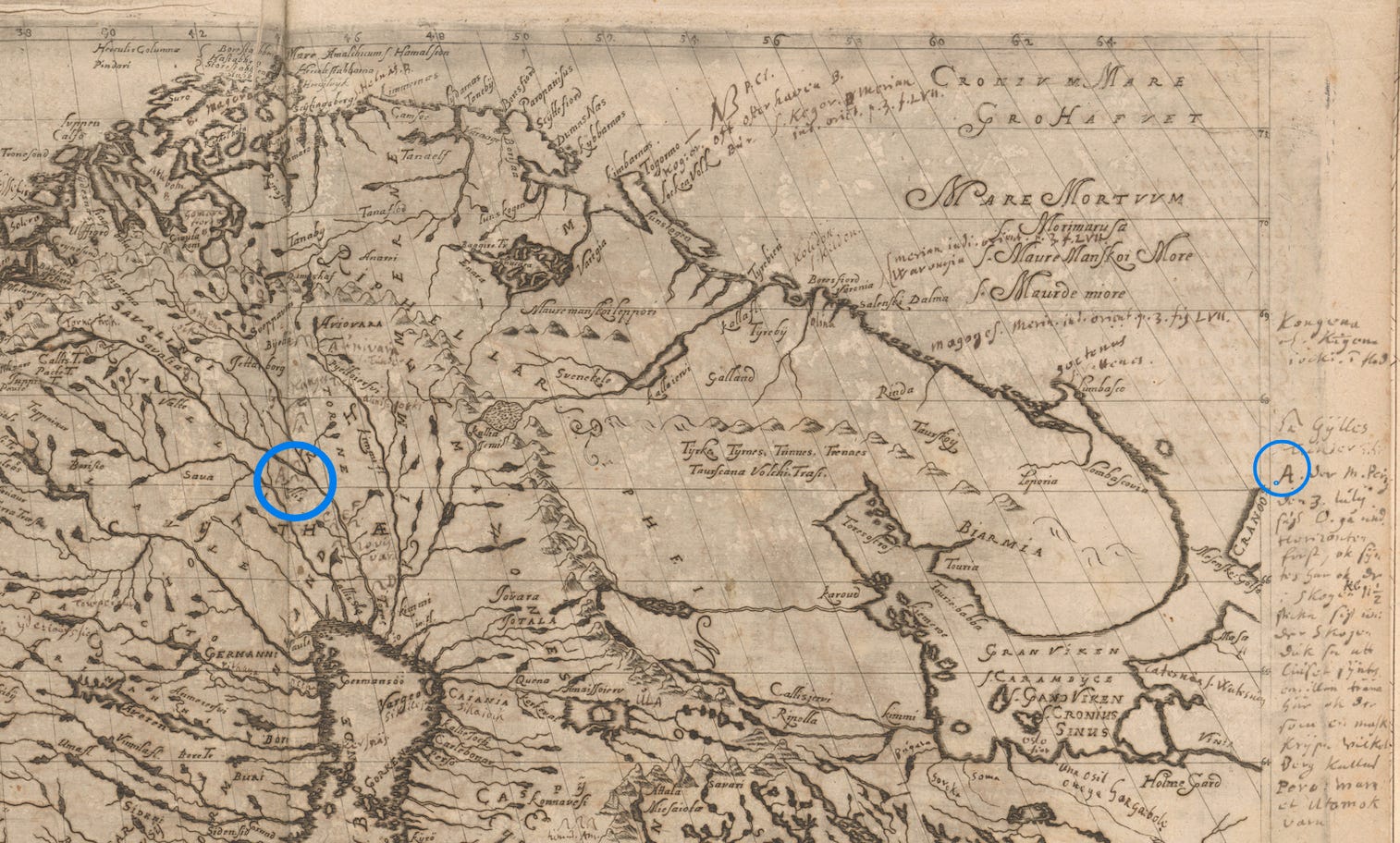
The two antiquarians provided him with names and location of hills along the Torne River, as well as observations of the sun they had made on their tops. With their information, Rudbeck updated his map of northern Sweden.
Beneath his pen, a network of vantage points materialised – elevations where, as he believed, kings like Atlas had made observations that brought forth the first calendars.
Never Falling Together
Kengisvaara. Luppiovaara. Aavasaksa.
Some of the names flashed by in white font on blue – road signs on the way towards the Arctic Circle.
Of these hills, Rudbeck wrote, Peringer and Hadorph climbed the northernmost – Kengisvaara on the eastern bank of the river – on 3 July 1687. In the Atlantica, he translated the name as ‘King’s Hill’. For Rudbeck, it was a relic of the rulers of Atlantis, who once kept observatories along the river.
Two weeks after midsummer, he wrote, the two antiquarians still saw the sun scrape the tree line half an hour before and after midnight, “creeping like a worm”.
The Torne River marks a border not only between countries, but between time zones. I had lost track of how close I was to solar midnight. The digital clocks around me showed numbers whose reference points eluded me.
What guided the journey was the sun’s path. Its centre, so they said in the 1680s, would never touch the horizon.
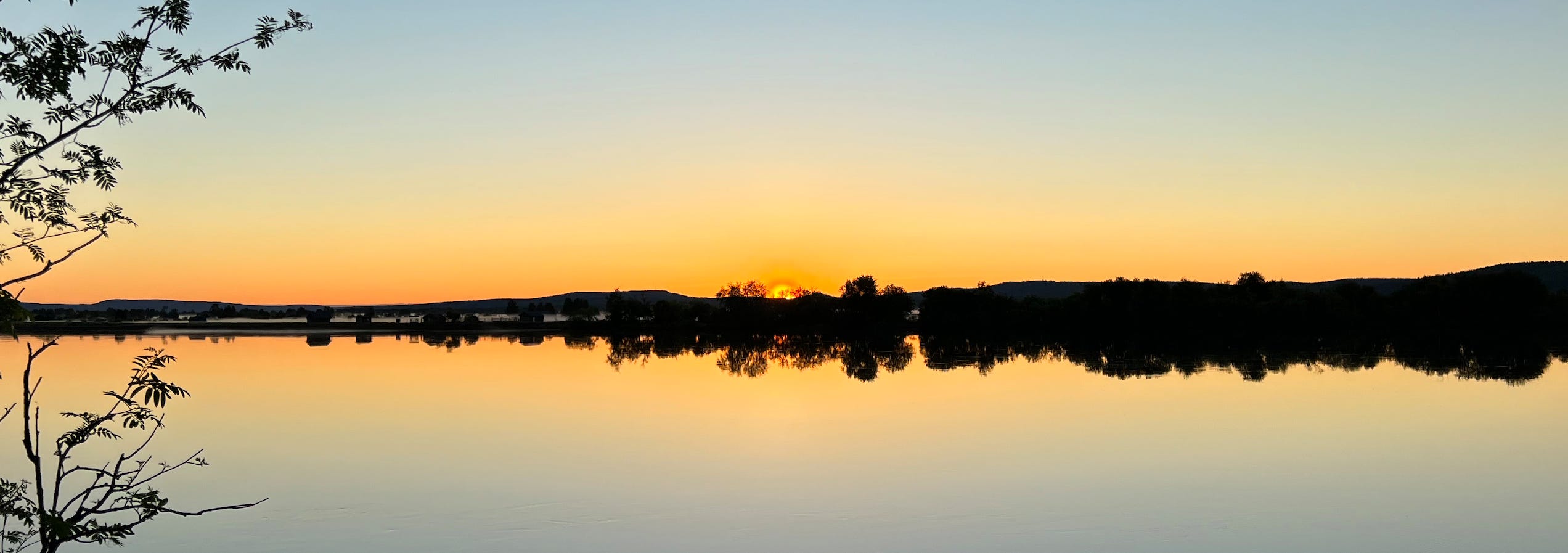
The sun approached the horizon like an asymptote – never falling together. From the deserted main road, I pulled off onto a farm track that ended at a cattle ferry landing. Across the water, an island split the river in two.
I was not the only waking.
Cowbells carried across from the meadows on the island. Above, the birds did not seek rest that night, feasting without pause. Their wings cut the air, and brief cries stitched the silence over the waters.
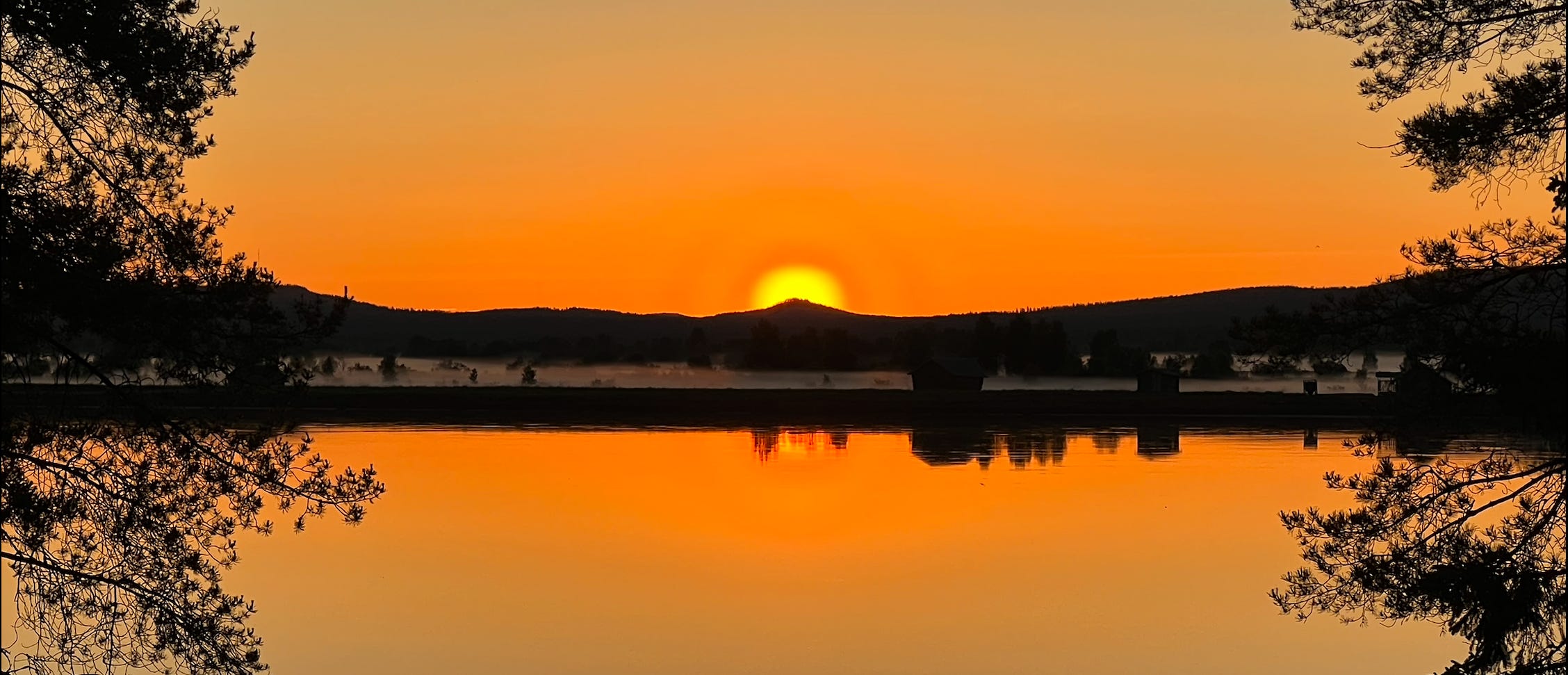
Treetops rose from the shore of the island, and through their veil I watched the midnight sun creep across the tree line. Not once did the charioteer yield the reins, nor release the horses to the pastures classical myth imagined beneath the horizon.
Soon Mount Aavasaksa edged its silhouette into the sun’s course. The ridge cast a shadow over the eastern bank, and where the shore still lay dimmed, mist hung low – the water beyond already aglow in apricot light.
The New Astronomer King
In 1694, observing the course of the midnight sun was a tighter call.
Eight minutes before twelve, the disk passed under a thinning veil of cloud at Torneå. A gust drove a darker band across the sun, its edge dissolving behind vapour and forest.
Shortly after midnight, the sun emerged again.
In his almanac, Charles XI noted the times and what he had just witnessed in the sky. Beyond any doubt, he wrote, the sun had not sunk below the horizon.7
The Swedish king descended from the bell tower cast as a new Atlas.
At Torneå, he had reconnected with the tradition of Sweden’s astronomer-kings whose lineage Olof Rudbeck had traced from Gustav Vasa back to that first of Swedish kings.8 Hadn’t already classical myths still intimated the truth about Atlas, their accounts and iconography honouring him as inventor of the science of the skies?
For Atlas had worked out the science of astrology to a degree surpassing others and had ingeniously discovered the spherical nature of the stars, and for that reason was generally believed to be bearing the entire firmament upon his shoulders.
Diodorus of Sicily, Library of History, 4.27.5 (tr. C. H. Oldfather)
Across Sweden, Charles XI was celebrated as a regent who had taken great hardship on his shoulders to study the wonders his kingdom holds. The governor of Norrland, who had joined the regent on the tower at Torneå, later had the observations his king jotted down that night inscribed in golden letters in the church at Torneå.9
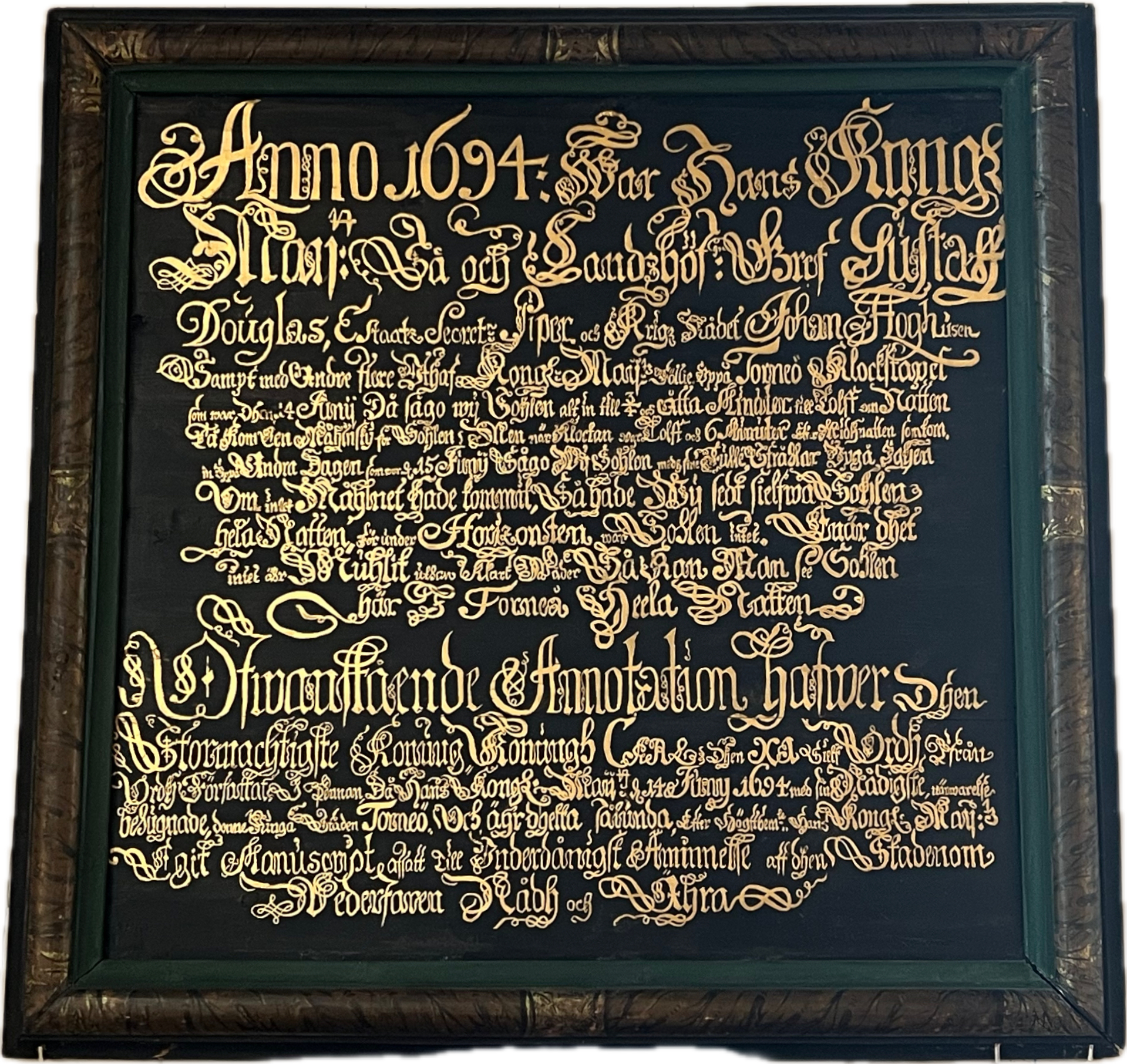
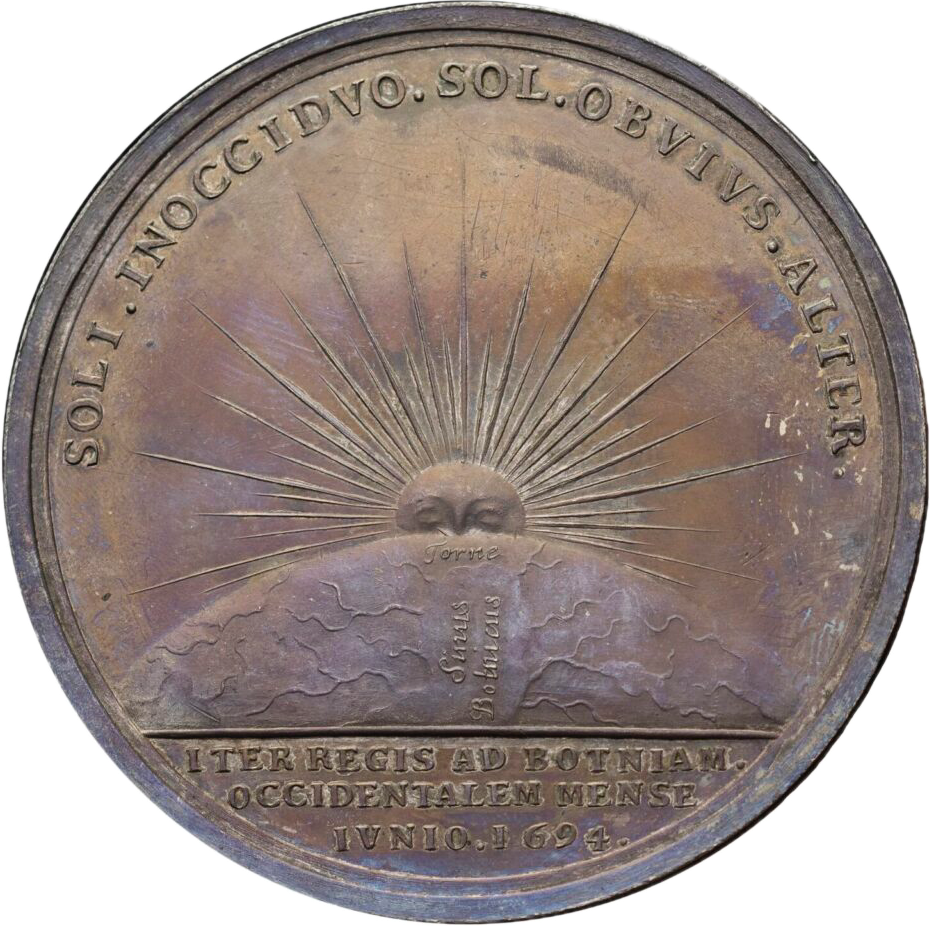
In praising the king for this feat, Count Douglas was not alone. The artist Arvid Karlsteen struck a medal that commemorated Charles XI’s journey north.
Its reverse shows a sun hovering above the northern tip of the Baltic Sea, commemorating the king’s journey in an imagery and a Latin motto that recalled tropes of absolutist courts: “The sun that doesn’t set is encountered by another sun”.10
At Uppsala, the Neo-Latin poet Peter Lagerlöf chose poetry as his means to honour the astronomer-king. Addressing the blessed town of Torneå, the scholar praised Charles XI for the selfless efforts he undertook for the sake of science:
In you he has seen the sun waking at nightly hours,
Himself waking for the sake of his home;
Has seen its face resplendent with never-setting light
And his kingdom relishing a never-ending day.Peter Lagerlöf, On Charles XI Observing the Midnight Sun at Torneå 11
Rudbeck, too, joined the ranks of those congratulating the king.
Right after his return, Rudbeck wrote in the third volume of his Atlantica (1698), Charles XI had shared with him his handwritten notes – the very observations Count Douglas had displayed in golden letters in the church at Torneå. Four millennia after Atlas, Rudbeck praised, the king had witnessed a day of never-ending sun shining over his kingdom.12
And there was more.
Charles XI himself had not only pioneered in the astronomy of the North.
Its scientific exploration was a goal he had furthered ever since.
Sending out the Scientists
Already the year after, Charles XI ordered a scientific expedition to follow up his observation from the bell tower.
On 21 May 1695, astronomer Anders Spole and mathematician Johannes Bilberg left from Uppsala. On 6 June, they arrived at Torneå in good time for the summer solstic, and prepared their instruments on the bell tower.
The coming days, the sun disappeared behind rain and fog. All the men could do was wait.13
In the decisive night, the weather remained stable.
Between the 10th and 11th of June, they measured the midnight sun sinking over Torneå. What they observed with instruments confirmed what the king had written in his notebook:
We saw the body of the sun reaching out from above the horizon by almost three quarters of its body, while the fourth quarter sank under the horizon to a degree that the centre of the sun indeed remained above the horizon.
Bilberg, The Refraction of the Sun that Never Sets 14
That night, Bilberg and Spole were not the only visitors from the south observing the sun over Torneå.
A little upstream, an expedition team around Rudbeck the Younger was holding watch (he later claimed he even found a vantage point superior to Bilberg’s and Spole’s, hoisting himself up on the sail of a windmill).15
When his father had gotten wind that spring of the king’s plan to send a mission north, he had been quick to react. In a letter to the chancellor, he explained that his son Olof – an aspiring naturalist – had long harboured ideas of an expedition into Sápmi, the land of the Sámi people.
By adding a natural-historical appendix to Bilberg’s and Spole’s astronomical mission, Rudbeck advertised, the king could lay the foundation for a project of national interest: to write a complete history of Sweden’s North.16
Once again, Rudbeck’s intercession yielded success. The day after Bilberg and Spole had left Uppsala, a further expedition set out north.
Having observed the midnight sun at Torneå, Rudbeck and his team continued upstream the Torne River. Having concluded measurements further up in the Torne Valley, Bilberg and Spole embarked on their way south.
The time to publish their findings had come.
The Refraction Reaction
Already by late October 1695, the two scholars finished drafting a treatise. Barely a year after the king’s ascent, it translated the phenomenon he witnessed at Torneå into numbers, calculations, and diagrams.
With their work dedicated to the king, Bilberg and Spole explained how it had been possible for him to see a heavenly body from Torneå that, astronomically speaking, had already sunk under the horizon.
The name of the phenomenon was refraction.
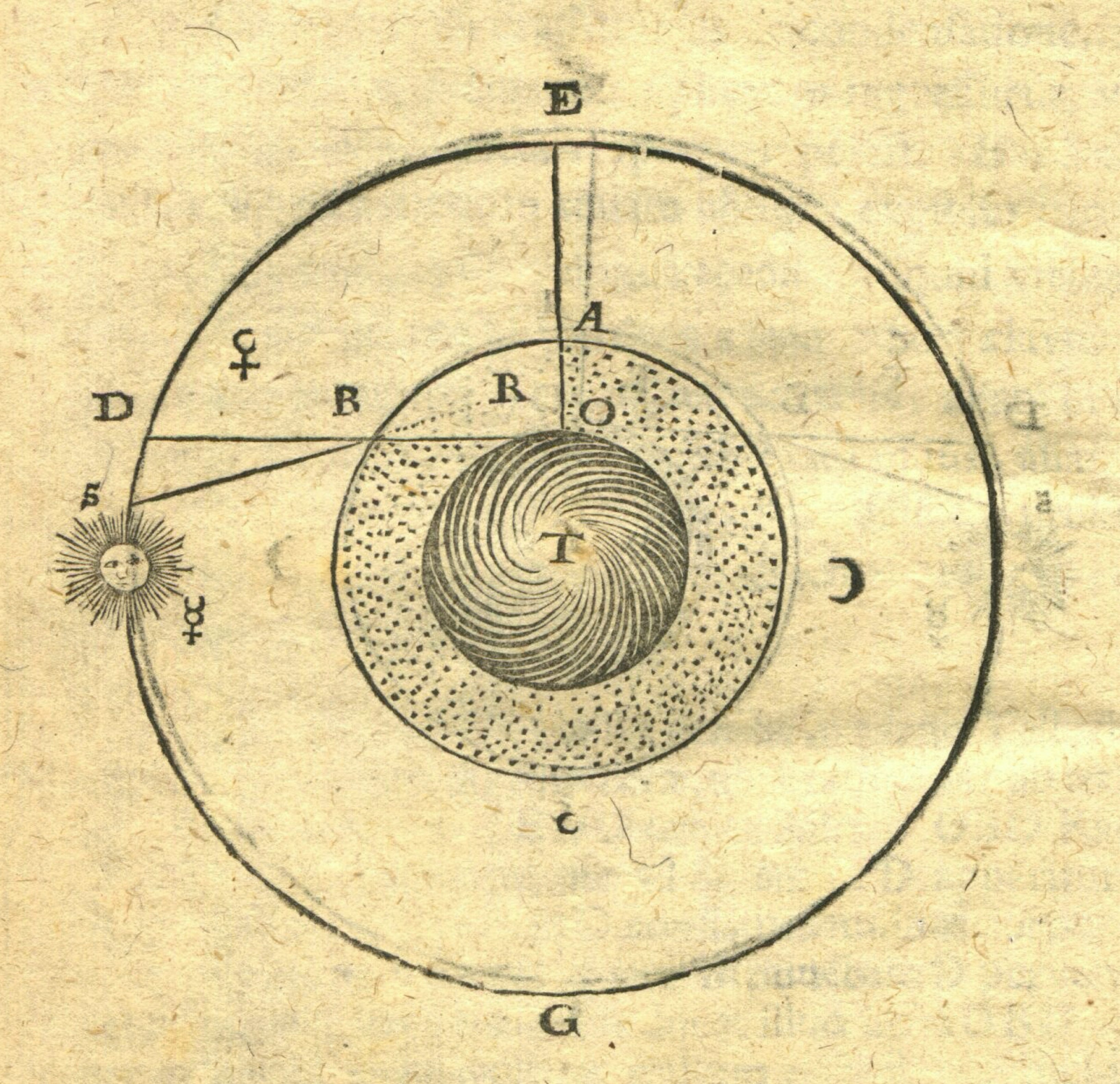
On latitudes near the Arctic Circle, Bilberg and Spole explained, the light of the sun passes through a thicker layer of atmosphere near the horizon. This layer acts like a lens, bending the rays downward towards the observer.
As a result, the sun still appears not to set around the date of the astronomical solstice – even at locations situated just below the Arctic Circle. A glowing ball skimming the horizon, its glare softened, its rays diffused by the thickened air.
Driving back south on the river highway, I felt its warmth on my neck again.
In the morning mist, I saw the sun rise across the built-over horizon of Torneå. To the south of the island emerged the steeple and the old bell tower next to it, the mark where this city had begun four centuries earlier.
In its middle: the towering concrete mushroom to which I had returned.

12:11:15. The timer read when I connected to the camera.
The seconds kept ticking. It had recorded through the night.
I let the camera run as the sun continued towards noon.
When I later reviewed the recording, I saw it:
Through a clear sky, the glaring disk approached the horizon, flattening into a seam of orange light as if igniting the line of forests and hills, then rose again.
A sine curve, drawn here century after century – long before human eyes turned towards these skies.
Further Reading and References
The events described in the opening took place before access to the Torneå water tower was discontinued due to a changed world situation. The site is no longer open for visits. It is being discussed to demolish the tower in coming years; see the article by Raisa Huttunen, “Tornion vesitorni pysyy suljettuna”, published on lapinkansa.fi, 18.08.2025.
All translations, photographs, and videos are my own unless noticed otherwise.
When quoting from Latin sources, abbreviations were silently expanded and orthography lightly adapted to current standards.
Please note the general bibliography available here.
A predecessor of today’s church was built in the 1640s. It burnt down in 1682 and was subsequently reconstructed. For a contemporary description of its history see the dissertation by Ericus Brunnius (resp.) and Ericus Alstrin (praes.), De urbe Tornea, eique adjacentibus paroecis, Uppsala 1731, § VI.
Until 1735, there were no hatches in the tower separating the bells from the outside; see Stina and Lawe Söderholm, Lapin kirkot Pohjoiskalotin kirkot, osa II - Kyrkor i Lappland, Kyrkor på Nordkalotten, pt. II, Pohjan Väylä 2002, p. 21.
See Johan Bilberg, Refractio solis inoccidui, in septemtrionalibus oris ..., Stockholm 1695, pp. 10–12 (digitised by Umeå University Library).
See Rudbeck, Atlantica, vol. III, p. 264. On King Atlas / Atle starting the dynasty of the ‘Attleboren’ see also ibid., vol. I, p. 219. On Atlas as the inventor of astronomy see ibid., vol. III, cap. 2 and 3. On Atlas and the rune staffs see ibid., vol. II, p. 163.
See Rudbeck, Atlantica, vol. II, cap. 9, and pp. 160ff. On their origins see ibid. cap. 9.2. On their structure cap. 9.4. The columns of his comparative chart of calendars are explained ibid., p. 173.
See Rudbeck, Atlantica, vol. II, cap. 5.17.
Bref af Olof Rudbeck d. Ä., ed. C. Annerstedt, vol. IV, Uppsala 1905, p. 319 (online at digitale-sammlungen.de): “som ligger på den orten där wåra älsta fädar först observerat Solens och Månens lop”.
See Bilberg, Refractio solis inoccidui, 15: “Men när Klockan var tolf och 6 Minuter effter Midnatten, som kom in på den andra Dagen, som var den 15 Junii, sågo Wij Solen mit sina fulla strålar uppgå igen.” The original notes were taken by the king in his personal almanac, see Karl XI:s almanacksanteckningar, ed. Sune Hildebrand, Stockholm 1918, p. 294 (online at Google Books).
See the chronological tables printed with the first volume (RfA-ID 205 and RfA-ID 206). For Atlas see column R / biblical year 2380.
The full text is quoted in Bilberg, Refractio solis inoccidui, p. 16.
See the description in Bror Emil Hildebrand, Sveriges och svenska konungahusets minnespenningar, praktmynt och belöningsmedaljer, pt. 1, Stockholm 1874, p. 447 (online at runeberg.org).
Lagerlöf’s Latin poem was printed with a facing Swedish translation in the opening of the treatise by Bilberg, Refractio solis inoccidui, [s.p.]. I give a full English translation of the Latin text here:
“Torneå, old glory of the north, now renewed,
lashed by the utmost waves of the Bothnian Sea!
A great honour has befallen you that our present time does envy
And whose praise posterity will go on singing.
For not long ago has Charles, resembling the exalted star,
From closer distance beheld the Hyperborean pole.
And wherever he travelled, both Bears broke into applause
And the whole North rejoiced in new joy.
In you he has seen the sun waking at nightly hours,
Himself waking for the sake of his home;
Has seen its face resplendent with never-setting light
And his kingdom relishing a never-ending day.
Go on now, whoever you are, and accuse our land
Of eternal ice and Cimmerian chaos!
Read what Bilberg reports (he too has been an observer,
By order of the king, of such a magnificent light)!
You will recognise what great lustre here makes summer shine,
Nourishing nature’s bountiful gifts with gentle touch.
You will recognise how purely the air we breathe does flow,
And how fertile the earth we farm does lie;
How the sun treats no region with greater favour,
How in no place else for longer does it dwell!
Endure the frosty nights and the hardships of winter –
For midsummer’s splendour makes up for everything!”
See Rudbeck, Atlantica, vol. III, p. 266.
See Bilberg, Refractio solis inoccidui, cap. 2. I use the dates as given stylo vetere in the original.
Translated from Bilberg, Refractio solis inoccidui, p. 42: “Ipsum itaque corpus solis tribus fere quartis corporis sui partibus supra horizontem eminere deprehendimus, quarta tantum horizontem subeunte, adeo ut centrum solis revera supra horizontem exstaret.”
See Rudbeck the Younger, Dagboken, in: Iter Lapponicum. Skissboken från resan till Lappland 1695, vol. II, ed. by Tomas Anfält, Stockholm 1987, 28–59, p. 34.
The windmill might be among the ones also used as vantage points by later gentlemen on their journeys to Torneå to see the midnight sun; see the engraving in Matthew Consett, A Tour through Sweden, Swedish-Lapland, Finland and Denmark. In a series of letters, illustrated with engravings, London 1789, [opening plate] (digitised by litteraturbanken.se).
Rudbeck, Letter to Chancellor Bengt Oxenstierna, 27 April 1695, published in Annerstedt, Bref, p. 355, no. 124 (online at digitale-sammlungen.de).