


Arctic Thresholds
The first aurora of the year washed across the sky like poured-out milk. Opening a flap of the roof tent, I watched the stars shimmer through a faint haze.
Andromeda had begun her rise, and so had Perseus, her rescuer in the myth.
The last hours of the night felt like a final exhale of summer, the air rising from the ground carrying the musk of soil.
Somewhere out in this forest verging on the next season lay a stone. Before climbing down, I jotted its coordinates into my notebook – a monument whose lure had drawn expeditions north three centuries before.
In the light of my headlamp, droplets shimmered in spiderwebs between the spruce trees. I wandered among them for a few kilometres when the sun rose between the stems, its edges softened to a warm blur by the air above the Arctic Circle.
In its light, I checked the coordinates again. The first rays of sun warmed my face, while my boots sank slowly into the moss beneath.
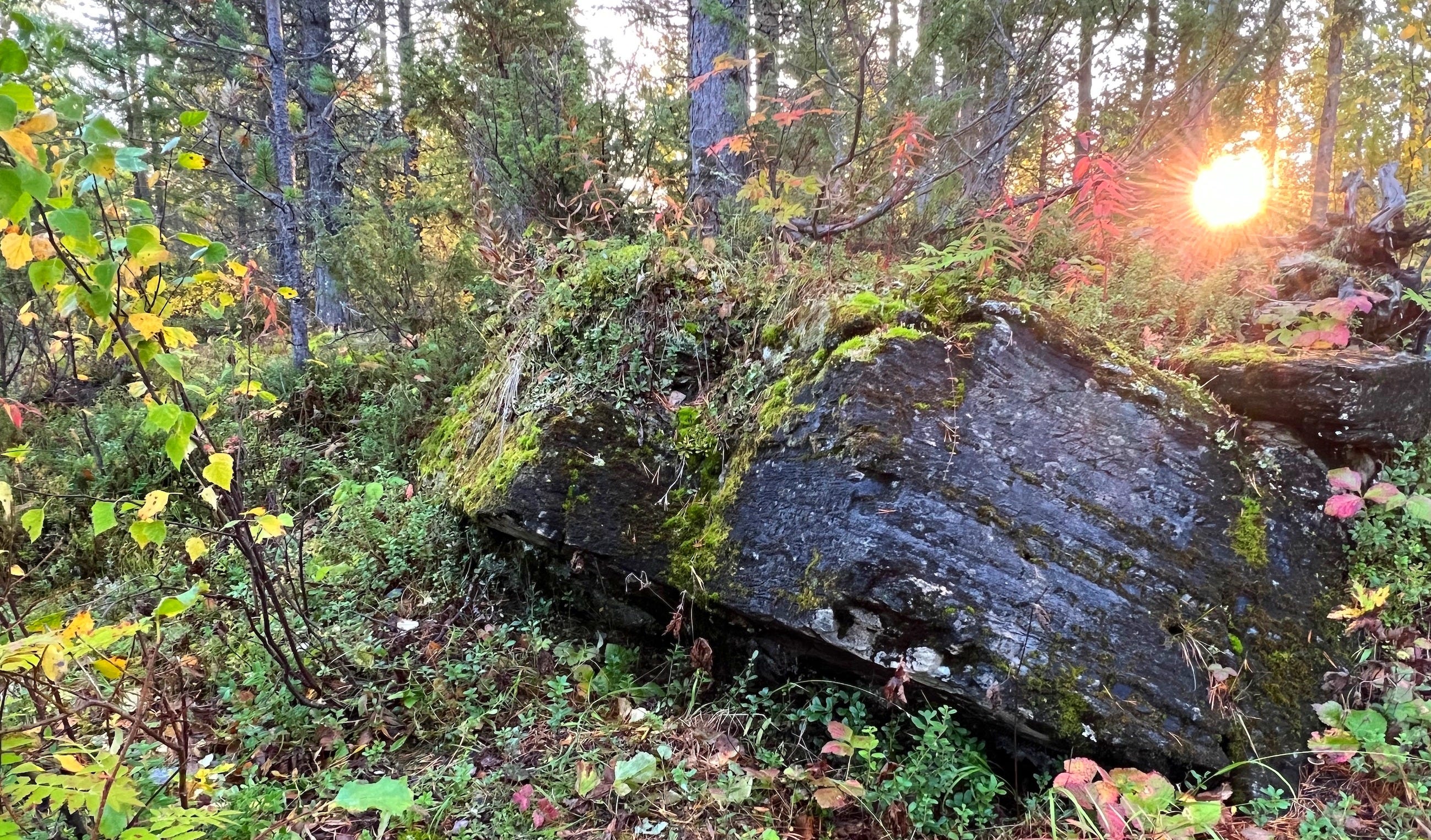
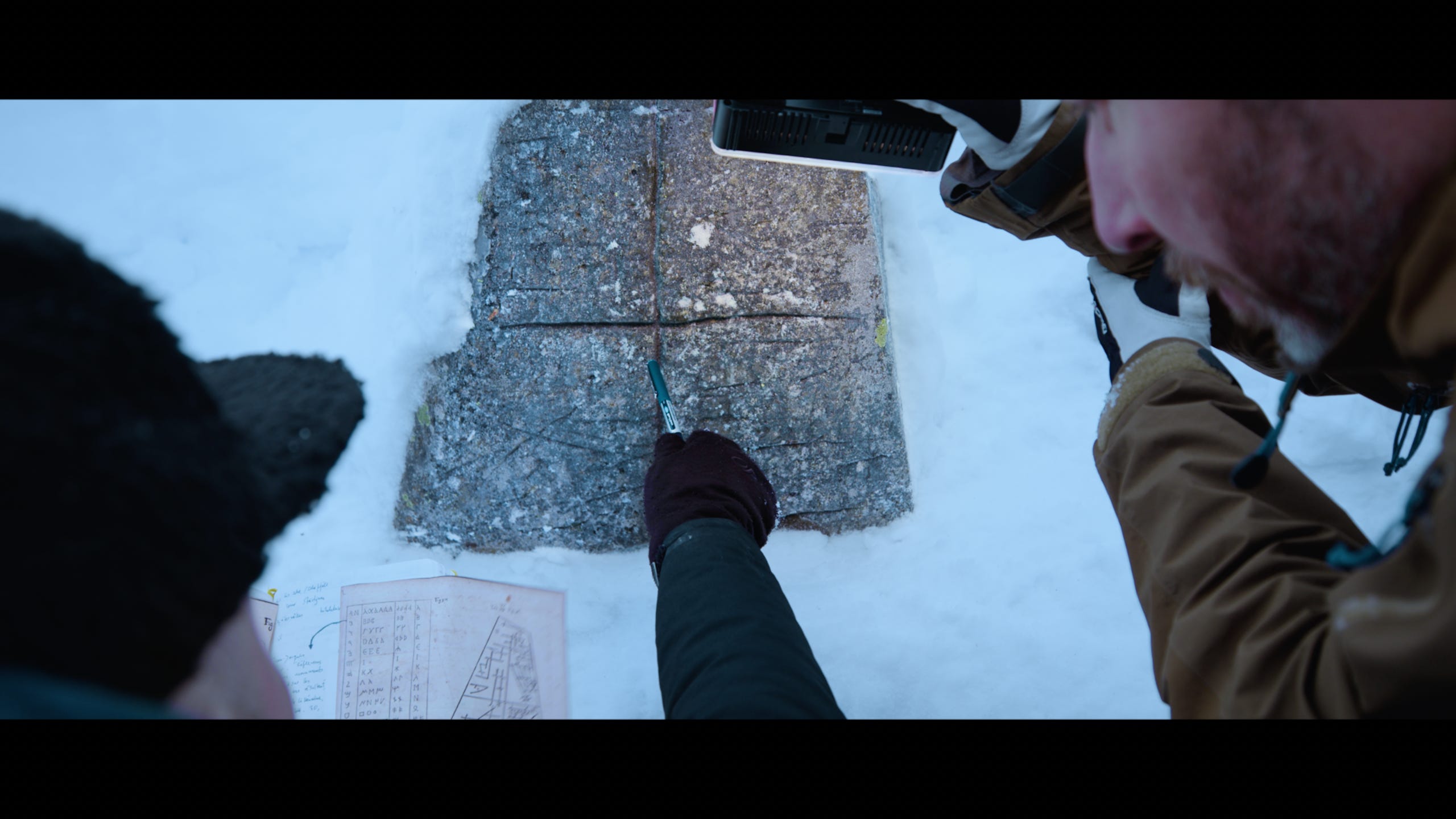
The numbers guided me further up a hill. Near its crest, a few solitary boulders lay lodged in the forest floor, as if hurled by a Titan’s hand. Most of their sides had yielded to shrubs and moss.
Condensed water trickled down the faces turned away from the sun. Creases in the stone caught reflections of its light, lending a golden shimmer to the lines for which I had come.
Drawing closer to the furrows, a first doubt began to rise.
Was this really what they had seen?
Northern Crowns
Rumours of this stone once called antiquarians – and even kings – into action. What if the emblem of the Swedish king could be found up north, beyond the Arctic Circle?
Centuries ago, such word had travelled south. At Stockholm and Uppsala, reports of a stone marked with three crowns sparked an expedition to find evidence that the power of Sweden’s kings had reached to the outer edge of the kingdom.
All this began with a desire to illuminate the deeper history of the Swedish Empire. In the decades after 1660, the Board of Antiquities launched official inquiries to collect information on ancient monuments.
Around the middle of the 1680s, reports came in about an ominous stone located near the village of Käymäjärvi.1 Upstream the valley of the Torne River, they claimed, lay a monument whose face not only featured a rune-like inscription, but also three crowns.
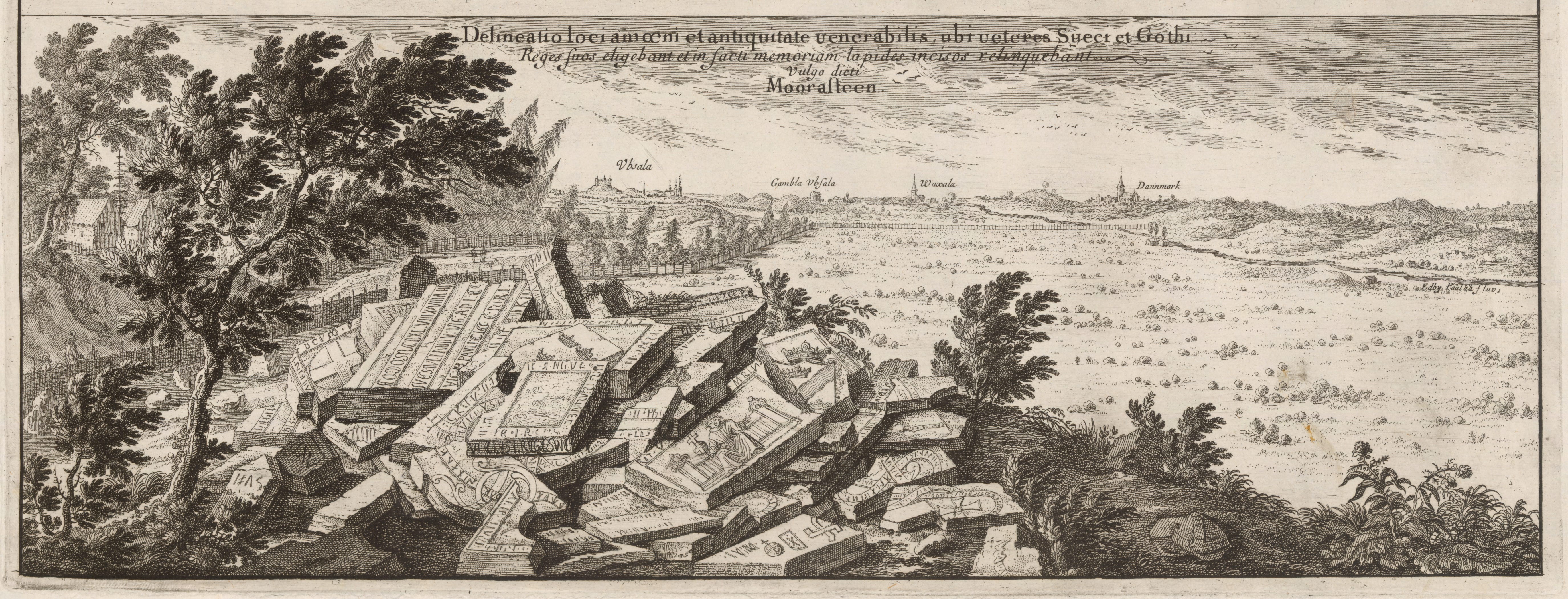
Until then, the only archaeological evidence known of this emblem of the Swedish kings had been the Mora Stenar (‘Stones of Mora’) near Uppsala. At this site, Swedish kings were elected and sworn in in earlier times, before setting out on their Eriksgata through the provinces of the realm.2
Rudbeck Organises an Expedition
To antiquarians, the outlook was tantalising: could there be evidence for royal iconography on the northern margins of the kingdom – hundreds of miles further north than any known rune stone?
The Uppsala professor Olof Rudbeck was among the first to take action.
On 10 June 1687, he drew up a letter to persuade his patron Bengt Oxenstierna that an expedition was necessary.3 As chancellor, Oxenstierna had the king’s ear.
If pitched from the right angle, Charles XI might finance such a mission. Its main objective naturally lay on the stone, in a venture that promised to shed new light on the history of the royal emblem and its reach.
Yet Rudbeck entertained secondary objectives, as well – goals that, to him, were at least as tempting.
The stone lay in the region he advertised as the one where “our oldest fathers first observed the course of the sun and the moon”.4 This phrasing tied back to a core idea he unfolded in his Atlantica: that the cradle of astronomy had stood in the Torne Valley.
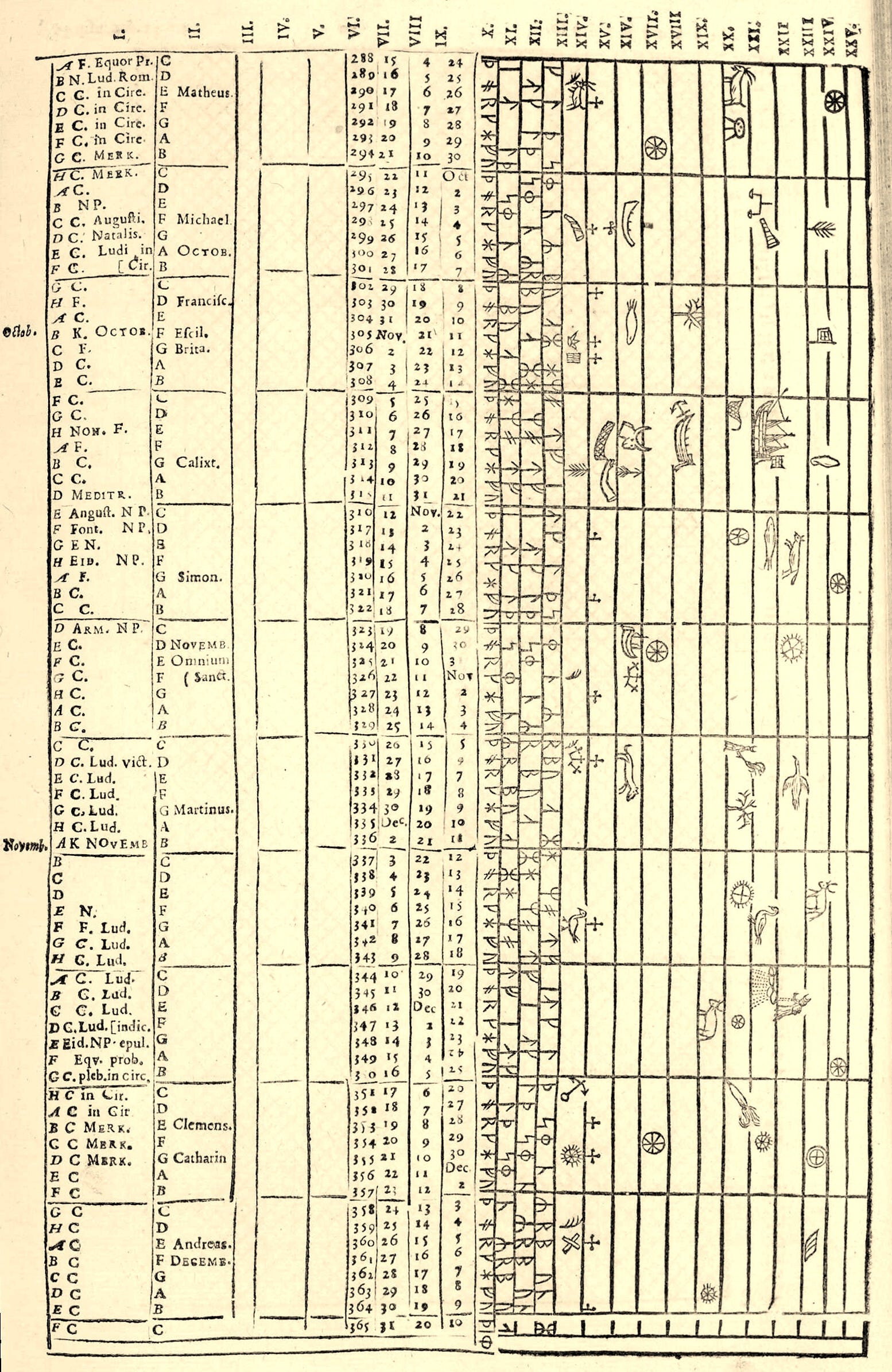
It was here, he claimed, beneath the wide skies of the High North, that the first kings of Sweden had observed the sun and the moon. Applying the early art of letters, they devised the first calendars, handing down the movement of the celestial bodies to later generations.
If the decision to send out an expedition was made quickly enough, Rudbeck pressed on in his letter, the antiquarians could reach the Arctic Circle in time to gather astronomic observations during the days of the legendary Midnight Sun – in the very region where, in his vision, Swedish kings had launched astronomy and devised the first calendars.
The Antiquarians Head North
With his letter to Oxenstierna, Rudbeck had made a compelling case. Johan Hadorph, secretary at the Board of Antiquities, followed up with a further letter in its support.5 Already the next day, the matter was settled.
By royal decree, two antiquarians and a servant were granted a travel bursary to carry out the mission Rudbeck had proposed. The men who set out north were Johan Peringer – later ennobled as Peringskjöld – and Johan Hadorph junior, the secretary’s son. After 11 June 1687, the party departed.
It was the first expedition Sweden ever sent beyond the Arctic Circle – and already the third Rudbeck had launched into Norrland to gather evidence for his ideas.6
Little is known of how Peringer and Hadorph travelled. But they reached the North at remarkable speed. By early July, they had crossed more than a thousand kilometres and passed the Arctic Circle.
Beyond this line, the sun does not set for at least one night in summer. All along the way, the men took notes on its course at midnight.7
By 3 July, they reached the mining estate at Kengis on the Torne River. From there, they continued upstream before turning northwards. Heading for a hill called Vinsa, they entered the mosquito-infested forests – towards the stone whose rumours had launched them north.
The Northernmost Runes
There is no account of the moment when Hadorph and Peringer first encountered the Vinsa Stone.
We can only imagine how they cleared its weathered surface of moss, searching for signs that might live up to the wondrous reports that had launched their journey.
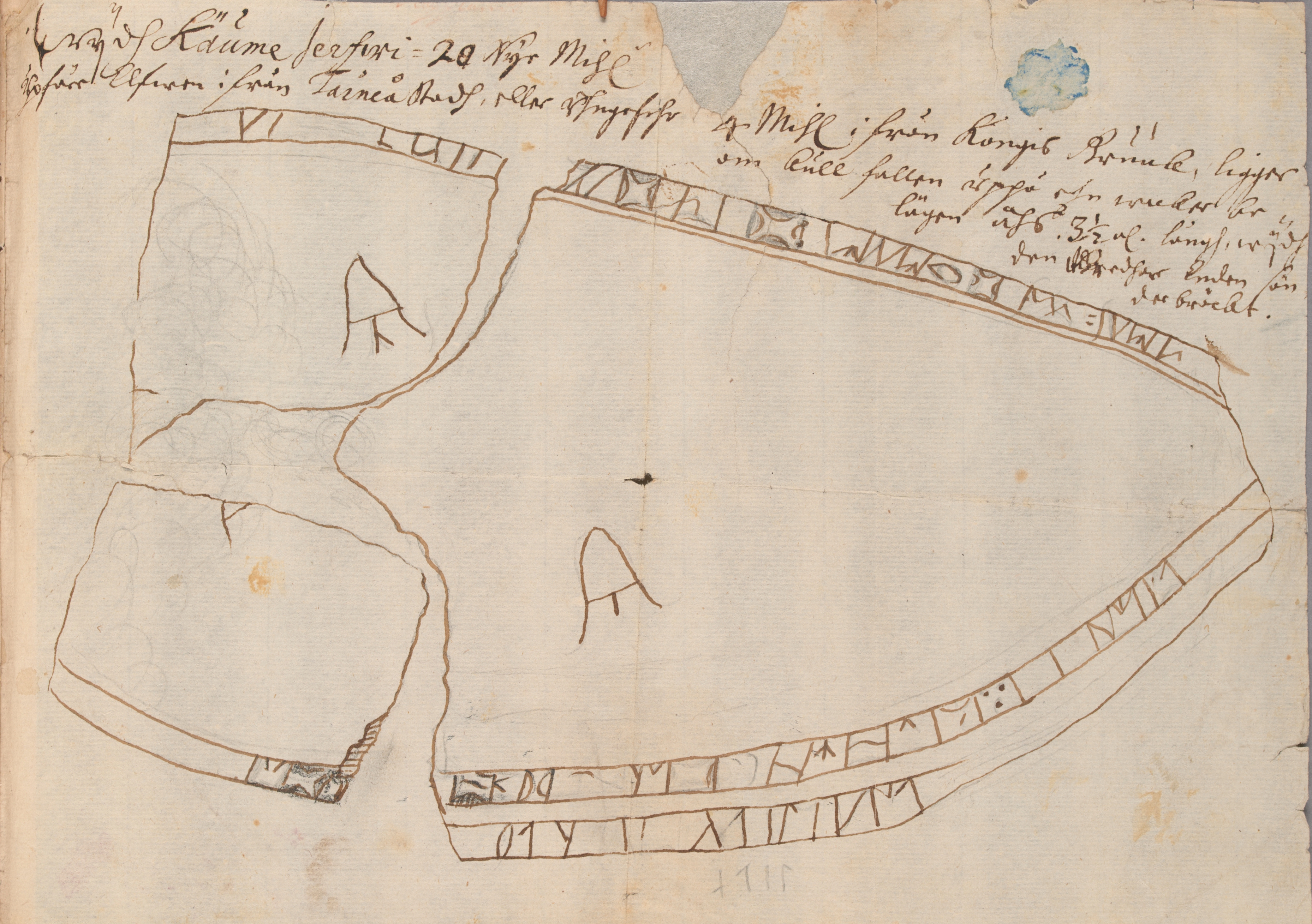
What survives is a sketch Peringer drew that day. It shows what appears to be three fragments, lined with a band of signs.
Closer to the centre, two bell-shaped figures appear besides the fragment of a third. Above them, an inscription indicates where these markings were found – on a tipped-over stone near Käymäjärvi, some forty kilometres north of Kengis.
Of all of this, nothing I had seen in the National Library could be identified on site.
After filing the drawing, Peringer and Hadorph began their return. Freed from the astronomic constraints that had hastened their journey north, they now travelled at a slower pace.
As time pressure eased, they could attend to antiquarian stopovers further south that Hadorph senior had already suggested in his letter to the king. These included a journey up the Åredalen in Jämtland, to the rune stone at Frösön and the ‘Stone in the Green Valley’ near Storlien, and to the elusive rune stones of Hälsingland.8
From Crowns to Constellations
Across Norrland, Hadorph and Peringer collected evidence of the northernmost rune stones known in Sweden. With a folder full of drawings, they returned to Uppsala.
The moment the two antiquarians placed the sketch from Vinsa on Rudbeck’s table must have been underwhelming. After thousands of kilometres and months in the field, they produced a drawing whose signs hardly resembled three crowns.
Peringer and Hadorph could make little of the creases that reports had presented as runes and the royal emblem. In the later volumes of his Atlantica, Rudbeck did not write a single word about the Vinsa Stone or its alleged inscriptions – rumours he had originally used to secure the expedition from the king.9
The expedition to the stone had failed as proof of crowns and runes above the Arctic Circle. Yet it returned with something else that would prove invaluable to the Atlantica project: numbers and names.
Hadorph and Peringer had brought back notes on places and the sun’s course around Midsummer. With their annotations, Rudbeck returned to his personal copy of the first volume. Dipping his pen, he updated the map of Sweden he had printed in 1679.
Two years later, he presented the ideas developed on the basis of these notes in the second volume of the Atlantica (1689).
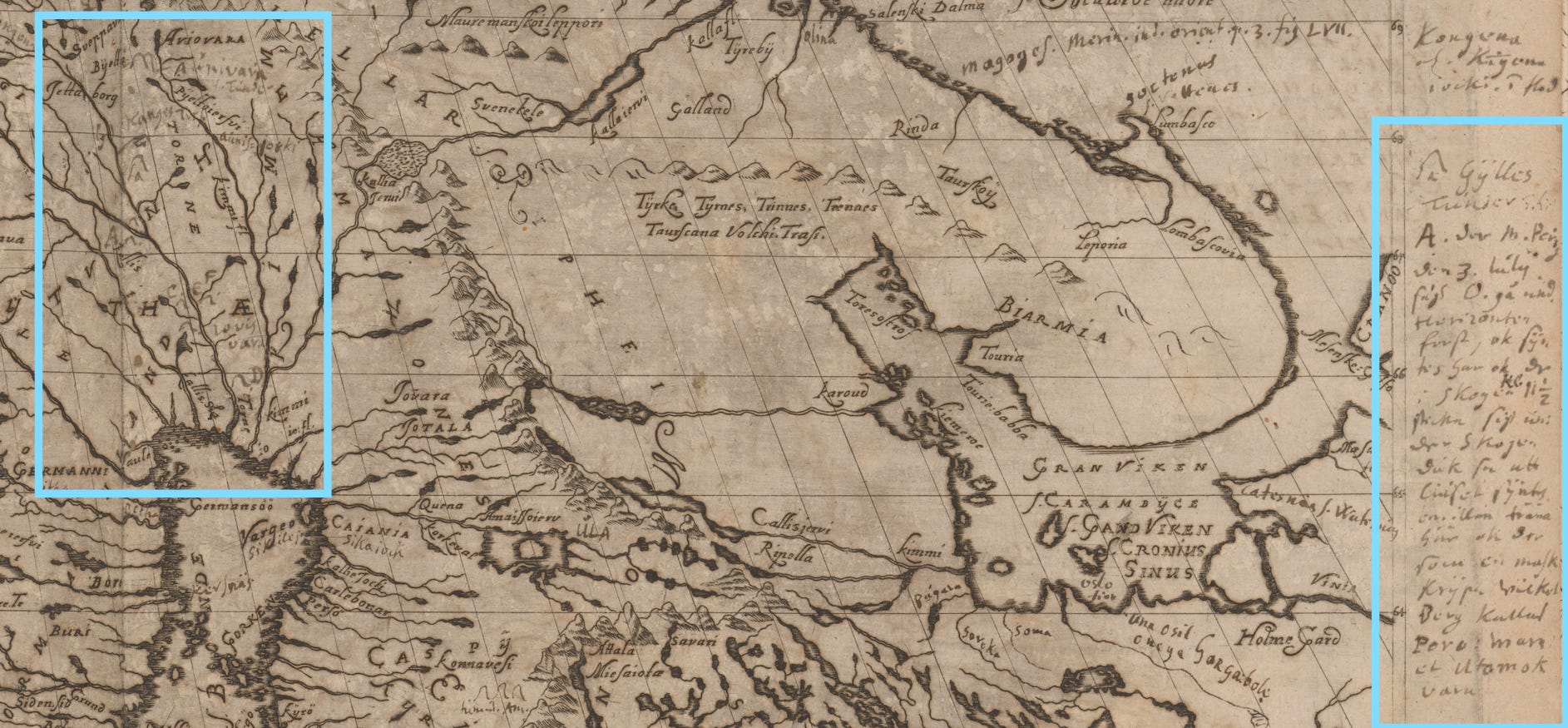
In Rudbeck’s view, elevations in the Torne Valley bearing names such as Kengisvaara –translated by Rudbeck as ‘King’s Hill’ – still bore witness to the first rulers of Sweden. All along the river, he argued, the early kings had maintained a network of observation points. From these, they first grasped the movements of the celestial bodies.
The notes from beyond the Arctic Circle allowed Rudbeck to substantiate this vision of the North. Millennia ago, he imagined, Swedish kings had held watch across the northern sky. Raising his gaze over the Torne Valley, King Atlas himself – the namesake of Atlantis – had begun the noble art of astronomy.
Hadn’t the classical authors still caught a glimpse of this truth when they later remembered the god as its inventor?10

The Stone Resurfaces
Again, Rudbeck assembled the pieces into an intriguing story.
What he wrote in the second volume of the Atlantica about the cradle of astronomy in the Torne Valley motivated a new wave of expeditions north.
In 1694, King Charles XI himself travelled to Torneå. From the bell tower near the river mouth, he watched the Midnight Sun skim the northern horizon. The following year, an expedition of scientists set out from Uppsala along the same route to analyse the phenomenon their king had witnessed.11
Once more, Rudbeck seized on the opportunity to graft an additional mission onto the astronomical one. Drawing on his king’s renewed interest in the North, he succeeded in adding a natural historical expedition into Sápmi, led by his own son, Olof Rudbeck the Younger.12
All this had begun with rumours of the ominous stone at Vinsa. Once Hadorph junior and Peringer had inspected the monument beyond the Arctic Circle, it faded from academic debate almost as quickly as it had entered it.
Half a century later, Rudbeck’s speculations had passed their zenith. Among antiquarians, however, memory of the stone and its lure persisted, resurfacing in new contexts.
In 1736, a young priest returned to the Torne Valley.
Five years earlier, Eric Brunnius had defended his dissertation at the University of Uppsala. In the work, he treated the town of Torneå and the surrounding parishes. As part of this, Brunnius mentioned the Vinsa Stone and the “crowns it once showed”, as Hadorph had related:
The venerable secretary Peringskjöld and his companion Hadorph junior also visited this site on the mission they undertook into our lands by order of Charles XI, where they found a sort of runic writing on the stone, however very obscure, so that they were unable to make sense of it.
Brunnius (resp.), De urbe Tornea13
After the Great Fire of Uppsala (1702), the grand narratives the Rudbecks had woven about Sweden’s early imperial prime had lost much of their force. Any renewed interest in the Vinsa Stone required a different framework of urgency.
Brunnius may have left much of his antiquarian interests behind in Uppsala when he moved into the parish house beneath the Arctic Circle. Yet it was here, on the western bank of the Torne River, that the knowledge he carried about the stone found receptive ears – at a time when the North was no longer sought as the cradle of ancient wisdom, but as a testing ground for universal laws.
In 1736, a team of scientists led by the Frenchman Pierre Louis Maupertuis and the Swede Anders Celsius sailed up the Baltic Sea. Their aim was to resolve one of the great scientific questions of the age – the shape of the Earth towards the poles.
It seems as if a phantom of Rudbeck’s vision guided them to the Torne Valley – the region they identified as the ideal arena for their geo-astronomical observations.
That winter, the parish house at Övertorneå became their basis of operations. During the longest nights of the year, the men ventured onto the frozen river. Moving wooden rods across the ice, they measured a baseline for a trigonometric grid spanning the Torne Valley, their efforts illuminated by the shimmer of the Northern Lights.
Perhaps it was after one of such days that they returned to the stove in Brunnius’s house. As sensation returned to their limbs, they may have listened to the stories their host shared in Latin – of a mysterious stone farther north, whose signs had eluded scholars for generations.
It was the kind of report powerful enough to lure the scientists off the tracks of their measuring mission, out into the forests in deep Arctic winter, and to melt the stone free from metres of snow – but let this be another story.
Further Reading and References
All translations and photographs are my own unless noticed otherwise.
When quoting from Latin sources, abbreviations were silently expanded and orthography lightly adapted to current standards.
Please note the general bibliography available here.
A first study of the stone was published by Henrik Schück, “Torneåstenen”, in: Fornvännen 28 (1933), 257–68 (online at diva-portal.org).
The Vinsa Stone does not feature in the extant documents of the so-called ransakningar (‘inquiries’), which are scarce for the Arctic area. Knowledge about the stone may have reached south via Arendt Grape, who operated the Kengis mine up north (discussed in Matti Enbuske, “Tornionlaakson Käymäjärven riimukivi– tieteenhistorian fantasiaa [The runestone of Käymäjärvi in the River Tornio valley – on a fantasy in the history of science]”, in: Harmaata näkyvissä: Kirsti Paavolan juhlakirja [Grey in sight: Festschrift to Kirsti Paavola] , eds. J. Ikäheimo, R. Nurmi and R. Satokangas, Oulu 2011, 95–106, p. 99.
See the introduction by RAA (online at diva-portal.org).
See Bref af Olof Rudbeck d. Ä., ed. Annerstedt, vol. IV, p. 319 (online at digitale-sammlungen.de). Rudbeck reports on the expedition and how it came into being in his Atlantica, vol. II, p. 158.
Bref af Olof Rudbeck, p. 319: “som ligger på den orten där wåra älsta fädar först observerat Solens och Månens lop”.
See his letter in Schück, “Torneåstenen”, p. 258.
The first expedition covered the Dalälven, Härjedalen, and Jämtland (1675). On a second one in the 1680s, Rudbeck the Younger and several students explored mountains north of Älvdalen in Dalarna. In 1695, Rudbeck sent his son to Lapland (articles on the last two expeditions are in preparation).
My account of the expedition follows Rudbeck, Atlantica, vol. II, pp. 159f.
In a letter preceding the expedition, Johan Hadorph suggested their plans for stopovers on the way back in greater detail. These included the rune stones in Hälsingland (see e.g. RfA-ID 353), the rune stone on Frösön (not depicted in the Atlantica), and a wondrous stone at Undersåker up the Åre Valley. See Hadorph’s concept book of letters as quoted in Schück, “Torneåstenen”, p. 258.
Once the journey up the Torne River was completed in July 1687, the expedition visited Frösön and continued up the Åredalen up to Trondheim. On Frösön, Peringer drew the famous rune stone (see the digital copy on alvin-portal.org (alvin-record:97575) and the blogpost by Magnus Källström on k-blogg.se from 20 March 2020). Near Storlien, Peringer and Hadorph visited the Stone in the Green Valley that Rudbeck first had printed. On the drawing Peringskjöld produced see our article on the Stone in the Green Valley.
This was correctly pointed out – yet mostly ignored in discussions of the stone – by Enbuske, “Tornionlaakson Käymäjärven riimukivi”, p. 101.
See the account in Rudbeck, Atlantica, vol. II, pp. 159f.
It is unclear if Rudbeck the Younger visited the Vinsa Stone on his expedition along the Torne River in 1695. With the ill-fated publication of his Laponia Illustrata, the main account today for his itinerary is the so-called Dagboken. As part of this journal, he describes his arrival to the Kengis estate south of the stone. The section north from there, in which one might expect a description of a potential visit to the stone, is missing in the manuscript ( the surviving part of the journal only picks up again further upstream, in the area around Torneträsk). See Olof Rudbeck the Younger, Dagboken, in: Rudbeck, Iter Lapponicum, Skissboken från resan till Lappland, vol. II, Stockholm, ed. Tomas Anfält, Stockholm 1987, pp. 24 and 39.
An article on this expedition is forthcoming on this platform.
An article on this expedition is forthcoming on this platform.
Erik Alstrin (pr.) / Erik Brunnius (resp.), Dissertatio gradualis de urbe Torna, eique adjacentibus paroeciis … Uppsala 1731, p. 25 (digitised by Umeå University Library): “Nobilis secretarius Peringskiöldius et comes eius Hadorphius iunior terram nostram, indultu regis Caroli XI invisuri hunc etiam locum petebant, ubi in lapide scripturam quidem runicam sed valde obscurum, ut sensum eruere nequirent, comperiebant.”
Earlier, Brunnius points to Hadorph as his source; see ibid.: “… in quo [sc. lapide] tres coronae atque scriptura Runica insculptae conspiciebantur, ut verba Dn. Joh. Hadorphii innuunt.” In a corresponding note (k), Brunnius clarifies: “Verba Hadorphi in Monumenta Palmskiöldiana de Westro-Botnia in genere.”
This points to the manuscript volumes in which Elias Palmskjöld (1667–1719) collected antiquarian knowledge for the various regions of Sweden. Today, this collection is kept at Uppsala, see the description on alvin-portal.org (record 259098).