


At the River of Light
A concrete wall held back the river on the horizon.
We arrived to Ljusnan during the long days before Midsummer, and from the bridge we crossed, the view rebounded from Laforsen Dam.
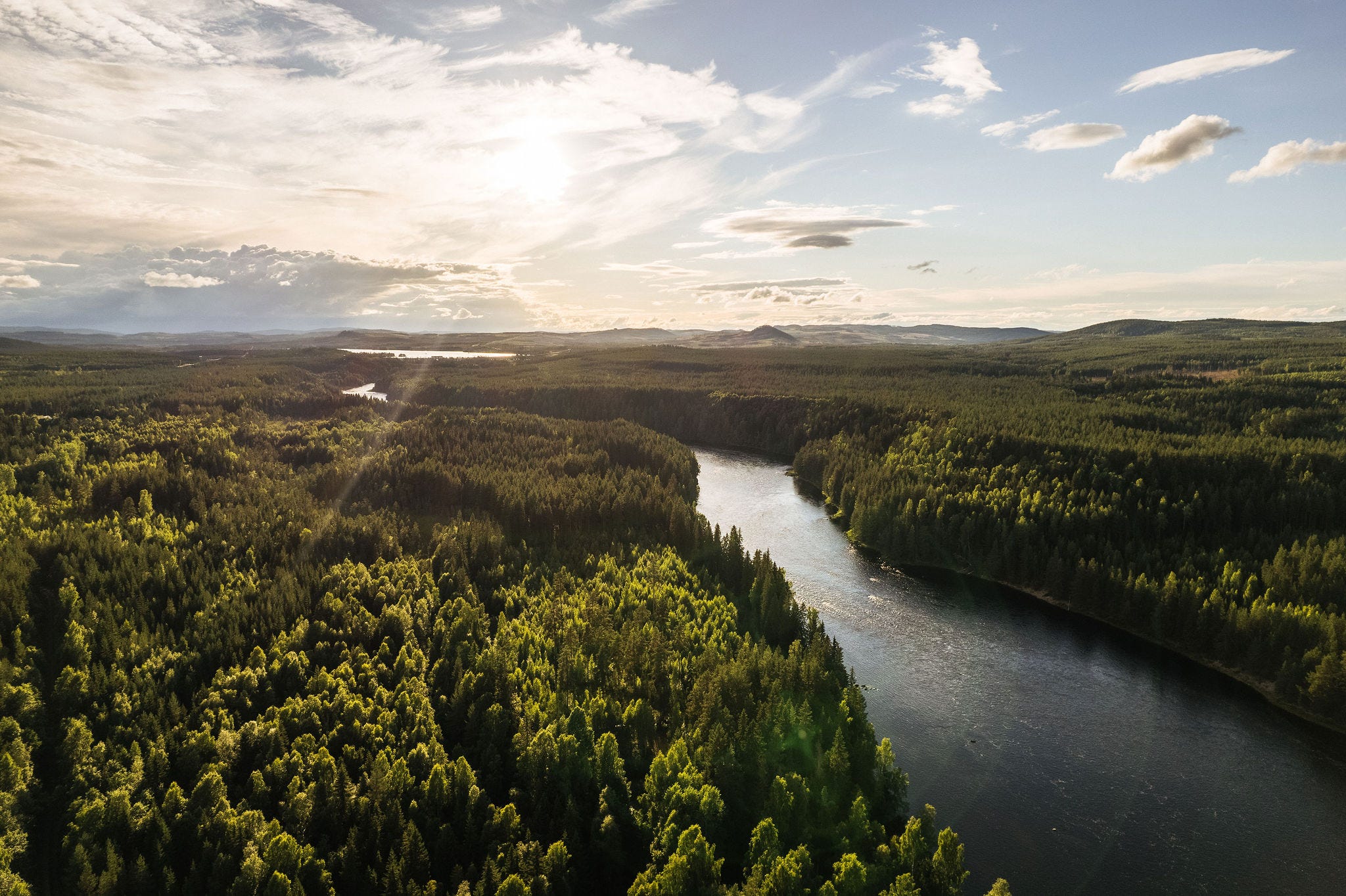
Beneath its barrier stretched an empty riverbed, of one of the rivers along whose banks Olof Rudbeck located the ‘Elysian Fields’ of the ancients – paradisiac landscapes that he claimed still existed in the North.
Ever since I had read of Rudbeck’s take on Elysium, I had felt the lure of experiencing lands he presented in a golden light. Through Lars – an experienced kayaker who grew up along Ljusnan – the idea of paddling the river’s last free-flowing stretch took shape.
In early summer, we travelled south for a pre-film scouting, crossing Ljusnan before sunset. Little did I know how experiencing the river later that summer would change how I thought about telling the journey in film.
The plan had been to return with a camera team, to capture encounters between ancient myth and a landscape that has changed within a few decades. Initially, I imagined a few short-form videos as a result.
Yet Ljusnan planted a different seed – one that would grow into a feature film.
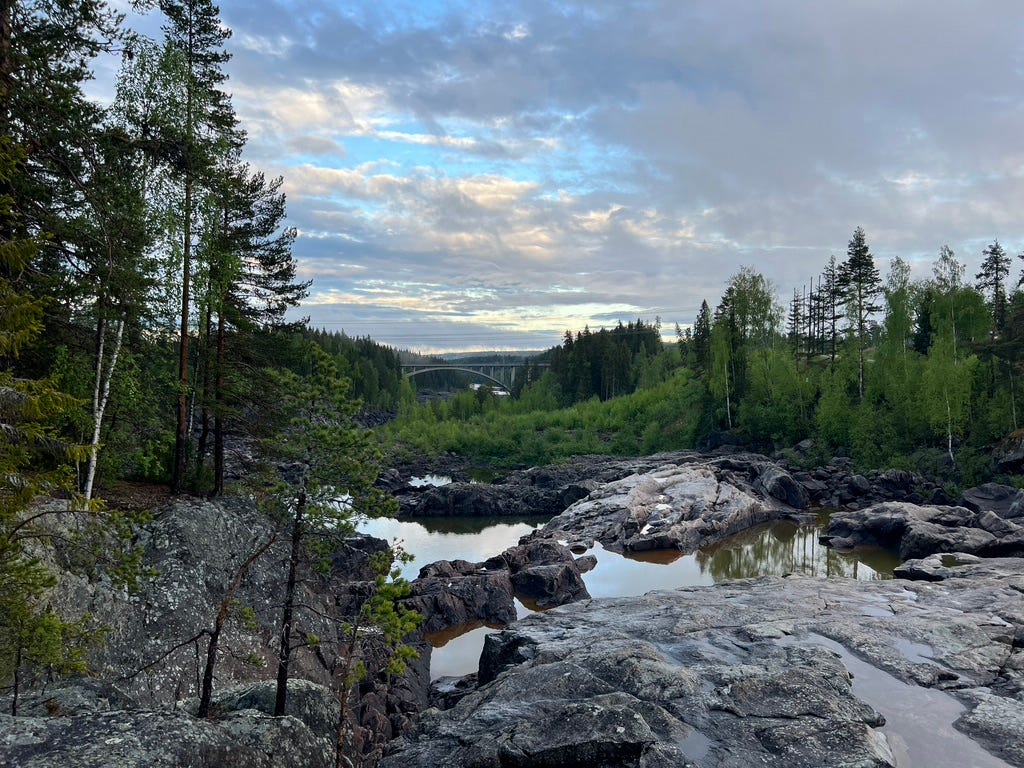
Scouting around Laforsen Dam in the evening light, Lars and I approached the concrete wall; four gates of steel wedged into the river, its waters widening into a lake above. On the horizon arched the bridge that we had crossed over the dry river.
Power lines ran in parallel across the sky. From the nearby substation, a hum carried over. Where the empty bed ended, a silvery band of water caught shimmers of last daylight – the diverted river that re-emerged from the outlet.
Down there, any journey towards Elysium would have to begin ...
Poets of Paradise
Had Elysium been a place on earth?
For millennia, readers of classical poetry grappled with this question. From 1679 onward, the volumes of Rudbeck’s Atlantica came as a revelation – and as provocation to humanists on the continent.
The polymath from Uppsala claimed a host of mythical places as originating in Sweden. Among them, he included Elysium – the place where the ancients imagined the souls of the blessed residing after death.1
I had come to Ljusnan curious to experience riverbanks inscribed with layers of mythical meaning. From his desk at Uppsala, Rudbeck had read their nature and names, their geography and botany as resonating with the landscape the classical poets described.
In Elysium, Vergil imagined the souls to dwell on lush riverbanks; a place he described as filled with music and eternal light. On the grass of the Elysian river, the poet envisioned, persons of merit and honour lived a life of virtue and beauty, inspired to song and dance by the world around them.
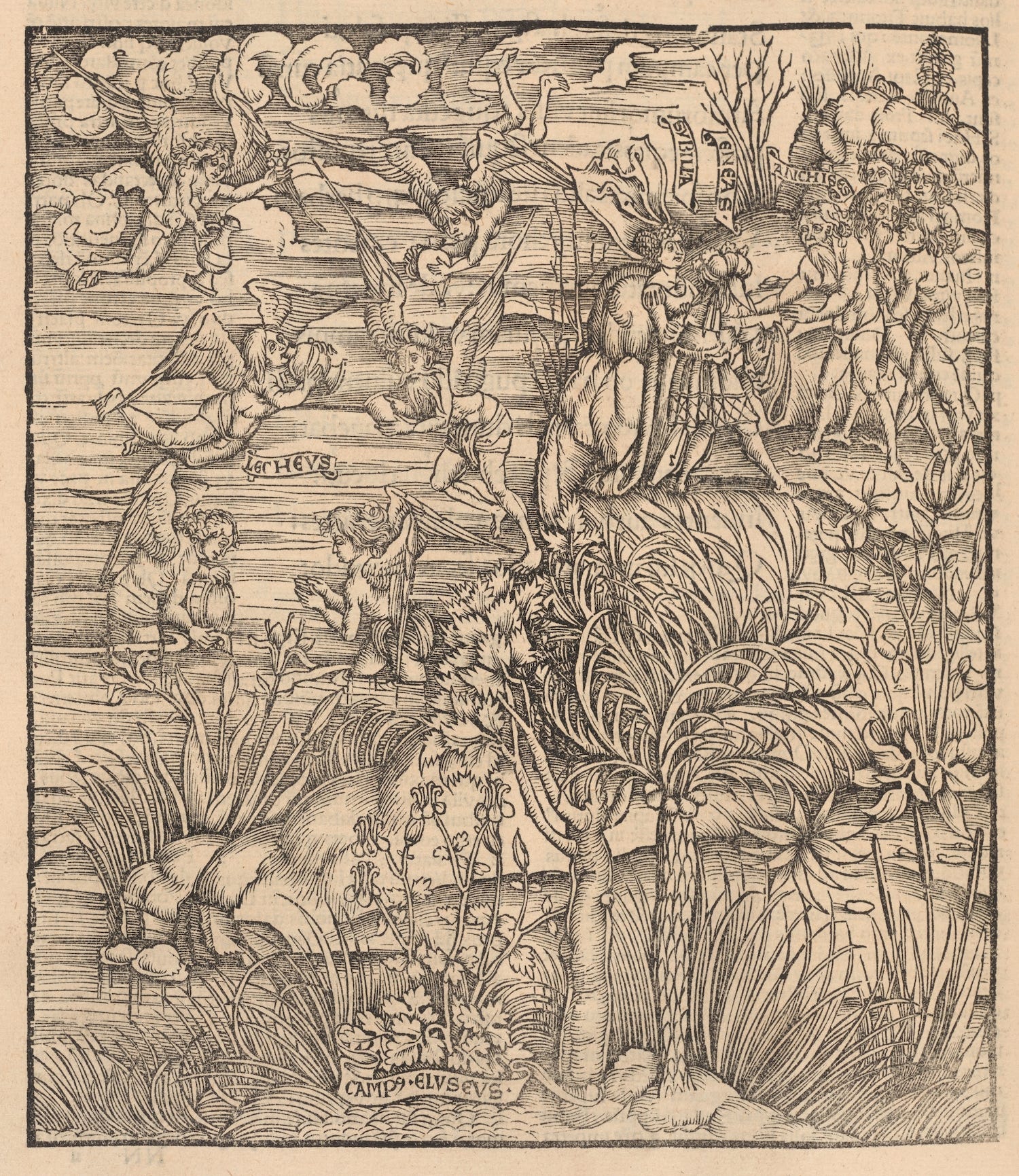
Vergil describes the Elysian Fields in the sixth book of his Aeneid. The epic tells of Aeneas, an exile of Troy in search for a new home. With his family, he had fled the burning city, unaware that fate had destined him to lay the foundation for the city of Rome.
Unaware of his greater mission, Aeneas is tossed around on the sea. Reaching Italy, he is forced to bury his father on foreign shores.
Later, Anchises appears to his son in a dream. In Elysium, he shall meet him: There he shall learn the fate of his family and that of Rome itself, the city he is destined to found. Yet to reach the blessed fields, a Sicilian oracle later foretells, Aeneas must find the Sibyl – the seeress who lives near Lake Avernus in a cave.
Once found, the Sibyl becomes Aeneas’s guide to the Elysian Fields. To reach them, he first must win the favour of the queen who guards the threshold to the Otherworld. As an offering, she instructs, he must pluck the Golden Bough. This ominous twig, the seeress continues, grows hidden on a shimmering tree. Having located the Bough in the gloomy forest with divine support, Aeneas eventually embarks on his journey and passes the threshold to the Otherworld:
Their duty to the goddess done at last,
They came into a glad land: pleasant grounds
In forests of good fortune, blessèd home.
A richer, shimmering air arrays these fields,
Which have their own familiar sun and stars.
VERGIL, Aeneid, Book VI.638–41 (tr. Ruden)
Mapping Elysium in the North
What Vergil cast as poetry, Olof Rudbeck would later argue, had once been read from the North itself. For him, the poet’s lines were not inventions. The Aeneid preserved, in distorted form, memories of places that still existed in his home country.
Around Midsummer, Rudbeck explained, Sweden’s summer nights bathe the riverbanks in the North in a near-eternal light. In his view, this natural condition provided the experiential ground in which Vergil’s lines about the light-filled Elysian Fields were anchored.
Such truth he saw inscribed into names themselves. In Rudbeck’s interpretation, Ljusnan translated as ‘River of Light’, deriving from the Swedish word ljus (‘light’). In his view, this logic of sound and sense still echoed in the Latin name ‘Elysium’.
Classical myth contained such truth in distorted form. Its most original layer, Rudbeck argued, was to be found in Norse mythology. In his century, Swedish and Danish scholars had begun to edit and translate manuscripts that preserved the Nordic sagas.
In Rudbeck’s view, these texts preceded classical myth by far. They also contained pristine accounts of blessed landscapes in the North, speaking of a place called Glaesisvallur – the ‘Fields of Light’ in Rudbeck’s rendering.2
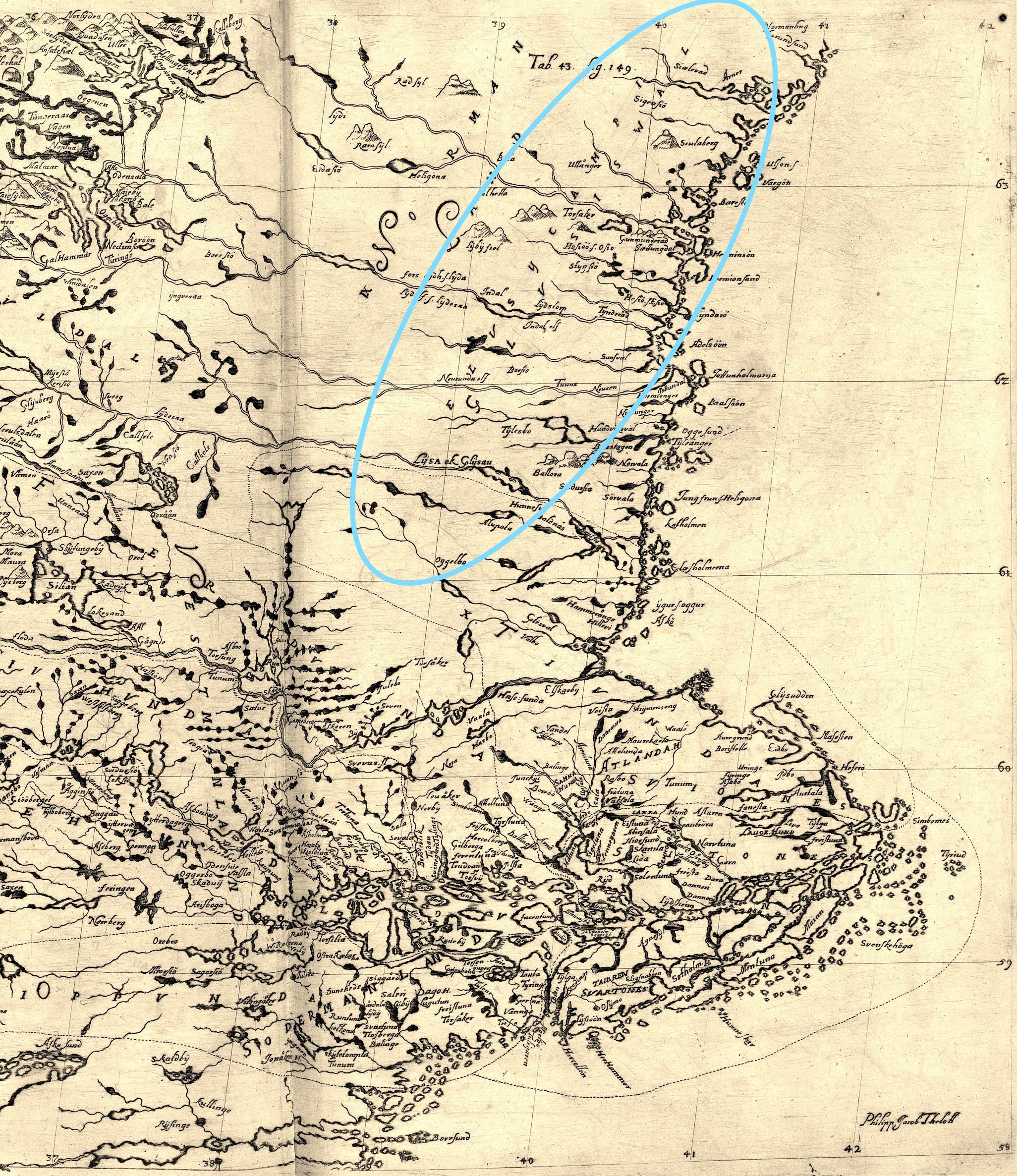
In the 1670s, the layers of myth that Rudbeck cast on Sweden’s North gained more contour. In 1675, he had sent an expedition up the Dalälven River to the mountains. Their mission was to gather measurements and observations that could further anchor his claims in empirical description.
From their data emerged a map of middle Sweden that accompanied the first volume of the Atlantica. In this document, Glysisvall and Elysii Campi appear as synonyms through which Rudbeck’s mythological argument found cartographic expression.
Both names designate the river landscapes that widen between the mountains of Sweden’s North and the Baltic coast. It was here that names and nature, in his reading, mirrored the spiritual dimension that humans had associated with these lands since the earliest of times.3
In this way, Elysium emerged not as an allegory detached from place, but as a reality still tangible, still legible in the names, vegetation, and light along the northern rivers – qualities inscribed into the landscape itself, to which his Atlantica claimed to provide the map.
Passport to Elysium
Yet only a few mortals were granted by the gods to reach Elysium. To make it to the Otherworld and back, the Sibyl warns Aeneas, “that is the work; that is the effort”.4 Before reaching the blessed fields, the traveller must cross boundaries that separate worlds – the river of the dead, guarded by Charon, which marks the passage from the living to the realm beyond.
Yet before that perilous journey can even begin, the gods have placed a further quest. Aeneas has to find and pluck the Golden Bough as an offering for the Goddess of the Underworld. This material sign, the Sibyl instructs, grants passage where force or pleading would fail and the twig yields itself only to the chosen. Eventually, the hero finds it in the vast forest, guided by the birds his mother sent in aid:
The[y] perched on what Aeneas sought, the contrast
Of flashing gold among the tree’s green branches;
Just as the mistletoe in dead of winter
Grows a fresh leaf, its own and not its host’s,
And rings the smooth trunk with its yellow shoot;
So the gold leaves stood out against the darkness
Of the oak. Their foil was jangling in the light wind.VERGIL, Aeneid, Book VI.203–9 (tr. Ruden)
The power of the Golden Bough lies not in what it is, but in the transition it allows. For centuries, scholars have argued over the nature of the tree Vergil described. Leaving botanical speculations aside, many Christian humanists favoured symbolic readings.
Within the reception history of Vergil, later readers came to treat the poet as a figure of spiritual authority. In his Fourth Eclogue, he foretold the birth of a boy that would bring salvation. On such ground, many considered the Roman author as enlightened – as someone who had seen a truth even before the coming of the Lord.
As a prophetic poet, some Christian interpreters concluded, Vergil had formulated truths of this kind also in his Aeneid: With the Golden Bough, he had created an image for the shining power of virtue – the condition that safely guides through the underwood of vices, and ultimately permits safe passage into eternal life.5
For Rudbeck, these allegorical readings obscured rather than explained the actual nature of the elusive twig. In his Atlantica, he once again traced this myth back to the constant base he saw in the nature of the North: From this, as he argued, human beings had formed stories and meaning of a kind that Roman myth still narrated as if in a distant mirror.6
To reach down to this core of original meaning underlying the Golden Bough, Rudbeck combined strands of contemporary discourse: On the one side his expertise as one of the leading botanists of Europe, and on the other what scholars had begun to publish on the Sámi, the Indigenous peoples of the North.
In their works, non-Sámi scholars such as Johannes Scheffer presented Sámi culture to a learned audience. In the most authoritative of them – Scheffer’s Lapponia that was first printed in 1673 – Rudbeck read about practices of the Sámi noaidi: by beating their drums in certain patterns, Scheffer described, these ritual specialists could leave their bodies, travel to remote places, foresee the future, or converse with the dead.
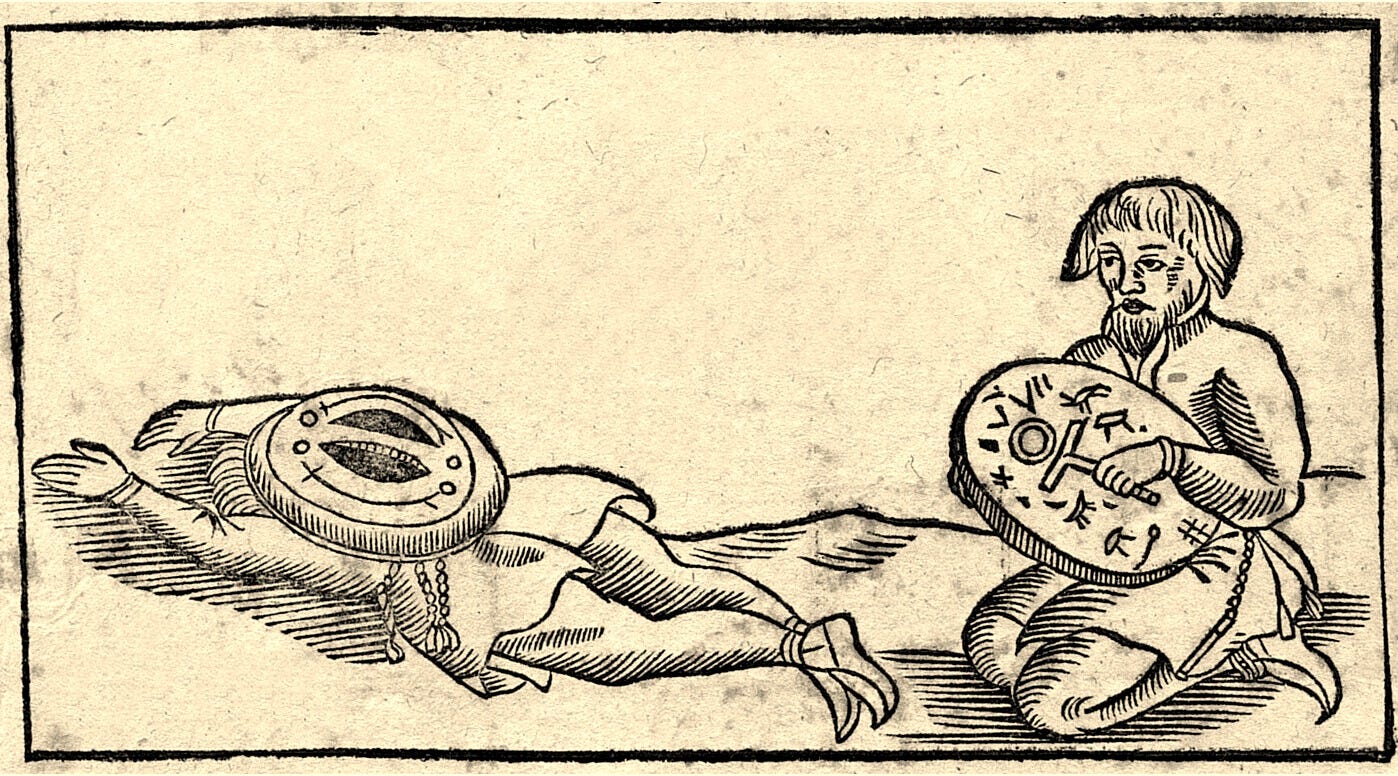
In his Atlantica, Rudbeck appropriated details that Scheffer described for their ritual practice, and used them as a key to Vergil’s text: By chewing the bark of the alder tree, Scheffer related, the noaidi produced the dye to mark their drum skins with intricate carvings.
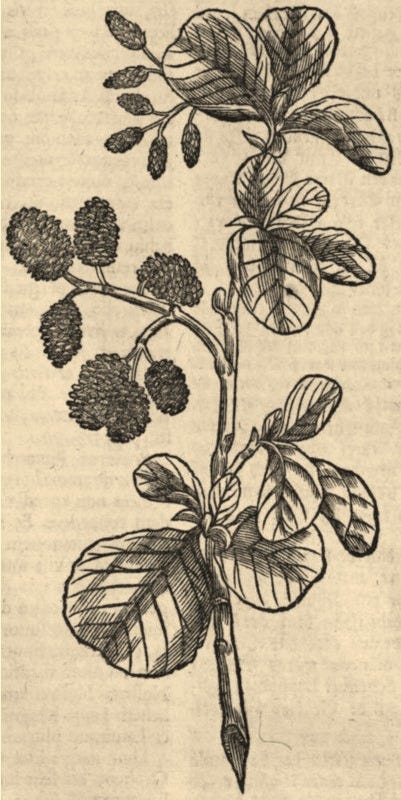
The alder’s bark has three layers, Rudbeck the botanist commented, its innermost turning golden-brown when a twig is freshly plucked. This tree stood at the heart of the ritual object believed to create a passage into the otherworld: On the drums, the sap of alder made the spiritual landscapes visible that the noaidi travelled on his journeys.
Of this tradition, Rudbeck argued, a residue was still found in the way the Aeneid instructed access to Elysium. Taking the alder as key, everything else began to fall into place for him: Long before the Roman texts, the Nordic sagas had held the tree in great esteem. In al, the Swedish name for the tree, he still heard echoes of Ale, Thor’s second name.7 When it came to the alder’s preferred habitat, leading authorities in the field had already pointed to the riverbanks of the North.8
Project ‘Elysium’
By the late seventeenth century, Rudbeck’s engagement with Elysium expanded far beyond the interpretation of individual myths. For the Rudbecks, asserting the primordial status of the North over the classical tradition became a central intellectual aim.
With the early volumes of his Atlantica, Rudbeck the Elder laid the groundwork for the expansive ways in which he and members of his family fused diverse strands of contemporary knowledge. After his 1695 journey into Lule and Torne Sápmi, his son joined this intellectual enterprise.
With his Laponia Illustrata (‘Lapland Illustrated’), he went at great length to push his father’s approach even further. In twelve volumes, he planned to publish on the High North of Sweden, its nature and its Indigenous peoples – all underlining Sweden’s premier place in God’s creation.

By the 1690s, the engine of Rudbeckian scholarship was humming at Uppsala. His son and daughters joined in finishing yet another monumental project that Olof Rudbeck the Elder had envisioned – an atlas of plants as the world had never seen before.
In the seventeenth century, botanical literature mainly relied on convoluted names describing plants in Latin. Even if some institutions could boast Herbaria of pressed plants or botanical gardens (as Rudbeck himself had founded one at Uppsala), visual references remained scarce.
Against this backdrop, Rudbeck embarked on a work that intended to depict each plant known to humankind. Such an atlas, heavily illustrated, would prove an invaluable aid to botanists.
The work was planned to appear in twelve volumes. Each corresponded to a category in the system the Swiss botanist Caspar Bauhin had devised in the 17th century. Once the atlas was completed, it would contain an unrivalled number of 10.000 to 11.000 woodcuts.9
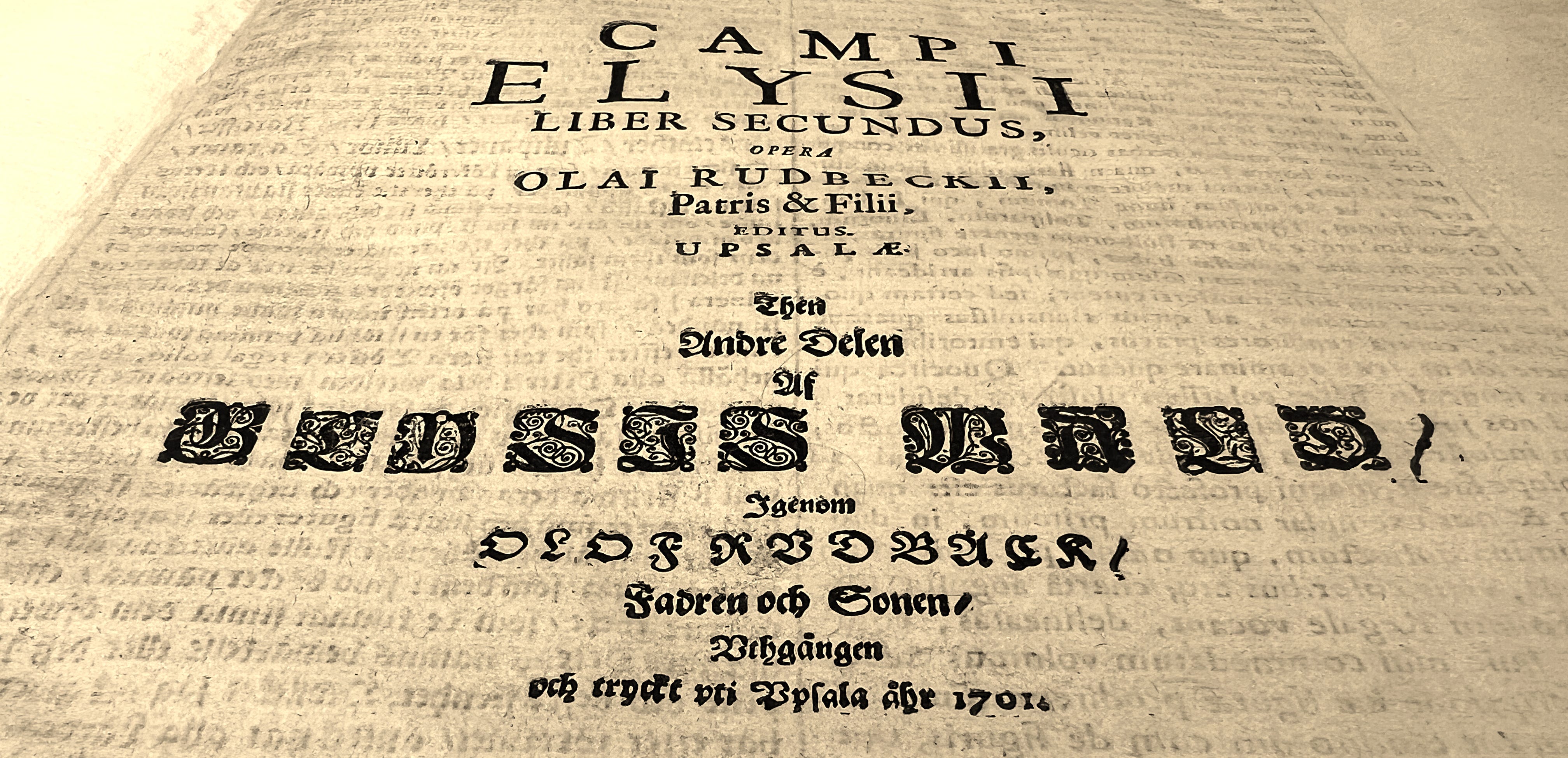
Yet the mammoth work had a spiritual dimension, as well. By revealing the kingdom of plants with unprecedented visual richness, it was bound to unfold the beauty and richness with which God had invested Creation. With a book project of this extent, the possibility of making that abundance visible – a key facet in the concept of paradise – seemed palpable. Accordingly, Rudbeck chose the title for his monumental project: ‘The Elysian Field’ (Campus Elysii) – or Glysiswald in Swedish.10
The Elysian Gaze
By the end of the seventeenth century, Elysium was no longer a destination to be reached, but a total vision to be mapped and catalogued. Across his works, Rudbeck did more than bolster geographical claims from the past: He proposed ways of seeing in the present.
In this practice, landscapes and nature became readable and perceptible as archives of meaning; as the bedrock of myths that once had grown from sensual experience. It was a key claim of his Atlantica that these experiences could, in principle, be recovered.
In Rudbeck’s presentation, the Elysian Fields emerged neither as realm of allegory, detached from place as Christian humanists envisioned it, nor as the distant afterlife of religion. Elysium may rather stand for an archetypical quality of place – one that seems to emerge where a combination of vegetation, water, and light enter into resonance with human imagination.
To seek such places in our world also means to wander towards a threshold – a point where bodily experience, historical imagination, and the material conditions of landscape become porous.
Yet the promise Rudbeck made several centuries ago built on a central tenet: that landscapes of this kind remain legible, that rhythms of season and flow remain intact. That this ground itself might once become fragile – that nature might lose her function as ultimate guide to the truth behind myth – this thought still lay beyond Rudbeck’s imagination when he wrote the Atlantica.
Three centuries later, however, much of what sustained his ways of seeing has been altered, diverted, or erased. The journey on which we planned to embark towards Rudbeck’s Elysium was not about retracing a line on a map. Rather, it would allow to formulate a question more clearly: if the conditions to experience such resonance still exist, and how we might enter them in the present.
It was a question that could not be answered at the desk. If the idea of Elysium was, at its very core, once rooted in bodily experience – in light, movement, and sound – then it needed to be tested by entering the landscape itself.
With the hum of the substation in my ears, I gazed down at the thresholds blasted in the rock beneath Laforsen Dam.
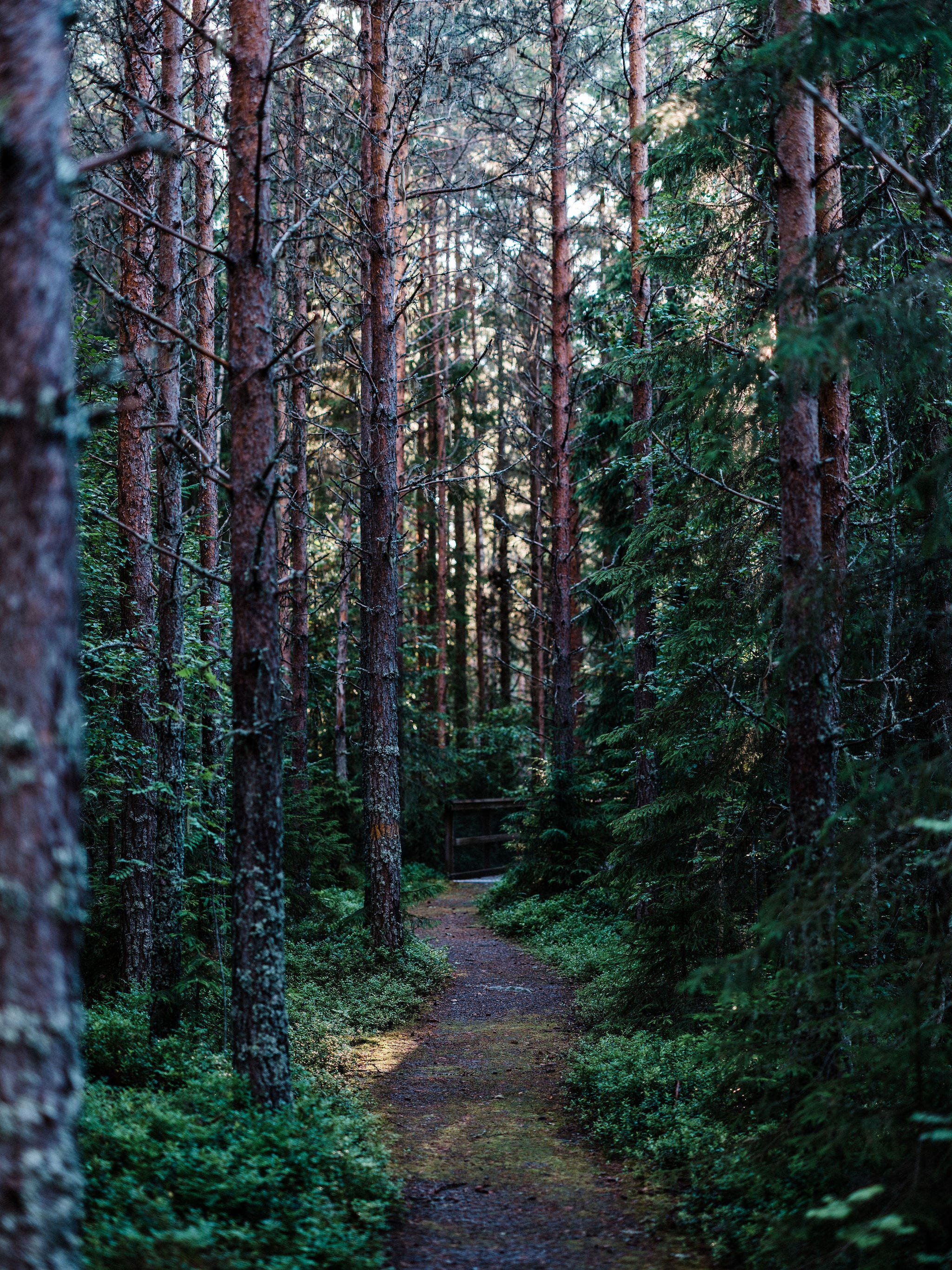
Pools of water had gathered in the naked riverbed, occasionally rippled by a landing insect. The stagnant mirrors reflected back the tops of pine and spruce trees along the banks of Ljusnan. Below, a band of birch and alder ebbed out, lining the ghost of the river until it re-emerged from the outlet on the horizon.
Down there, any journey towards Elysium would have to begin ...

Further Reading and References
All photographs and translations are my own unless stated otherwise.
Please note the general bibliography available here.
For the key chapter on the appropriation of Elysium see Rudbeck, Atlantica, vol. I, cap. xxiii.
One of these sources was the Hervarar Saga. In its first lines, the Norse text mentions a site called Glaesisvaller, a word consisting of glys (shine) and vollr (field). Rudbeck’s friend Verelius had commented on Glaesisvallur in the edition he prepared of this text, see Hervarar saga på gammal götska, ed. Olof Verelius, Uppsala 1672, pp. 19–21 (online at kb.se).
As Verelius points out, previous scholars had already considered the site as identical with the Elysian Fields, the site where the souls of the blessed dwell, and whose name they described as light-filled place (linked to ‘glesa’ – to shine). Rudbeck integrates this into Atlantica, vol. I, pp. 572f.
See also the dictionary that Olof Verelius prepared on the Norse language (published posthumously by Olof Rudbeck): Olof Verelius, Index linguae veteris Scytho-scandicae sive Gothicae, ed. Olof Rudbeck, Uppsala 1691, p. 96 and p. 298 (online at onb.digital).
Rudbeck, Atlantica, vol. III, pp. 411f. From north of the Dalälven River – the traditional border into the part of Sweden known as Norrland – Rudbeck selected names confirming this spiritual dimension. E.g., the Latin name for today’s Gävle (Gevalia) he saw deriving from the Glesvall / Glysisvallur of the Nordic sagas. Undersåker in Jämtland was read as Odins-åker, conflated from åker (field) and Odin, the ruler over the realm of the dead. Along Ljusnan itself, the town Ljusdal pointed to the ‘Valley of Light’ that widened along the river.
Vergil, Aeneid, 6.128.
From the vast literature on Vergil’s sixth book and the Golden Bough, see Matteo Soranzo, “Exploring the Forests of Antiquity: The Golden Bough and Early Modern Spirituality”, in: Walking through Elysium: Vergil’s underworld and the poetics of tradition, edd. by Bill Gladhill and Micah Young Myers, Toronto 2020, 77–93, and Anthony Ossa-Richardson, “From Servius to Frazer: The Golden Bough and its Transformations”, in: International Journal of the Classical Tradition 15 (2008), 339–368.
Rudbeck develops this argument on various occasions. For a central overview see Atlantica, vol. II, cap. iii.
See Rudbeck, Atlantica, vol. III, pp. 431f. (with reference to Johannes Scheffer, Lapponia, Frankfurt 1673, p. 124).
See Rudbeck, Atlantica, vol. III, p. 432.
See Johannes Rudbeck, “Campus Elysii. Några bibliografiska anteckningar”, Samlaren 32 (1911), 49–62, pp. 49f. (online at runeberg.org).
The best rendering of Rudbeck’s Latin title in the nominative has been discussed in research literature. I follow Henrik Schück and Johannes Rudbeck, who argued for Campus Elysii as most fitting counterpart to the Swedish Glysiswald (the Nordic myth which ranked higher in Rudbeck’s hierarchy); see Rudbeck, “Campus Elysii” (as in note above), pp. 49f.