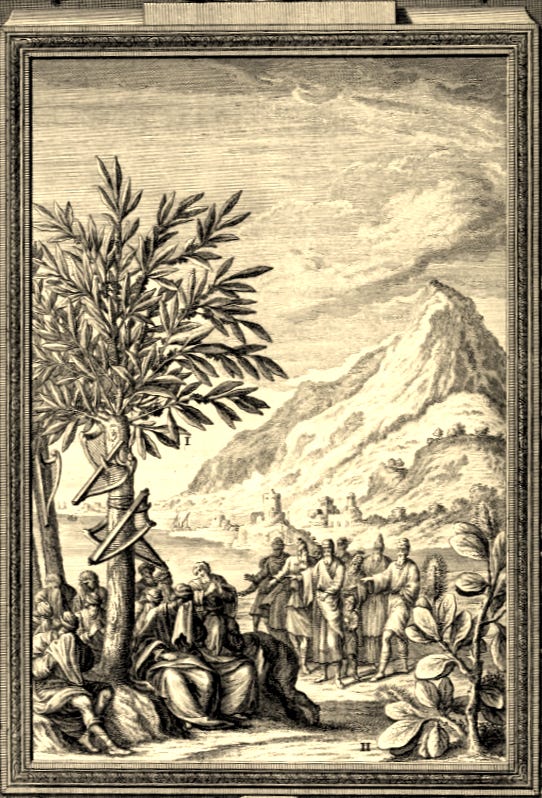

This article continues from Rudbeck the Younger’s 1695 expedition to Sápmi and his failed attempt at the Laponia Illustrata, as told in Part I.

A Golden Bough
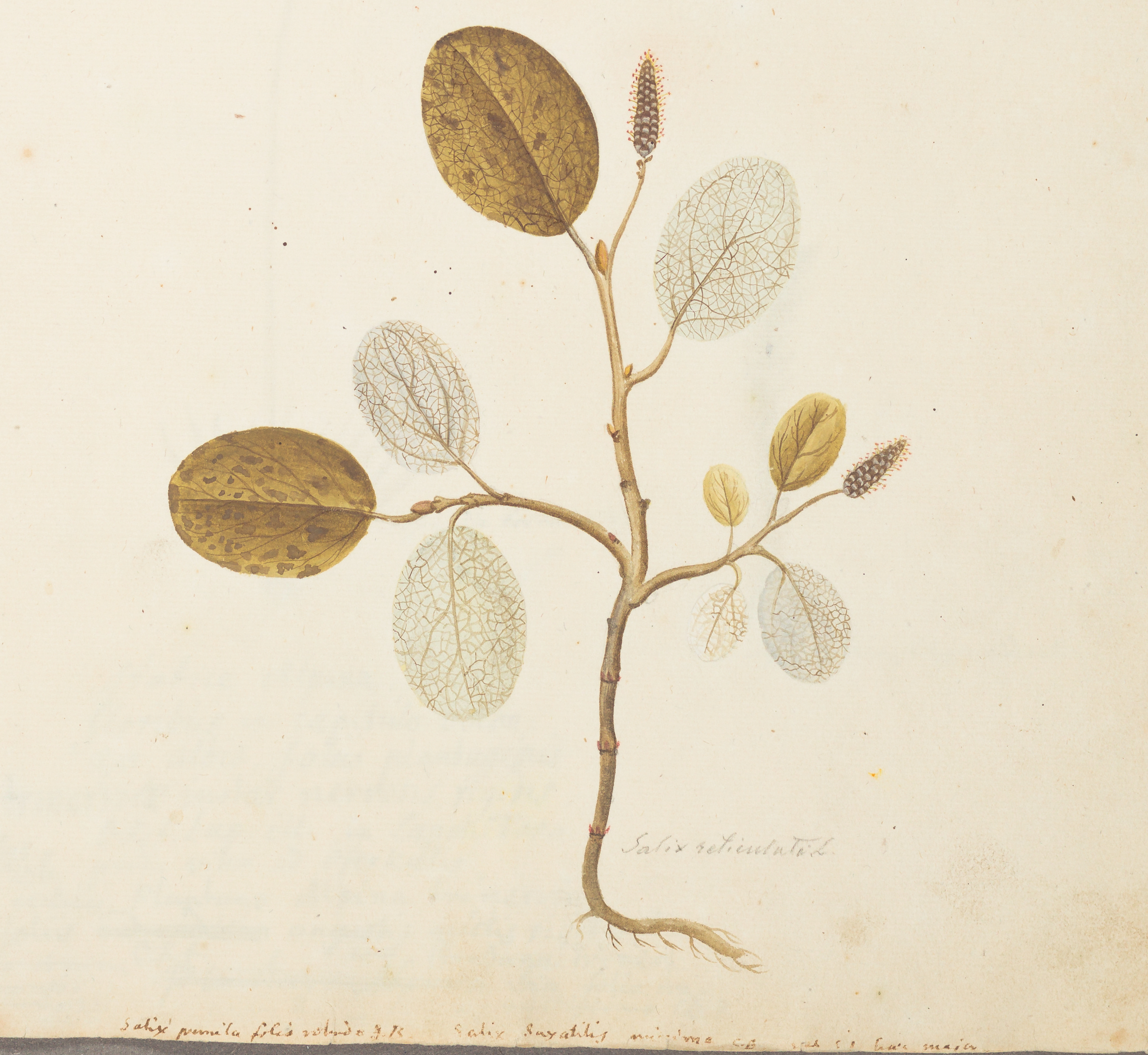
The watercolour drawing was one of hundreds.
The pages in the folio manuscript depicted trees, plants, and animals that Olof Rudbeck the Younger and his draughtsmen had painted on their expedition into Sápmi.
I sought them out at Uppsala on my return from crossing Sarek, exploring what remained from the first expedition sent to its border in 1695.
Little survived the Great Fire that struck seven years later. A manuscript with watercolours, the stub of the Laponia Illustrata, a handwritten travel journal.1
Rudbeck’s notes from Sápmi remained fragmentary. Yet their pages preserve glimpses of the mountains he beheld in Elysian light as he travelled up the Lule River.
On the lower of their barren slopes, Rudbeck found a humble plant, rising to a few centimetres in the fjäll. In the dwarf willow, the paradisiac vision found hold that he projected onto these lands under the Midnight Sun, recalling an ancient author “who wrote that on the Elysian Fields nothing else but salix should grow, i.e. willow”.2
In golden light, Rudbeck described the heart of Sápmi, and it seemed as if some of that shimmer still lingered on the twig drawn more than three centuries ago.
In some of the leathery leaves, the tissue had already vanished. Where it had, a lignin grid still remained, laying bare a network of veins bound to one root – the structure that sustained the living plant.
The Labyrinth
The Great Fire destroyed most of the material from the 1695 expedition. Yet the seed of the vision it inspired persisted.
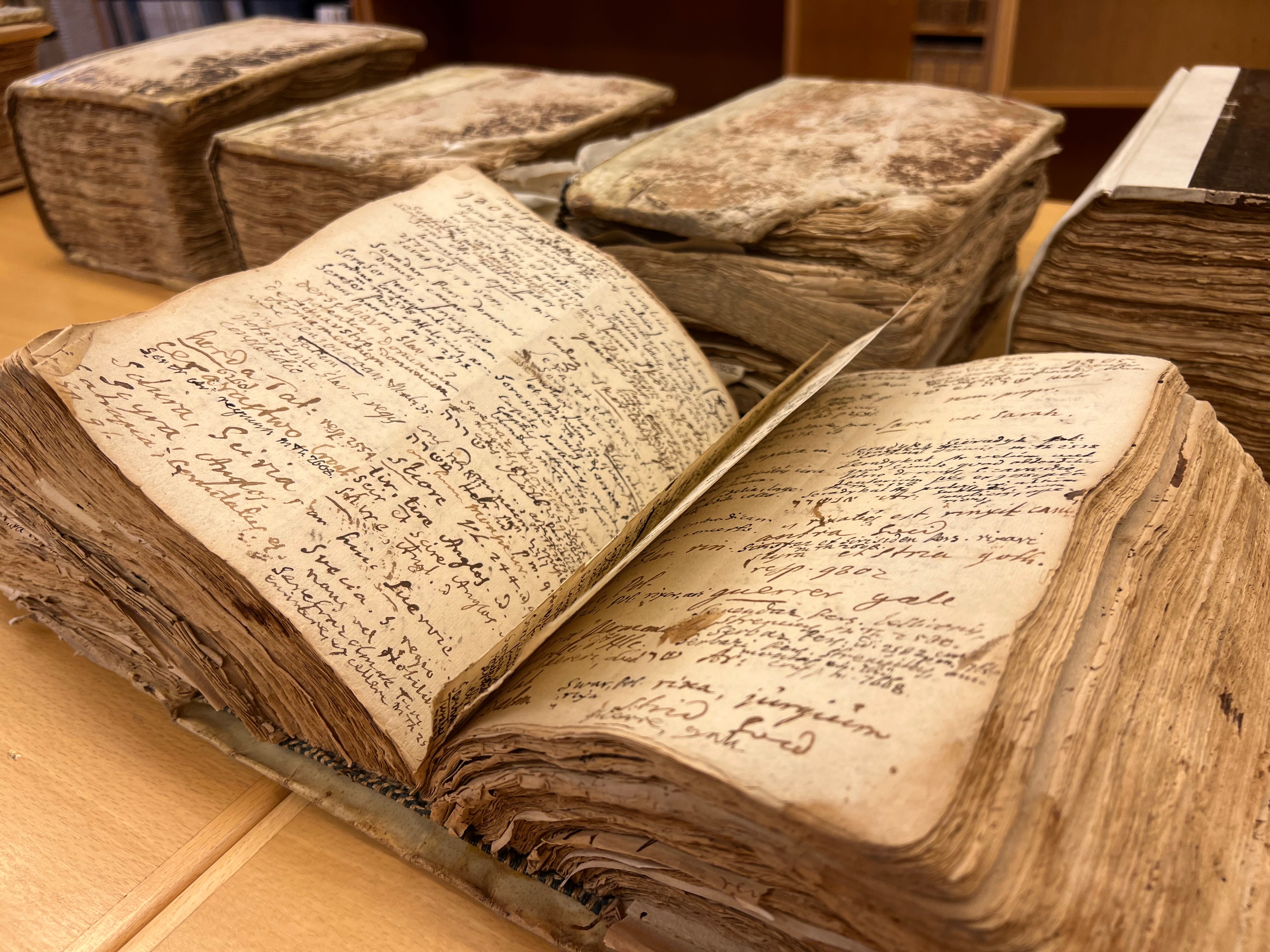
With the watercolours came twelve leather-bound volumes.
Systema Philologicum (‘Philological System’) was the working title Rudbeck the Younger gave the project on which he embarked after the inferno. Across more than ten thousand pages, he explored the structure which, he believed, connected all languages of the world and the creation they described.
Lifetime, coagulated on paper.
The pages of the Systema form the walls of a labyrinth overgrown with notes, connected through side passages and trapdoors, elusive to the gaze of the linear reader.
Rudbeckian terrain is riddled with rabbit holes. The closer one leans over works like these, the more one moves into a thicket of connections and digressions, of brackets opened and never closed – and the greater the risk that in mere describing, one mimics the very structure that informs their pages.
I am no stranger to these lands, and writing about the grand works of the Rudbecks, father and son, is incomplete without acknowledging the pitfalls of wandering on such ground.
In deeper folders on my hard drive lurk unfinished documents covering hundreds of pages – the results of early foraging, in search of a structure to tell the story.
Lifetime, coagulated in bytes.
Stumbling is inevitable on Rudbeckian terrain. And yet I would not have wished to venture elsewhere.
On some days, I do return to Uppsala to take a stroll in the labyrinth.
The Vision Collapses
The Systema became Rudbeck the Younger’s second attempt at a grand work of his own – an overarching master narrative evolving from his father’s Atlantica.
The journey to Sápmi in 1695 laid the groundwork for such a project. Under the title Laponia Illustrata, he announced a work in twelve volumes that would unfold a ‘history of everything there is in the north’.
In the flames of 1702 perished the materials for all forthcoming volumes, together with his collections from Sápmi.

Before the fire, only one volume of the Laponia had appeared in print.
Already in that book, Rudbeck had made use of linguistic speculations as a signature mode of reasoning. They featured in the lengthy digressions he wove around names and beings, such as ‘Charon’ (whom he associated with the ferryman over the Dalälven) or the birds he saw and shot on the further journey north.3
Hebrew as well as Sámi formed central points of reference in these speculations.
There was a kinship he believed to be manifesting before his eyes, between the people Rudbeck encountered in the north and the Bible, in whose language he was educated through Johannes Kemper.
In a linguistic work that he announced as his Lapo Hebraeus (‘Hebraic Sámi’), he wanted to explore this kinship further.4
Slash and Burn
The loss of collections from 1702 was traumatic. And yet, the year after, Rudbeck the Younger was able to see a silver lining.
At least, this is the tone he strikes in a letter written in 1703.
After he had returned from a sojourn in England, Rudbeck wrote to Oxford professor John Wallis. In its lines, he framed the inferno of Uppsala within the Scandinavian tradition of svedjebruk (‘slash-and-burn’). This practice, he explained, was so deeply ingrained into Swedish agriculture that his father had even related the name of Sweden itself to it.5
“There is that old principle about Swedish soil (Svidland) that it is fertilised through fire, and that it yields a harvest which by far exceeds the seeds entrusted to it when the surface of this land, covered with trees, bushes, and grass, has been turned to embers and ashes. The same principle, so I realise, now comes to my use, because after raging Vulcan has destroyed many things that I had gathered on this subject in previous years, my ‘Sámi’ and my ‘Swede’ have now arisen much fresher and eager when I approached this work after my return.”
Rudbeck the Younger, Letter to John Wallis (23 June 1703) 6
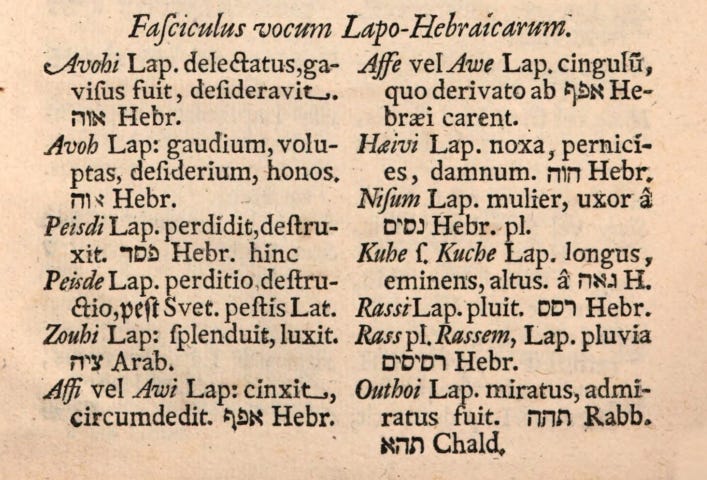
With the letter, Wallis received a taster of ‘The Hebraic-sounding Sámi in the North’. It included a list of words that suggested parallels between Hebrew and Sámi language.
Going Radical
With his collections gone up in flames, tracing linguistic connections became Rudbeck’s key method of reasoning.7
A guiding principle was borrowed from the three root letters that form a semantic nucleus in Semitic languages. In Hebrew or Arabic, the same sequence of radical letters – for example k-t-b – appears in verbs related to writing, or in nouns such as “writing”, “book”, “letter”.
In these languages, Rudbeck argued, the radicals and their pronunciation had changed over time and due to external factors.8 Yet beneath, there still was an underlying kinship – a harmony, as he dreamed, that was not limited to the languages of the East.
As Rudbeck the Younger ventured, comparative studies opened up a way back to a ground that once was common to all languages – before the traumatic event unfolded that the Bible describes as the Confusion of Tongues at Babel (Gen 11:1–9).
It was an accepted fact that languages had ramified and shifted ever since the Fall of the Tower of Babel. However, as Rudbeck the Younger argued, there remained echoes of a stable grid beneath their surface.
That original harmony between words and nature, he reasoned, still was operating beneath the languages of the East – but also those of the West and even the North: on the outer margin of the Swedish kingdom, Rudbeck believed he found the Sámi speaking in Hebraic forms.
Sweet Speculations
A key idea guiding Rudbeck’s efforts had been that ancient traditions – the Bible and the myths of Elysium alike – pointed to a reality still preserved in the High North of Sweden. After the material basis of his Laponia had collapsed, linguistic reasoning now advanced to the crown witness in the same case.
The epiphany of a kinship he saw between Sámi and Hebrew, as communicated to Wallis, left Rudbeck the Younger in high spirits and launched his new projects forward.
However, not everybody joined in his enthusiasm. Contemporaries expressed concerns that Rudbeck began to lose himself in lofty speculation.9
His father’s Atlantica had not been void of bold etymologies, too. Yet Rudbeck the Elder still had made an effort to anchor his elaborations on classical myth, on Sweden’s early history, and on promised landscapes in the north in tangible realities – in its mountains and rivers, its plants and animals, its earliest ruins and in antiquities.

His son, however, more and more detached from this ground: instead of teaching his assigned subjects, the naturalist entangled himself in linguistic speculations.
More than a decade later, Rudbeck announced the fruits that had grown from his flights of philological imagination. In his 1716 Thesaurus linguarum Asiae et Europae harmonicus (‘Harmonic Thesaurus of the Languages of Asia and Europe’) he presented the first outline of a monumental work.
With the brief treatise, Rudbeck advertised nothing less than an archaeology of the world’s languages. Digging down into their soil, he arranged words in closeness to a divine harmony between nature and languages that he still saw inscribed into them. The motivation for this enterprise, the author writes, was not political but spiritual:
In this matter, my considerations will not pertain to the dignity of nations and peoples; for I devote all my strength solely to this purpose: that I may spread the glory of God everywhere and that I restore the truth, as if dug out from its hiding places, to its former brightness. 10
With his Thesaurus, Rudbeck the Younger exemplified an architecture he believed capable of carrying such a work. In folio format, he planned to unfold the harmony connecting languages and nature.
The structure to support this load was a system of root letters. Underneath such radicals, he would present related words from several dozen languages. Wherever the necessity arose to draw on details of Natural History, antiquities, and so on, such realia, too, would be woven in into the work.
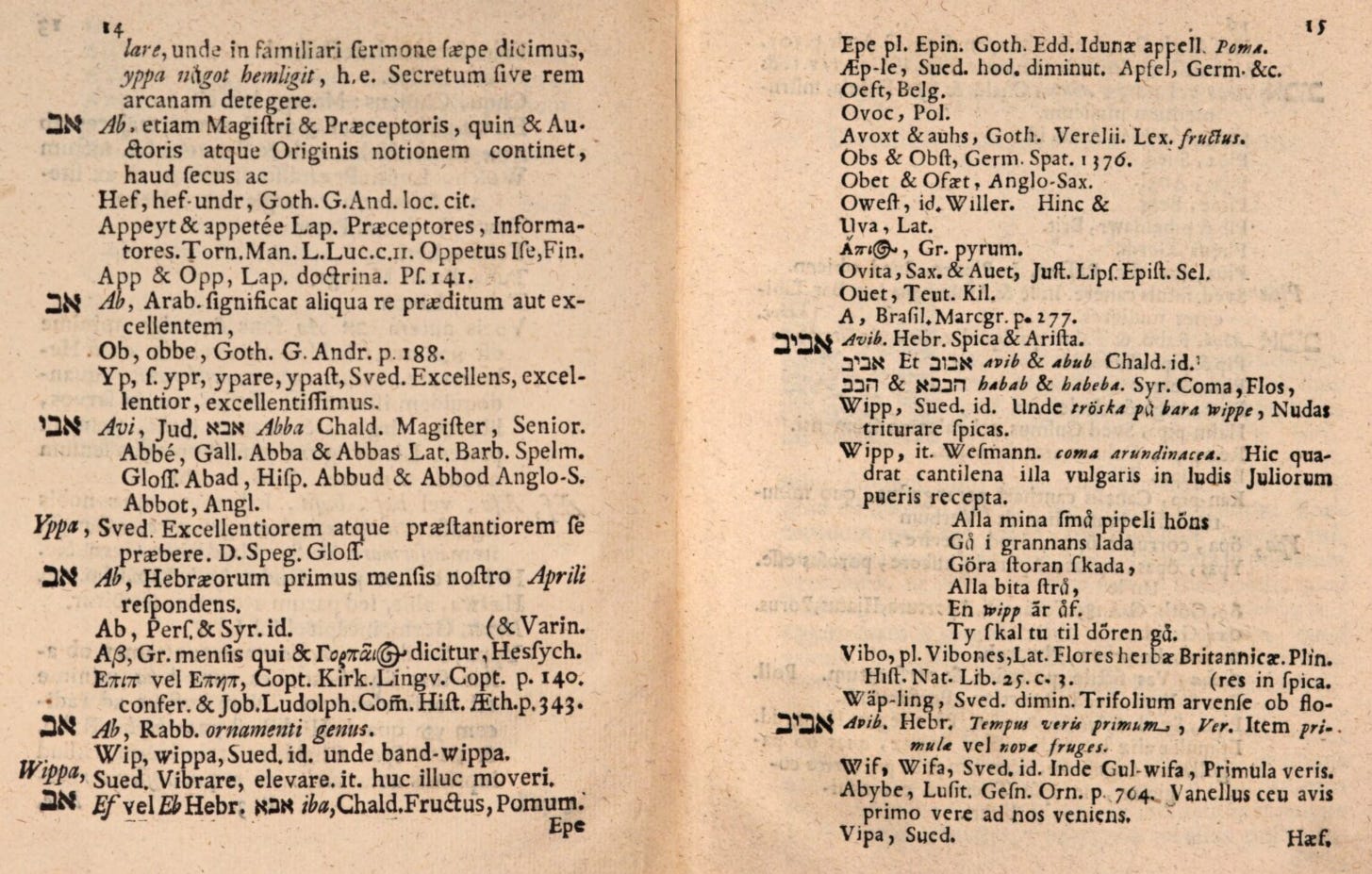
Preparations for the work, Rudbeck explains in the Thesaurus, had already grown to a collection of working notes that spanned beyond 11.000 pages. The final work would be complemented by treatises in quarto format, covering dedicated topics such as fish, birds, plants, animals, or minerals illuminating passages from the Bible whose nature so far had eluded scholars – a topic he had explored in works already printed or claimed forthcoming.11
Reality Strikes Again
From the ashes of the ill-fated Laponia, a linguistic project thus had flourished, realising his original ambition in new form. A series of publications was forthcoming, worthy to mark his memory and living up to the original idea of a ‘History of Everything’.
At least, so was the plan.
No part of the Systema ever appeared in print.
The sample that Rudbeck presented in his 1716 Thesaurus did not make it beyond the first few radical letters. Once again, a Rudbeck project stumbled after the first steps.
Already in his Thesaurus, the author hinted at the challenges he was facing.
Since the catastrophe at Uppsala and his father’s death, the political landscape in Sweden had changed. War was raging in the Nordic regions, and King Charles XII absent on battlefields in the east. At home, the kind of patronage that had sustained Rudbeck the Elder’s works was dwindling.
As a father of a family, Rudbeck the Younger writes in the Thesaurus, he can’t muster the means to privately finance the printing. For that reason, he resorted to recent practice in European publishing, asking printers to contact him if they were interested in moving the publication of his Systema plus the complementary treatises forward.12
Rudbeck’s Thesaurus came as a call for support to the learned world, advertising what he had in the pipeline.
His appeal, it seems, fell flat.
What remains are thousands of crammed manuscript pages – decades of a lifetime spent shoring up against the ruins of Babel.
At the End of the River
The trees around the Carolina Rediviva carried a hue of autumn when I returned to Rudbeck’s labyrinth. From Sarek I had brought my Ariadne’s thread: the humble willow that Rudbeck, drawing on an ancient authority, made shimmer in Elysian light.
Who was that writer?
I followed the question into the manuscripts.
Aravá (עֲרָבָה) is the Hebrew word for the tree, and as if holding tight to this branch, I stepped onto Rudbeck’s riddled ground.
On the inside of the leather covers I found small paper slips. On them, the names of readers who once signed for consultation. A few of them were still blank.
Page by page, I wandered across the etymological field – salix – sälg – selig – heilig – that the author wove around the willow in his 1695 journal, following references to trees with similar “roots”, such as those mentioned in works on the botany of Brazil and Ethiopia, or in the pilgrims’ journeys from the Holy Land; read notes from Rabbinic works on the use of willow twigs in the celebration of Sukkot.
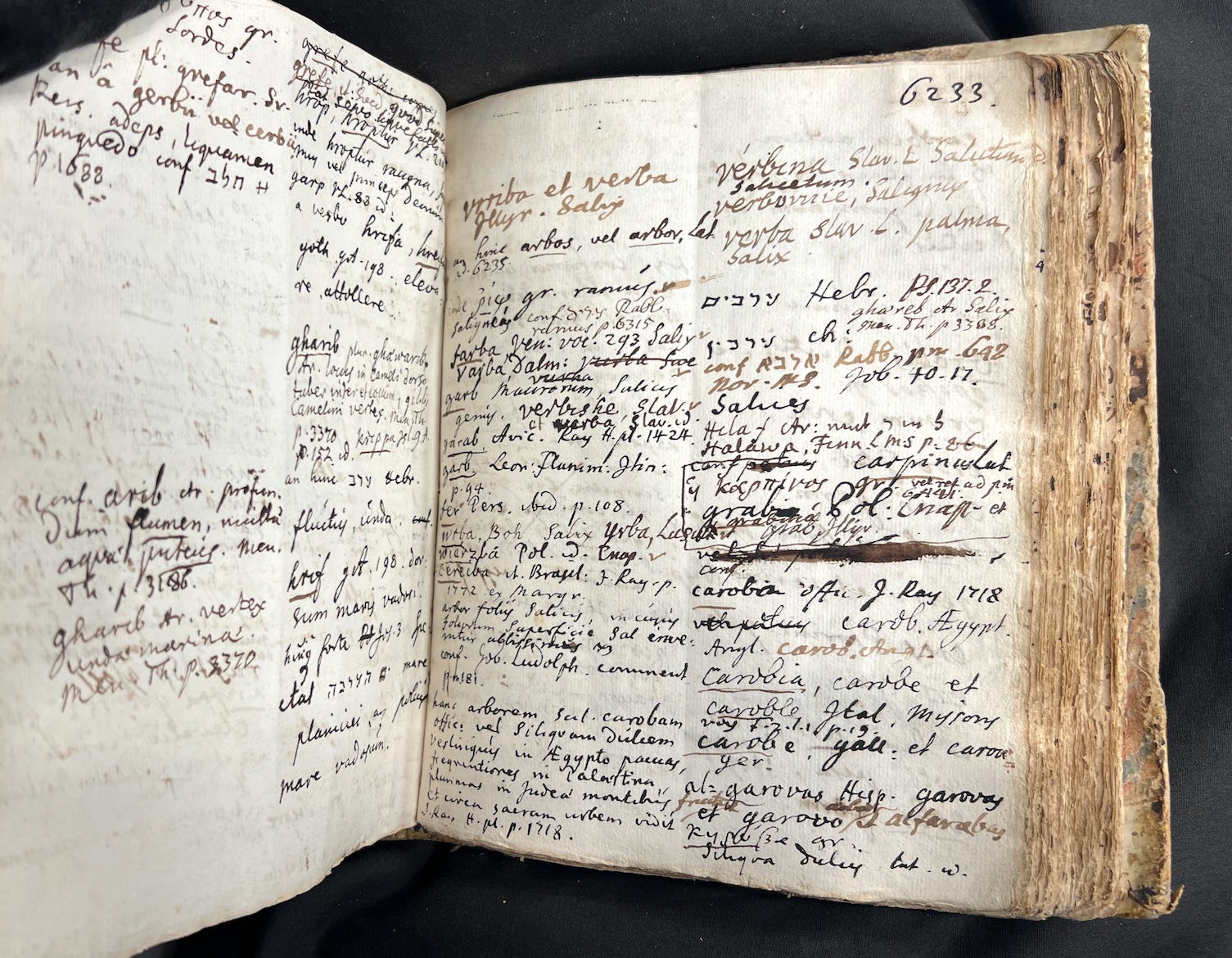
Yet among all the volumes, I found no trace of the ancient authority Rudbeck may have had in mind. Two decades after he had riffed on the Elysian willow, so it seemed, the mythical shimmer in which he once saw this plant shine near the headwaters of the Lule River had faded.
Did the Fire of Uppsala leave the undergrowth of his vision charred – the dream of finding the promised lands of the Bible in the north?
The threads Rudbeck later spun around the willow did not lead back to promised lands. They led to exile instead – to the memory of a harmony that once was real, yet that, despite all efforts, could not be struck again:
“By the rivers of Babylon
we sat down and cried
as we remembered Zion.Upon the willows there
we hung our harps.”Psalm 137: 1–2 13
Further Reading and References
All photographs and translations are my own unless noted otherwise.
Instead of the historical Lapo / Laponia in Latin and Lapp / Lappland in Swedish, I use Sámi and Sápmi in my text.
When quoting from Latin sources, abbreviations were silently expanded and orthography lightly adapted to current standards.
Please note the general bibliography available here.
The remaining drawings are collected in the so-called Iter Lapponicum. Online at alvin-portal.org (alvin-record 162152).
The remaining portion of the journal is published as Olof Rudbeck the Younger, Dagboken, in: Iter Lapponicum. Skissboken från resan till Lappland 1695, vol. II, ed. by Tomas Anfält, Stockholm 1987, 28–59.
For the full quotation see Rudbeck the Younger, Dagboken, p. 46: “Och skall något trä på de lägre wäxa, så är det intet annat än Salix pumila, den lilla sälg, whilket deras meningar som här nor åth sätta Elysios campos, eller de lyse ängar, intet lite styrker, särdeles effter en gammals hafwer skrifwit att på lyse engarna intet annat skulle wäxa än salix, det är sälg. Warandes det latinska ordet salix tagit av wårt sälg eller salig, beatus, eller i hopdragit af det ordet sol och helig, emedan sälg är ännu hos lapparna soln helgad. Ty här hafwa de lycksaligas boningar fordom warit och ännu Gudi lof äro, effter Prophetens ord: Guds ande skall hwila sig i norden.”
Already his father pursued the idea of Elysium in the North; see the article Threshold to Elysium.
See Olof Rudbeck the Younger, Nora Samolad sive Laponia illustrata, Uppsala 1701. Online at alvin-portal.org (alvin-record 103033), p. 33.
See Rudbeck, Atlantica, vol. I, pp. 633.
The letter was printed as part of Olof Rudbeck the Younger, Thesaurus linguarum Asiae, Uppsala 1716, fol. A2 [r]: “Et sicuti ea alias terrae Sveticae (Svidland) est ratio, ut igne foecundetur, atque ubi superficies ejus arboribus, fruticibus atque herbis consita, in favillas et cineres redacta est, semina sibi commissa largiore longe proventu reddat, ita idem mihi nunc usu venire deprehendo, quod postquam Vulcani furore haud pauca, quae in hanc rem superioribus annis congessi, deleta sunt, nunc cum postliminio ad hanc memet composuerim operam, alacrior multo et vegetior mihi resurrexerit et Lapo et Svedus”.
See Stefan Bauhaus, Olof Rudbeck der Jüngere und die Sprachen des Nordens. Zwischen Gotizismus und Orthodoxie, Berlin 2019.
See Rudbeck the Younger, Thesaurus, p. 3.
This discussion escalated in the context of an academic consistorium at Uppsala in 1705, where Rudbeck the Younger was reproached for the speculative nature of his linguistic studies. The conflict is paraphrased in Claes Annerstedt, Upsala Universitets Historia, pt. 2: 1655–1718, Uppsala 1908, pp. 357f.
See Rudbeck the Younger, Thesaurus, p. 5: “Ad dignitatem autem nationum ac populorum, nihil profecto hoc in negotio respiciam, quandoquidem in id cunctis viribus unice incumbo, ut Dei gloriam ubique progagem et veritatem e suis veluti latibulis erutam, pristino nitori reddam.”
See Rudbeck the Younger, Thesaurus, pp. 5–7.
See Rudbeck the Younger, Thesaurus, pp. 7f.
The biblical schoalrship of the 17th and 18th centuries contain rich discussions sparked by the opening of this Psalm and the respective trees (עֲרָבִים). From these see the following selection:
Olav Celsius, Hierobotanicon, Uppsala 1743, vol. 1. pp. 304–8 (digitized by Österreichische Nationalbibliothek).
Johann Heinrich Ursin, Arboretum Biblicum, Nuremberg 1663, cap. 12 (online at Google Books).
Johann Jakob Scheuchzer, Physica Sacra, vol. 2, Augsburg–Ulm 1732, ad Psalm 137: 1-2 (online at archive.org).