

Threshold to the Labyrinth
In the librarian’s eyes I caught a note of pity.
At the counter I had taken hold of the book trolley: a wooden frame carrying twelve manuscripts, their leather covers lifted to almost cubic proportions by thousands of pages. Like baleen, they held the trawl of a scholar’s dive through worlds both material and immaterial.
Pushing the shelf-meters across the Special Reading Room, their weight felt more than physical. The remains of the Systema Philologicum radiate the gravity of an idea that drew an author in – or should I rather say, down?
A wanderer in the intellectual thickets of Rudbeck father and son, I am no stranger to that sensation. There is a sympathy I feel for these authors – something that lures me onto their paper trails, closer to the core that kept them going in their quest to unfold ways of seeing that made visible the kinship connecting the tangible and the intangible worlds – and the code that might still shimmer through their fabric.
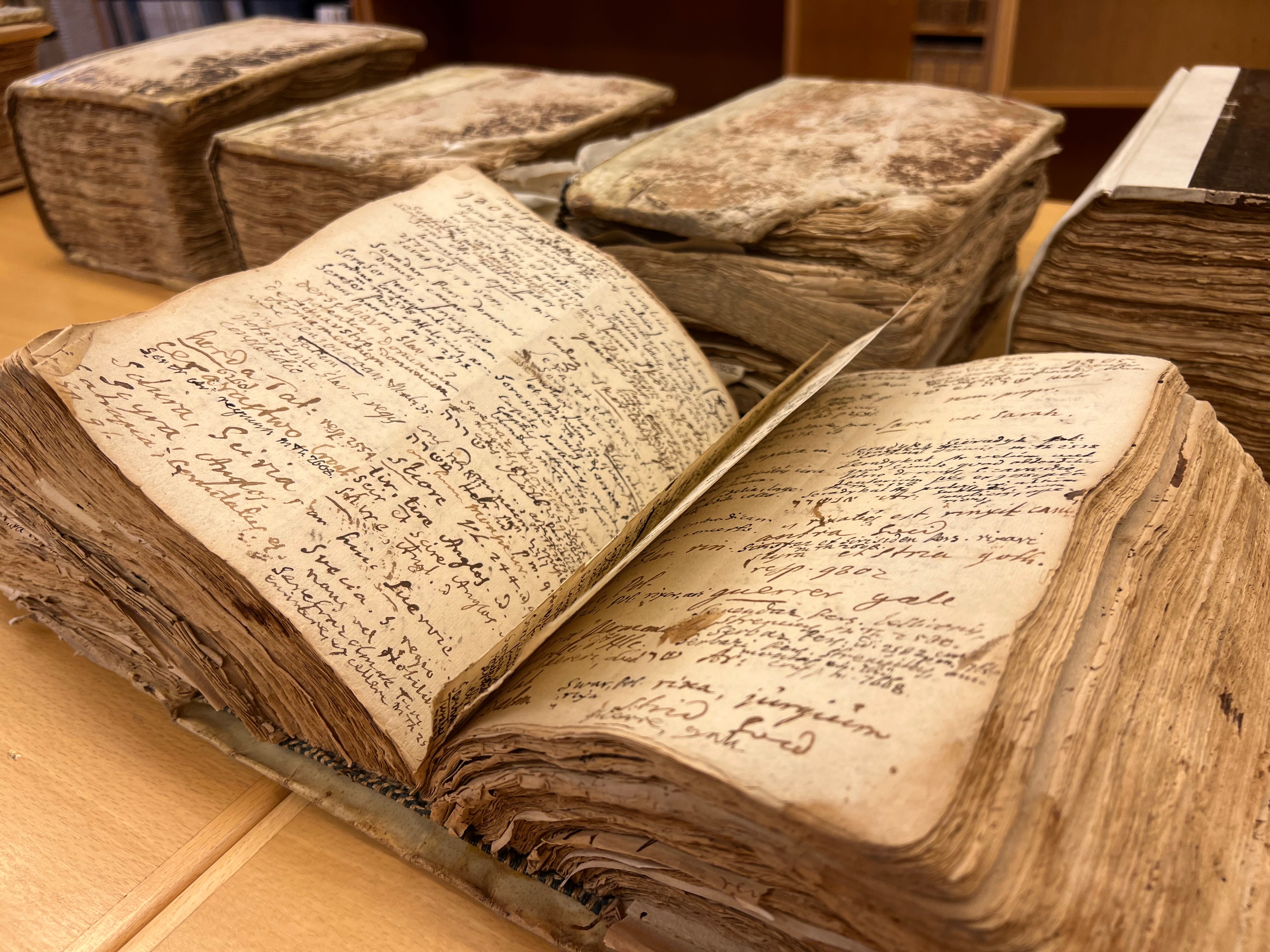
A contagious aura surrounds works like these that I have made companions in travel and writing. Over decades, they were accumulated by scholars meticulous in observation and boundless in association – convinced that every detail deserves its meaningful place within a system they felt called to create.
The Systema of Olof Rudbeck the Younger is the utmost extension of such an ambition – one that arcs across a scholar’s life. Its force still speaks from the remains in which it found expression, and the traces of its pursuit still pose a question:
What idea drove men to exhaust their lives in works like these?
Curling Parents
The answer leads far from Uppsala – on a journey to the north of Sweden. At the beginning stands an expedition into the heart of Sápmi – the land of Indigenous peoples in northern Scandinavia.
“Now my son Olof Rudbeck has a great desire to travel [to these most distant regions], to have drawings made of all those places that are not found here below, or in other places – as well as of various kinds of birds that come there in summer from the south and are not found here, but in winter depart again on their course – and also of other animals, both those on land and in the water, so that one might obtain a proper history of everything that exists here in Sweden and in the northern regions.”
Olof Rudbeck the Elder, Letter to Bengt Oxenstierna 1
With these words, Olof Rudbeck the Elder wrote to the Swedish chancellor in April 1695. The day before, he had learned about a scientific expedition the king planned to send towards the Arctic Circle. Its purpose was to measure the phenomenon Charles XI himself had personally observed the year before from the bell tower at Torneå – the sun that does not set for an entire day.

As soon as Rudbeck had heard about the astronomers’ mission, he suggested a natural historical corollary. Sending out a second expedition, he argued, the king would lay the foundation for a “History of Everything” of Sweden and its North.
Such a project was of national interest, he pointed out, placing the kingdom on par with natural histories written in other European countries at the time.2
The proposal found favour with the king. A royal bursary for his son was forthcoming.
It wasn’t the first time Rudbeck the Elder paved the way for his son’s career.3 After formative years in Holland, Rudbeck the Younger was already designated to follow his father as professor of medicine at Uppsala. As an aspiring botanist, he contributed substantially to the family’s Campus Elysii project.
In 1695, Rudbeck the Elder placed his naturalist son on a trajectory north, on which the 35-year-old would soon emerge with a major work – a ‘history of everything that exists in the northern regions’.
At least, so was the plan.
Towards a History of Everything
On 22 May 1695, a second expedition left from Uppsala, a day after the astronomers Johan Bilberg and Anders Spole had left. The travel party led by Rudbeck the Younger included the two painters Andreas Holtzbohm and Olof Thelott, the noblemen Jacob and Carl Gyllenborg, sons of the governor of Uppsala, and an unknown number of servants and assistants.
Bilberg and Spole made haste to reach Torneå in good time before the summer solstice. Rudbeck and his team travelled at a slower pace instead. All along the way towards the north, they filled notebooks with observations and sketchbooks with drawings of plants and birds.4
Their experience of the landscapes to the north (or more precisely: their later presentation) was informed by the mythical vision that Rudbeck the Elder had laid out in his Atlantica.
Traditionally, the Dalälven River is considered the border to Norrland – the ‘Land of the North’. Along its rivers, Rudbeck the Elder argued, opened the landscapes that ancient poets remembered as Elysium.

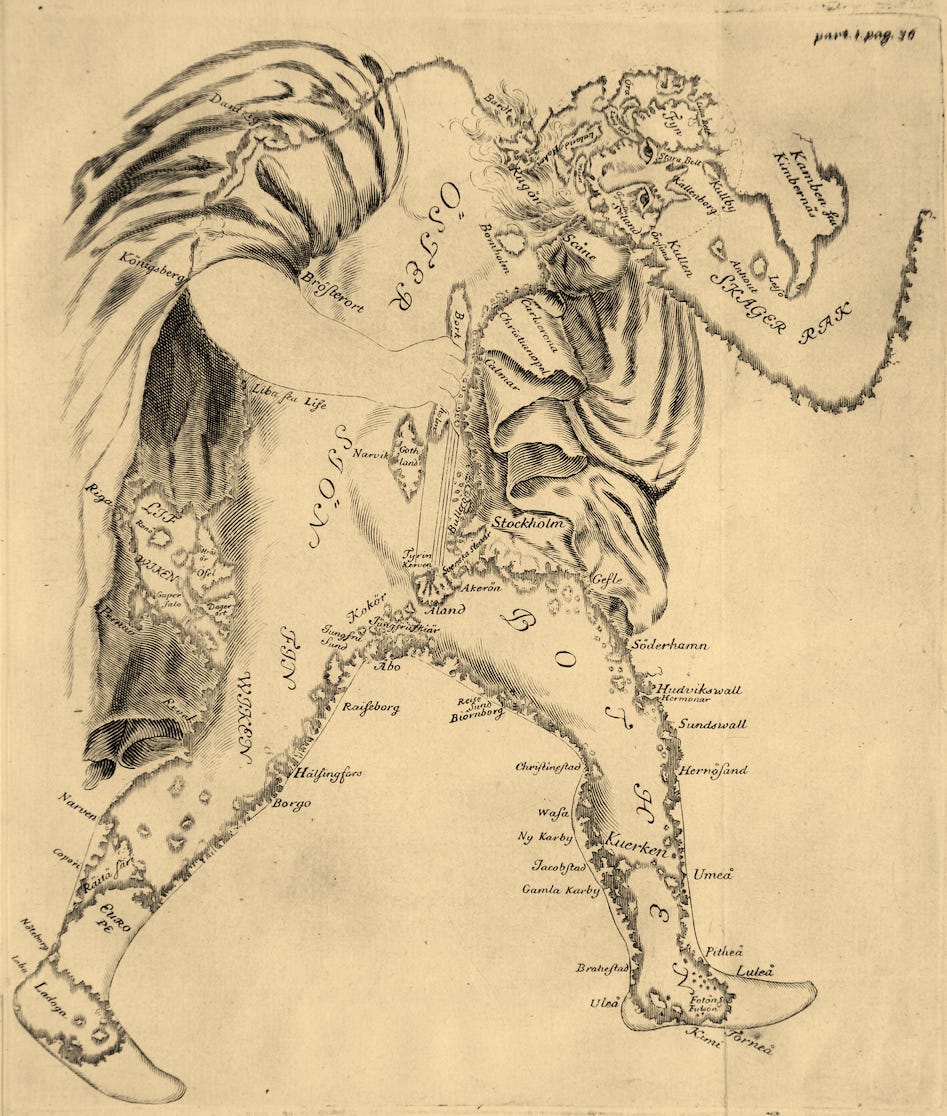
His son describes the first encounter with this river in his later travel account. White water foamed on the raging Dalälven. Along its banks, an elderly man waited to ferry them over. As Rudbeck the Younger writes, his ramshackle float and his features, furrowed by age, prompted associations with Charon from classical myth. Right after, he quoted verses in which Vergil described the ferryman to the underworld.
What follows from Charon illustrates a style of reasoning prevalent in Rudbeck’s works. Over dozens of pages, the author dissects the ferryman’s name, riffing on its syllables and the connections he saw extending from it across various languages (including Sámi, where kaarid according to his presentation meant to be held in a spot against one’s will).
Embedded in this semantic cloud, ‘Charon’ becomes a hinge of meaning prefiguring his role as gatekeeper to paradise and hell in myth – a trail which the author even follows into God’s perspective. The features Vergil describes for the ferryman Rudbeck ultimately finds in the outline of the Baltic Coast, the body of water to be crossed on the way towards Elysium in Sweden – and all along whose shore even the names of places resonated with features of the Baltic Charon.5
Elysium Beneath the Midnight Sun
A few days before midsummer, the Rudbeck party reached Torneå. Near the mouth of the Torne River, it united with the other expedition from Uppsala.
From the northernmost tip of the Baltic Sea, they observed the sun that does not set over the Torne Valley – the astronomers from the bell tower, and Rudbeck the Younger climbing the sails of a windmill further upstream.6
In the days that followed, the two parties continued up the river. Its rapids inspired awe in Rudbeck the Younger, as did the skills of the men who steered his party in long boats up the river. Then there were the hills along its banks, which had already attracted his father’s interest.
Already in 1687, he had an expedition sent up the Torne Valley. Through his men, Rudbeck the Elder learned of the elevations along the river, later fashioning them as early observatories of the Atlantean astronomer kings.
The stories the boatmen shared about the hills along the Torne Valley sparked the son’s interests as well. Around Luppiovaara and Aavasaksa, the Sámi told him, the sole survivors of a great flooding once had stranded. And there was more: remains of the keel, they said, could still be seen.
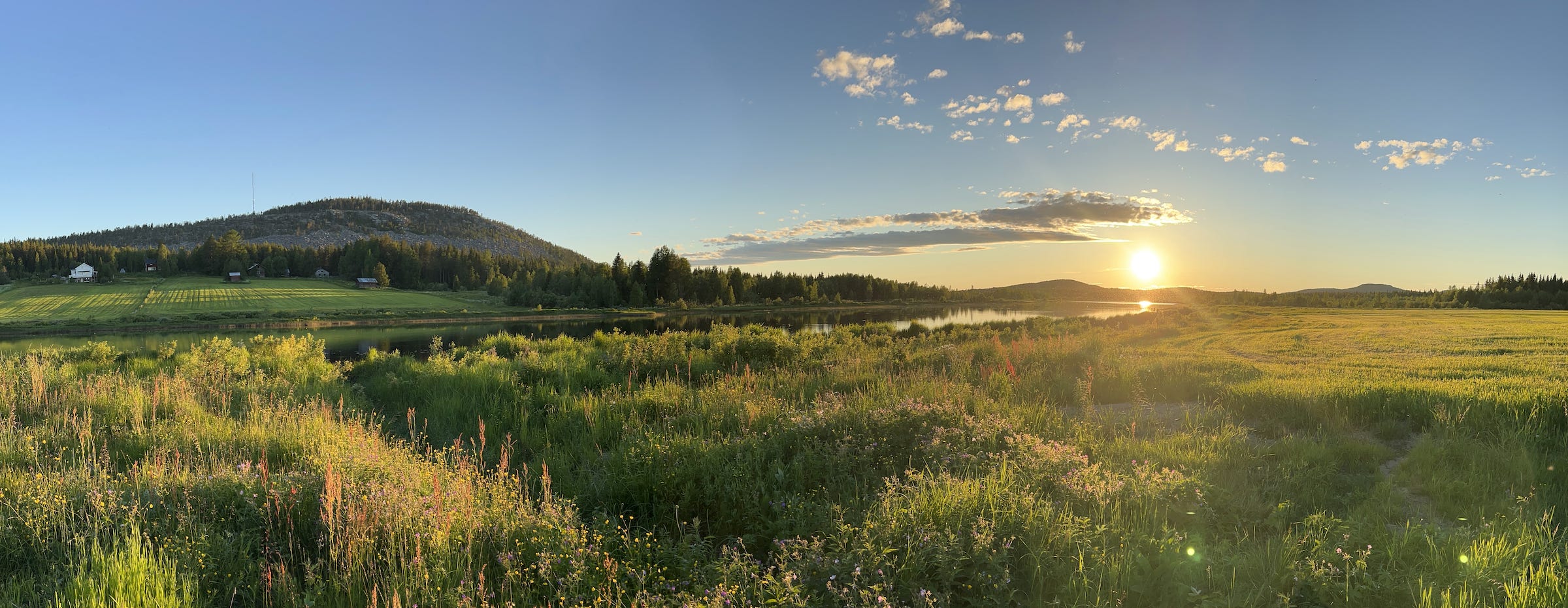
As Rudbeck the Younger suggested in his later account, there was a meaningful connection on a linguistic level between ‘Lupovara’ (his spelling) and ‘slup’, a type of boat. However, the stories of physical traces he discarded as being of little worth.7
Eventually, the expeditions reached the headwaters of the Torne River. From this northernmost point of their journey, Rudbeck the Younger and his men returned to Torneå. From there, the astronomers headed back to Uppsala to publish their results.
Rudbeck’s team embarked for Luleå instead. From the mouth of the Lule River, they continued upstream into Lule Sápmi.
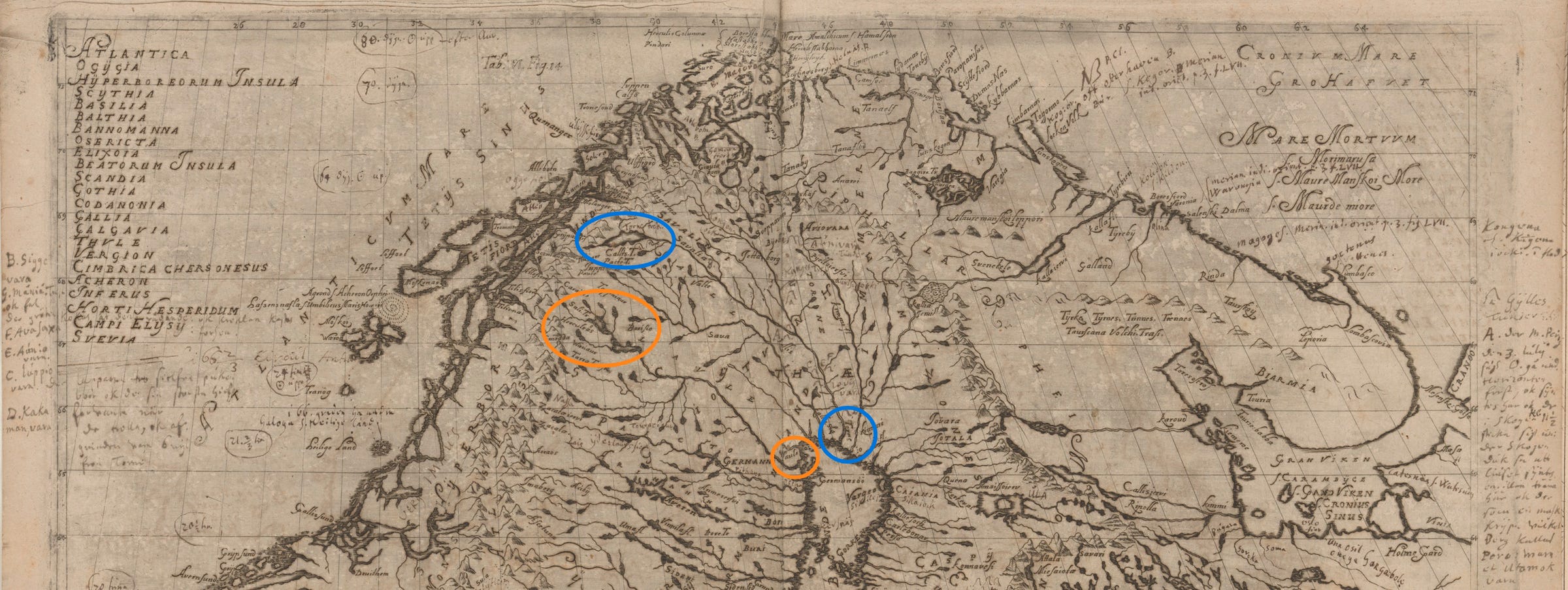
Adding a second leg to their expedition, the men ventured up to the region around Kvikkjokk. All along the Lule River, Rudbeck the Younger cast out the net for his ‘History of Everything’. In the heart of Sápmi, he collected notes on animals and herbs, on shells and pearls, on the course of the water. Near the border to Sarek – the most alpine region of Sweden – he noted observations on the Sámi and their way of living.
The mountains – their form, the age of snow, their vegetation – attracted his deep attention. Everywhere along the river, Rudbeck the Younger writes, the fjäll lies in sight with patches of white. The shape of the mountains rose gradually and gently, striking him as different from the sharply pointed panoramas that he had seen in travel journals from the Alps.8
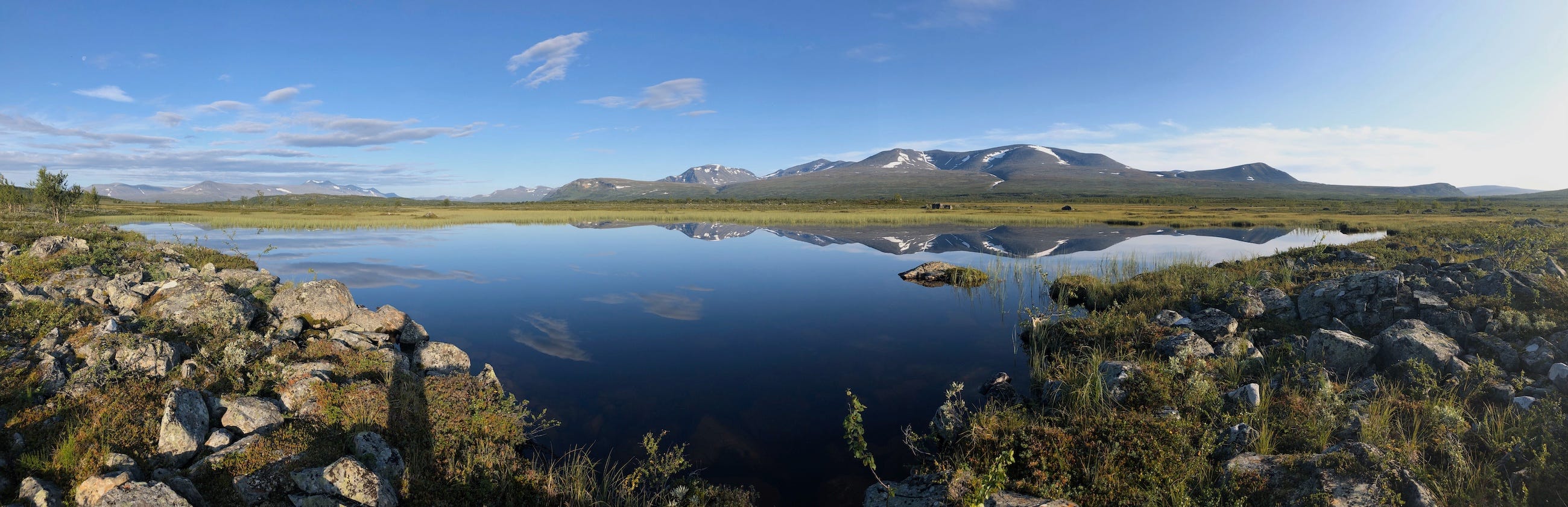
The fjäll were barren mountains, he writes. Yet on their lower slopes he still found a tree growing – the net-leaved dwarf willow. This humble tree Rudbeck fashioned into an anchor for the vision of a promised land unfolding before him under the midnight sun, along the banks of the Lule River – lands he believed were prefigured in the writings of the ancients and the Holy Scripture alike:
This strongly supports the opinion of those who locate Elysium here in the North, especially because an ancient author wrote that on the Elysian Fields nothing else but salix should grow, i.e. willow. The Latin word salix is considered to be either taken from our sälg (‘willow’) or salig (‘blessed’), or perhaps contracted from the word sol (‘sun’) and helig (‘holy’), because among the Sámi the willow still is consecrated to the sun. Thus here the dwellings of the blessed have been and, God be praised, still are, according to the words of the Prophet: “The spirit of God shall rest in the North.”
Olof Rudbeck the Younger, Travel Journal 9
Entanglements
With bulging nets, the expedition returned from its haul along the headwaters of the Lule River. Their papers filled with notes and drawings, Rudbeck the Younger’s expedition travelled downstream. In September 1695, the men arrived at Uppsala.
At that time, Bilberg and Spole had almost finished the treatise in which they presented the results from their astronomical observations.
Rudbeck digested the material from his five-month journey at a different pace. It would take another six years until first results surfaced in print.
In 1701, the first volume of the Laponia Illustrata (‘Lapland Illustrated’) appeared. The book was part of a series of twelve that Rudbeck the Younger envisioned.
The first volume takes readers on a stretch covering roughly a hundred kilometres out of Uppsala. Too tempting were the threads Rudbeck the Younger encountered along the way to Norrland.
Occasions for digression appeared all around him. The ferryman at the Dalälven crossing. The wryneck he shot right after crossing the border river. The cuckoo whose call they heard thereafter. A flight of crossbills flitting over the spruces. If the Laponia had a meme, it would be “Oh look – a bird!”.
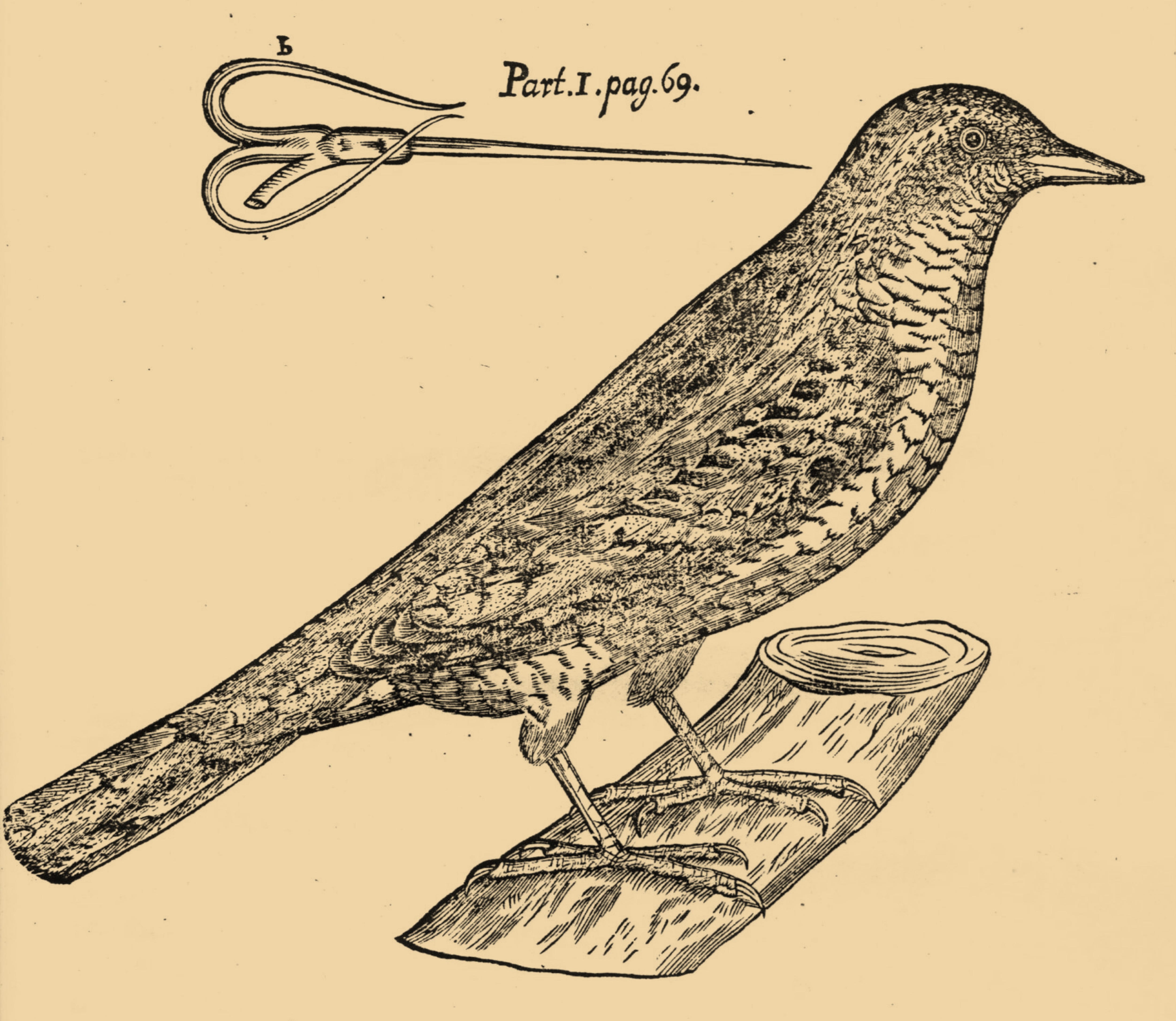
The wryneck motivated a fully-fledged ornithological excursus on the bird also depicted on a woodcut, together with its remarkable tongue. Rudbeck’s elaborations on the cuckoo ended in no lesser a promise than a work describing all birds of the north and depicting them life-size.
In his elaborations on the crossbill, the author ends on a mythical note. He made it seem no coincidence that the Greek had used the name loxia: this was suspiciously close to an epithet of Apollo (Loxias), the God of the Sun – for with its beautiful song, this bird heralded the return of light after winter solstice in Norrland.10
A Portal Opened
Within the first volume, Rudbeck the Younger had hardly tipped into the southern border of Norrland. Already in 1701, such density of digressions may have left his readers alarmed:
How many books will it take if we continue at this pace?
And yet, already the first volume of the Laponia graphically lays out the vision Rudbeck projected on Sápmi.
The book opens with a frontispiece – an engraving that, in allegorical forms, conveys the themes as well as the spiritual vector of his ‘History of Everything’.
An arched rock opens up glimpses of a landscape of pristine beauty, populated by Sámi reindeer herders, their rituals illuminated by the midnight sun.11
To the right of this rock portal, a river descends in cataracts. Stranded on a hill along its course, an ark overlooks the raging rapids. Smoke rises from a group of people on the banks below.
Beneath the scene, a medallion depicts a censer, quoting the biblical verse in which God acknowledged the burnt sacrifice that Noah’s family brought after the flood receded (Gen 8:20–21).
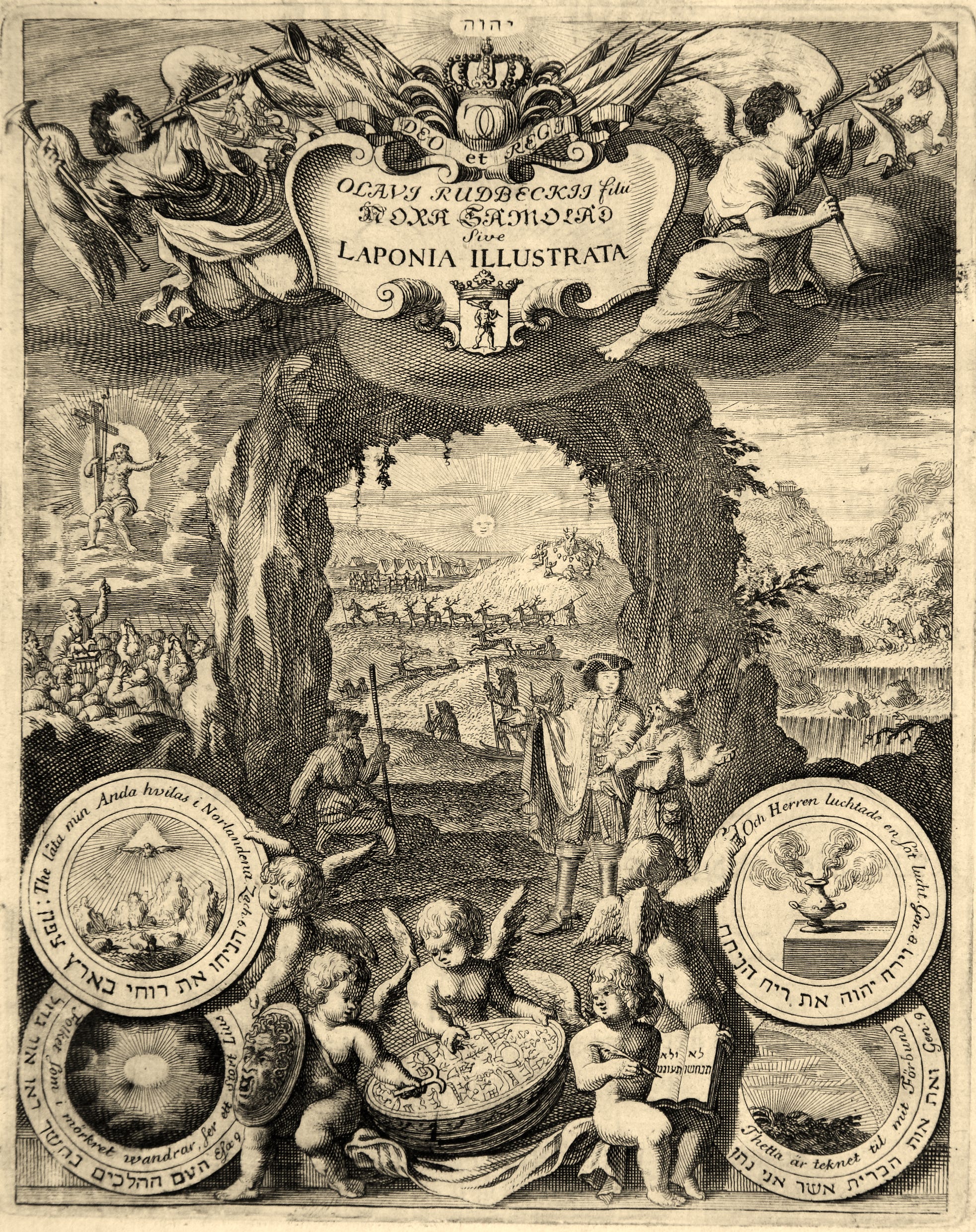
In such imagery, the frontispiece outlined a work in which biblical and classical traditions converge; refracted in the culture of the Sámi and the nature of the North. The Laponia was a portal to this world, and besides the gate opening in the frontispiece rests an elderly man. His features resemble those of the description Vergil gives of Charon, as if waiting at the threshold towards the true Elysium.
To his left, a putto holds a further medallion depicting a dove, the symbol of God’s spirit. The text beneath echoes the biblical verse that Rudbeck had quoted in sight of Sarek – words that let the lands he glimpsed in the summer of 1695 appear as divinely blessed:
“The spirit of God shall rest in the North” (Zech 6:8).
Vulcan’s Toll
With his Laponia, Rudbeck the Younger fashioned Sápmi as a promised land. In the High North, the parallel lines of spiritual and mythological traditions of past millennia seemed to vanish.
Studying its nature as well as Sámi culture and language provided the author with keys to illuminate passages from the Bible whose meaning had remained obscure. In the sacred text, Rudbeck the Younger strived to reveal the presence of the North: in these regions, he argued, one of the lost tribes of Israel had stranded.
In his time, he claimed, direct links to Hebrew traditions still existed. This kinship, as Rudbeck the Younger announced in the Laponia, he strived to further elaborate in a study comparing their languages.
However, it all came differently. The grand vision his Laponia promised to unfold never widened beyond the crack that its first volume had opened.
A year later, the Great Fire of Uppsala put an end to the monumental project. The flames destroyed what the Rudbeck family had prepared in forthcoming works – the father’s Atlantica, the family’s Campus Elysii botanical atlas, the son’s Laponia.

The ashes had hardly cooled when Rudbeck the Younger had to mourn the loss of his collections. What remains are the first volume of the stunted Laponia, the fragmentary pages of the handwritten travel journal he kept, a selection of manuscripts with drawings of plants and birds.
Seeing his attempt at a ‘History of Everything’ physically collapse was traumatic. And yet, beneath the cinders of 1702 still lay the seeds of Rudbeck’s original ambition.
In the decades that followed, they would grow into a new form. Eventually, they filled twelve leather-bound manuscripts – the very volumes that arrived neatly stacked on a wooden trolley in the Special Reading Room at Uppsala.

Further Reading and References
All photographs and translations are my own unless noted otherwise.
Instead of the historical Lapo / Laponia in Latin and Lapp / Lappland in Swedish, I use Sámi and Sápmi in my text.
When quoting from Latin sources, abbreviations were silently expanded and orthography lightly adapted to current standards.
Please note the general bibliography available here.
Olof Rudbeck, Letter to Chancellor Bengt Oxenstierna, 27 April 1695, published in Bref af Olof Rudbeck d. Ä., ed. Claes Annerstedt, vol. IV, Uppsala 1905, p. 355, no. 124 (online at digitale-sammlungen.de): “Nu hafver min son O. Rudbeck stoor lust att resa samma wegh att låta afrita alla de örter, som här nedre ei finnas eller på andra orter, som åtskillige slags foglar, som dit om sommaren komma söder ifrån ok ei finnas här, utan draga om winteren åter sin kooss, förutan andra diur af dem som ofvan iorden ok i watnet äro, så att man en wäl fattat historia kunde hafva af alt som här is Swerige ok der nordan finnes […].”
Ibid.
As a 28-year old, Rudbeck the Younger dedicated his botanical dissertation to the Swedish queen Ulrika Eleonora in 1688. At an audience, he was given the chance to present the queen in person with a copy. When she and her husband Charles XI later visited Uppsala in 1693, he could present his skills as a draftsman of nature to the royal couple.
See Bernhard Schirg, “Phoenix Going Bananas. The Swedish Appropriation of a Classical Myth, and its Demise in Botanical Scholarship (Engelbert Kaempfer, Carl Linnaeus)”, in: Apotheosis of the North. The Swedish Appropriation of Classical Antiquity Around the Baltic Sea and Beyond (1650 to 1800), ed. by Bernd Roling, Bernhard Schirg, and Stefan Heinrich Bauhaus, Berlin 2017, 17–46.
The remaining drawings are collected in the so-called Iter Lapponicum. Online at alvin-portal.org (alvin-record 162152).
See Olof Rudbeck the Younger, Nora Samolad sive Laponia illustrata, Uppsala 1701. Online at alvin-portal.org (alvin-record 103033), 25–65.
Carl Linnaeus, like his teacher Rudbeck the Younger, undertook a journey into Sápmi in 1732. Encountering the ferryman over the Dalälven three decades later still conjured up associations with Charon that Rudbeck the Younger had floated; see Carl Linnaeus, The Lapland Journey, ed. and tr. by Peter Graves, Edinburgh 1995, p. 32.
It is known that Linnaeus used Rudbeck’s information to prepare his own journey. On many occasions, his presentation – textual and visual – informed Linnaeus’s perception of nature; see e.g. his description of the mountains near Jokkmokk in The Lapland Journey, p. 110: “their peaks rose towards the sky exactly as depicted in form and colour on the frontispiece of Rudbeck’s Lapponia Illustrata.”
On this see also Carl-Otto von Sydow, “Linné och Lappland. Hans uppfattning av landet och dess invånare”, Svenska Linnésällskapets Årsskrift 1972–74, 22–71, pp. 32f.
Olof Rudbeck the Younger, Dagboken, in: Iter Lapponicum. Skissboken från resan till Lappland 1695, vol. II, ed. by Tomas Anfält, Stockholm 1987, 28–59, p. 34.
See Rudbeck the Younger, Dagboken, p. 38.
See Rudbeck the Younger, Dagboken, pp. 45f.
Rudbeck the Younger may have had alpine panoramas on his mind that began circulating around the middle of the 17th century through works such as Topographia Helvetiae, Rhaetiae, et Valesiae: das ist Beschreibung und eigentliche Abbildung der vornembsten Stätte […], Frankfurt 1642 (online at e-rara.ch).
Rudbeck the Younger, Dagboken, p. 46: “Och skall något trä på de lägre wäxa, så är det intet annat än Salix pumila, den lilla sälg, whilket deras meningar som här nor åth sätta Elysios campos, eller de lyse ängar, intet lite styrker, särdeles effter en gammals hafwer skrifwit att på lyse engarna intet annat skulle wäxa än salix, det är sälg. Warandes det latinska ordet salix tagit av wårt sälg eller salig, beatus, eller i hopdragit af det ordet sol och helig, emedan sälg är ännu hos lapparna soln helgad. Ty här hafwa de lycksaligas boningar fordom warit och ännu Gudi lof äro, effter Prophetens ord: Guds ande skall hwila sig i norden.”
For the quotation from the Bible see Zech 6:8. It reappears in the frontispiece discussed in this article. Rudbeck’s party drew dozens of specimens from the salix genus, suggesting the spiritual dimension he sought in these plants. You can follow this trace in the second part of this article.
For the ornithological digressions see Rudbeck the Younger, Laponia Illustrata, pp. 65–77.
The role of the Sámi seems limited to extras in Rudbeck’s projection of pristiness still preserved in the North. Many depictions are taken straight out of Scheffer’s 1673 Lapponia, placing Sámi in stereotypical roles that comprise skiing (in summer), incantations with drums, and worshipping idols under the midnight sun.