


Crossroads
No backseat in the car, I finally understood the gesture.
The teenagers in the front of the station wagon had smiled but shrugged their shoulders. Lowering my thumb, I watched the car creep by at throttled speed. The whole rear section had been converted into a stereo, I noted as the EPA-traktor passed.
Long after the warning triangle on its rear had disappeared behind the bend, the thumping from the loudspeakers still reverberated on the wind.
Pretty bassy for a castrato, I thought.
Yellow leaves tumbled over the tarmac with a dry rustle, past the pole where my backpack was propped, towards the signpost at a T-junction where the country road leading out of Härjedalen ended. Hede 12 km read the arrow pointing back.
Above my head, the wind danced through the birch trees.
Only a few cars had passed by since I was dropped off here, deep in the Swedish province. Waiting, I returned to the book that I had borrowed from Uppsala Library weeks before: New Print of Older Writings on Jämtland.1
And as I looked up from its pages to the empty road, the series of chance encounters of the past days drifted through my mind, connected by the trajectory I had taken through this part of northern Sweden.
Perhaps I’ve used up my hitchhiking luck for this year, the thought began to dawn on me as I felt the last remaining pages under my fingers.
“No One Rides for Free”
But let’s start at the beginning.
The scene a few days ago had been nearly identical. Autumn leaves. A country road branching off from the highway. A signpost that kept my backpack upright as I waited for a ride.
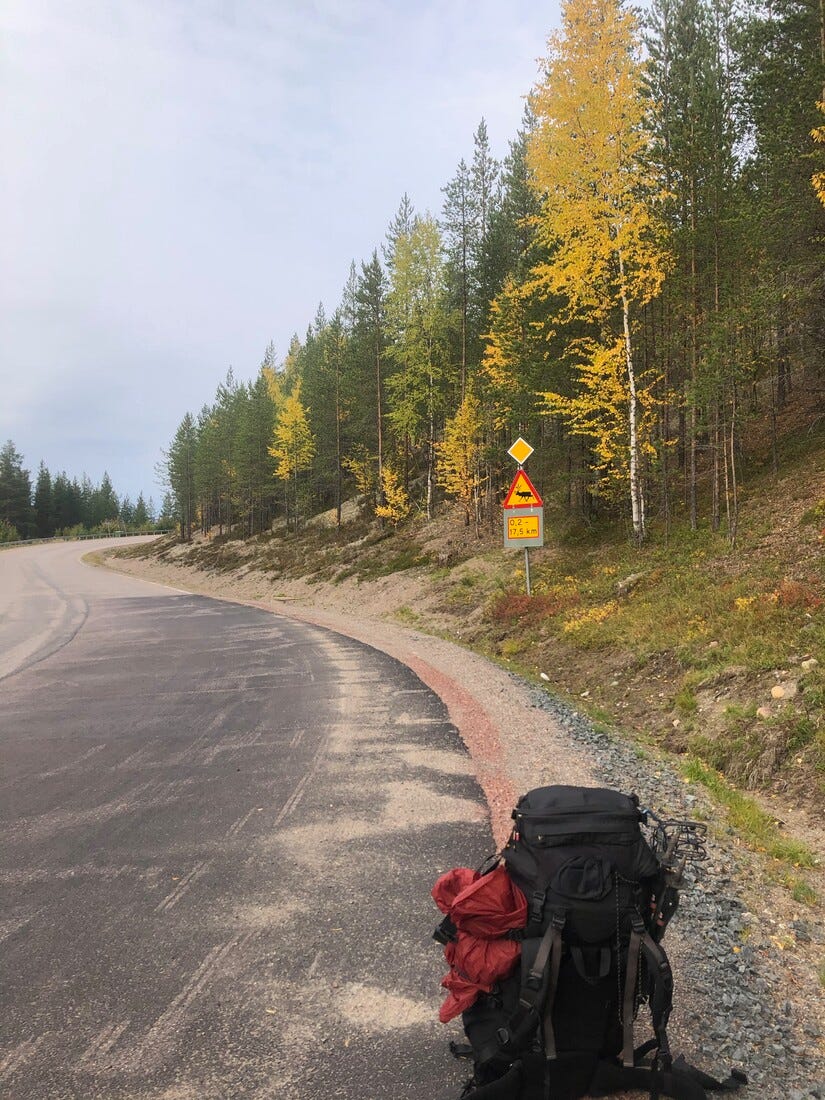
The previous three days I had spent exploring the mountains around the small town of Idre. Somewhere in its forests and along the course of the Dalälven River, an expedition from Uppsala had drawn a panorama 350 years ago, of mountains in which Olof Rudbeck would see antiquity’s Atlas Mountains.

I had left from Idre with more questions than answers, and still I felt in good spirits. Further illustrations had resulted from this expedition, and as I followed their historical trail north, new landscapes waited at the end of forest roads.2
Warning signs along their way announced the moose hunting season that had just begun. In a red jeep with gun cases tied to the roof, I hitched a ride out of Idre.
The brief journey lasted all of fifteen minutes. I spent them at the mercy of a driver glad of a captive audience for an impassioned soliloquy about guns and hunting cartridges, with particular emphasis on the merits of repurposed Wehrmacht rifles in bringing down the king of the forest – all delivered in a thick Småland dialect.
In rhythm with my forced nods of interest, the mantra ran through my mind.
No one rides for free.
“I Can Drop You Off There”
The hunter dropped me off at a junction in the forest.
From here, it was a day’s travel northwards to the next destination of my journey: a mysterious stone near the Norwegian border, inscribed with enigmatic characters – first sketched by the same expedition that had drawn the mountain panorama I had followed around Idre.

I had made it through some dozens of pages in my book before another vehicle stopped. Reflecting glimpses of sunlight, a heart-shaped balloon escaped into the hazy sky as the car door opened.
Inside, two couples from four different countries, on their way to a birthday party.
A Babylonian mix of languages filled the passenger cabin, sparkling like the rhinestone hearts on the jeans of my seat neighbour, the air suffused with a distinct note of hairspray. The conversation pinballed across several Eastern European languages – less fluent perhaps, yet cordial – but most of all less ballistic.
Half an hour later, I hefted my backpack out of the trunk again at a crossroads. “This hour, not much traffic,” the Estonian construction worker warned from the back seat, pointing to the road where I wanted to part.
I waved the birthday party goodbye, and had just taken out the book from the front pocket of my backpack again when a blue Volvo pulled over.
“I’m heading north”, I answered the driver in a lumberjack shirt wearing yellow ear protectors. “Towards the Norwegian border.”
Some years younger than me, I estimated from the rosy patches of skin not covered by his copper-coloured beard.
“I live about twenty kilometres up the road”, he answered. “I can drop you off there.”
I heaved my backpack next to a row of plastic storage boxes in the trunk. Between them, a rifle bag. Not again, I rolled my eyes, inwardly at least.
Entering the car, I swiped some Candy Cars off the front seat that had spilled from a plastic bag on the glove compartment. Empty soft drink cans clattered as I tried to find room for my legs. Riding shotgun, I thought of the irony as I buckled up.
His eyes glued to the road, my driver steered his vehicle home.
“So you’re back from moose hunting?”, I broke the hum of the engine, now already in sixth gear.
“Jau.” There was a shyness underneath his voice that sounded softer and gentler than his appearance had made me assume.
“I noticed the season has just started.”
“Jau”, he echoed.
With my thumb, I pointed back to the trunk, towards the empty plastic boxes.
“So no luck today?”
“Jau.”
The rubber antenna on his ear protector quivered with the vibrations of the road as the car ascended into the hilly parts of Härjedalen, towards the Norwegian border.
Is his radio still on? I began to wonder.
“Kalendergubbarnas By”
The villages through which we passed comprised little more than a few houses. The population density in this part of Sweden drops below one person per square kilometer.
The highest village in Sweden, a blue sign advertised on the way. Glacier-polished mountains soon added soft contours to the horizon. In silence we crossed through the sea of pine trees and yellow birches that filled the plains below, occasionally dotted with lakes and patches of marshland that were already verging towards earthen tones.
In a curve further on, another town sign flew by, more cryptic than the one before: Kalendergubbarnas By.
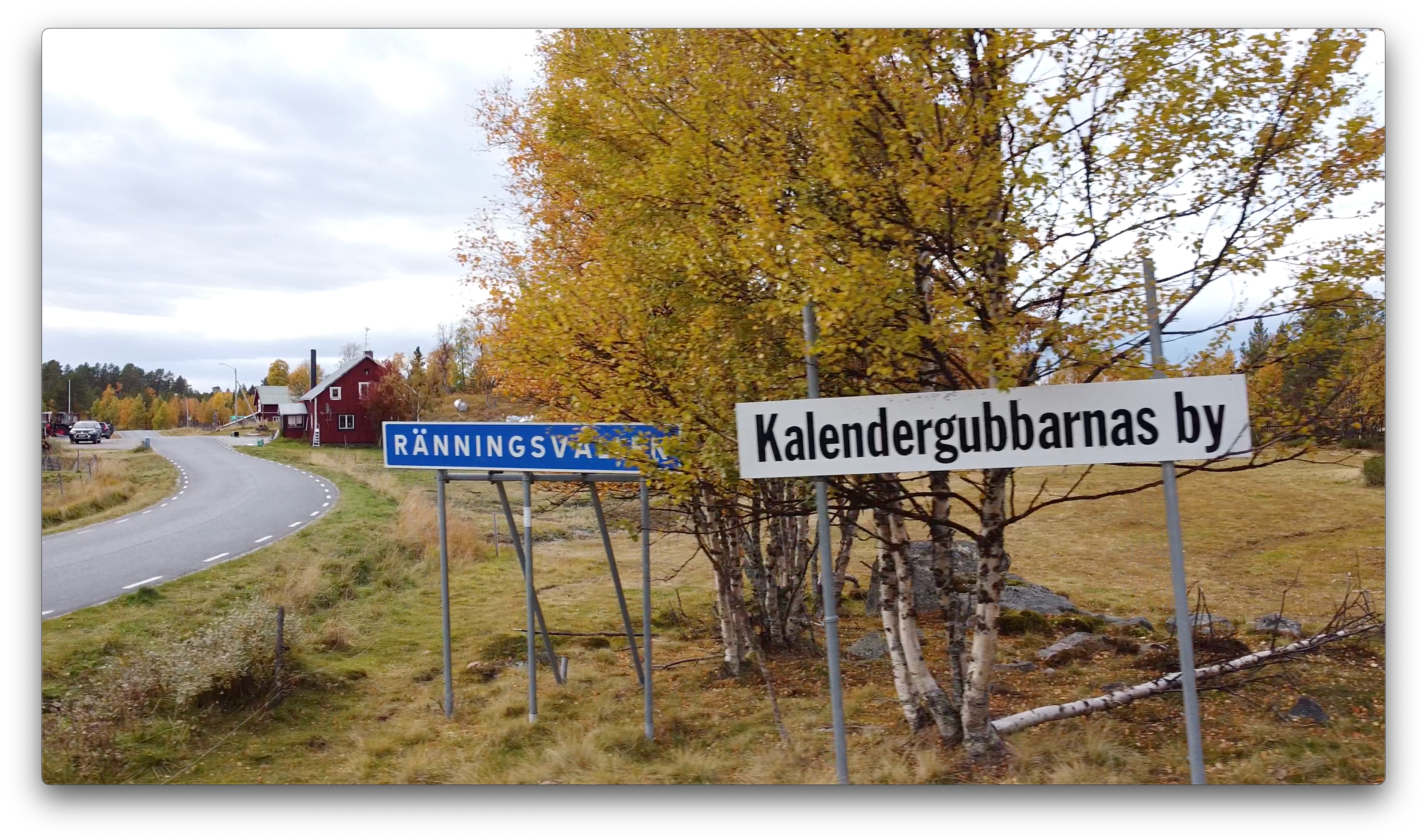
I was still pondering the meaning of the words when the car began to slow down. Village of the Old Calendar Men?
Switching off the engine, my driver headed straight for one of the houses along the road, leaving all his gear in the car. The ‘thank you’ I sent after him prompted a nod, followed by two syllables of goodbye.
I carried the backpack over to a trash can that lay tipped-over on the other side of the road. Taking a seat, I reached for the book in the front pocket once again.
From the pages, I occasionally lifted my eyes to the panorama of curiosa I saw displayed on the opposite side. Rusting machines and tractors, weeds growing on the truck beds. A flotsam of Euro-pallets, discarded propane tanks, and building materials lay scattered between them.
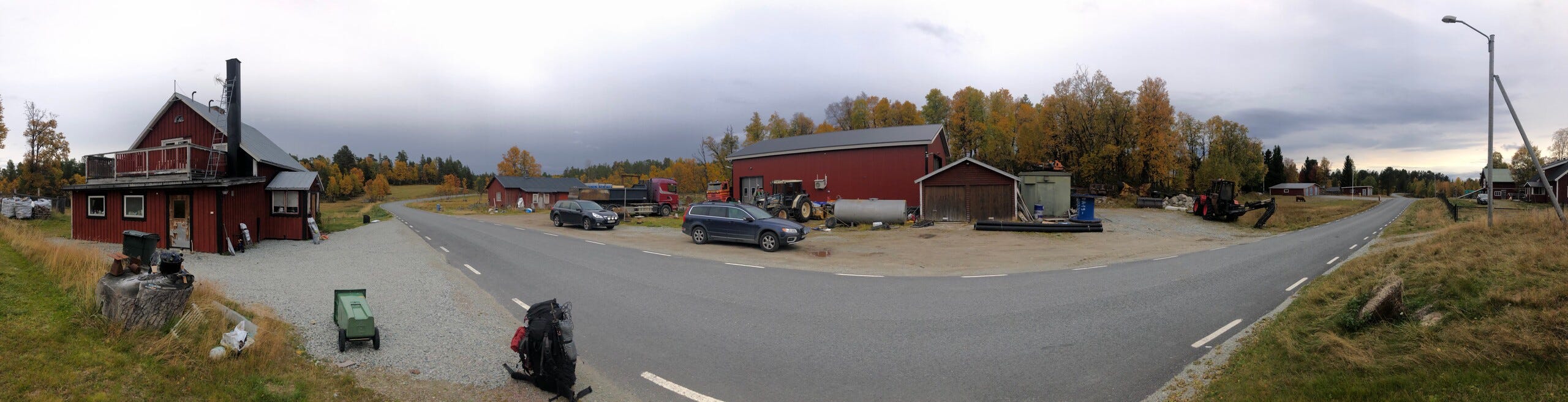
A rusting biathlon target rose from the scrap, with a few black disks stammering morse code on white ground. On top of a shed I spotted a vintage snow scooter parked, the lurid orange of its front panel blaring through the autumn colours.
There were not many pages left in the book before the next vehicle passed by. The logging truck set the weeds across the road wavering in its wake. The fragrance of fresh wood still lingered in the air when a station wagon followed after.
A friendly nod from the elderly couple inside.
The Estonian construction worker had been right.
A New Door Opens
Stretching my legs, I took a few steps towards the house in Falun-red that my monosyllabic driver had entered.
No lights were on, and no smoke rose from the chimney.
Through the glass I spotted him sitting in a corner of the living room – ear protectors still on. He didn’t turn his head when I walked by the front window.
After an hour or two, I picked up the backpack again. The time had come to give up and scout out a place to make camp.
“Are you waiting for Gustaf?”
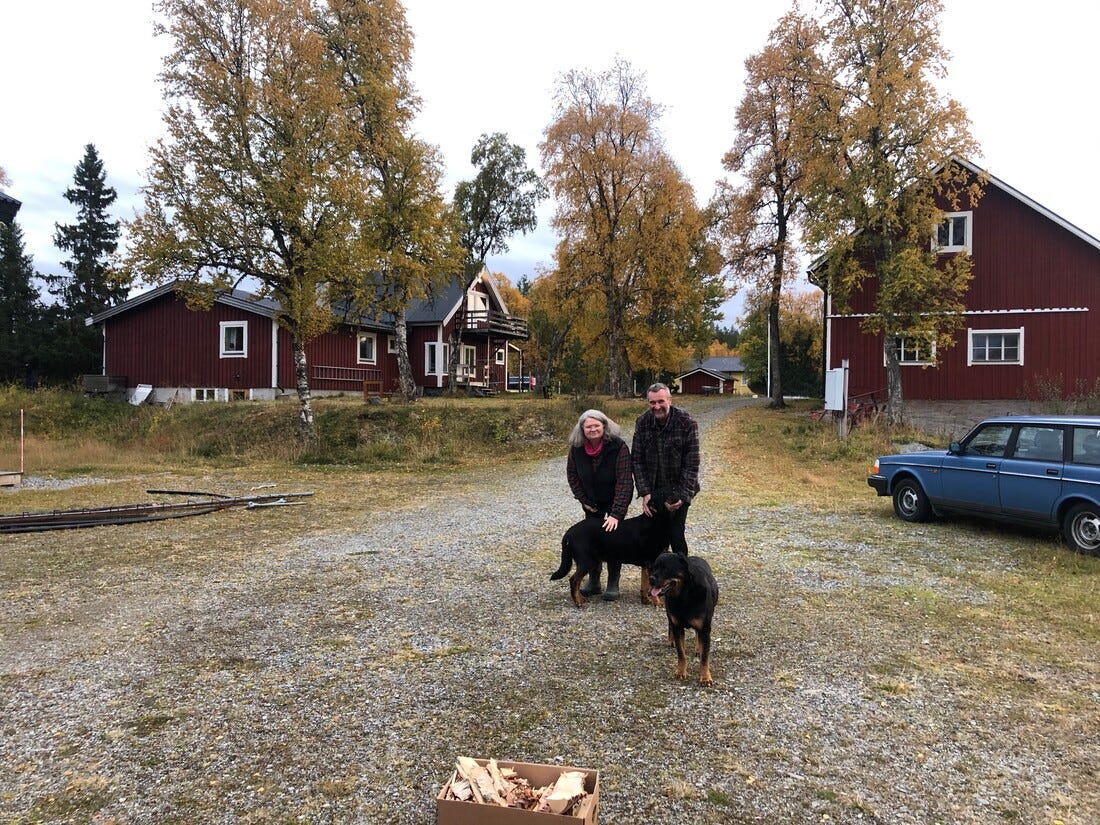
As I was walking up the road from my silent driver’s home, the front door of the house next to it had opened. A middle-aged woman with gray hair and a Norwegian sweater had entered the porch, accompanied by two Rottweilers, gazing at me in a way that I felt I’d better answer correctly.
“Are you a friend of Gustaf’s?” she rephrased.
“You mean the guy living over there?” I concluded, pointing to the red house.
“Yes! I saw you through the kitchen window. We thought you are waiting for him.”
“He’s already at home. He gave me a ride here.”
“Oh right, I see his car over there!” Then: “So where are you going now?”
“Heading for the forest. Looking for a place for the night.”
“Oh, why don’t you come in first!”
“Stay As Long As You Need”
I lifted the latch on the fence. The black gate swung open, drawing a wide arc over the road. The two dogs dashed forward, sniffing my hiking tights without a bark.
“That’s Scooby, and that’s Semla,” she introduced her canine companions. “And I’m Åsa.”
“So you’ve travelled up here from Uppsala?” Åsa inquired over green tea in the kitchen. I nodded as I took a first sip. Outside the windows, it was already dark.
Indicating the book peeking out of my backpack pocket, she asked: “Doing library research down there?” From my notebook I pulled out the printouts of the mountain panorama near Idre and the stone I now wanted to visit up near the border. Åsa did not let go until I had fully done justice to the story about Rudbeck and the 1675 expedition that had brought me to this part of Sweden.
“I suppose you know the Carolina Rediviva then?” she picked up the thread of my library studies again.
“Indeed,” I replied. “I’ve been spending quite a lot of time in the special reading room.”
“You know Krister Östlund?”
“I do. We actually had a drink some weeks ago, together with a close friend of mine who also works in the library. The two of them edit a series together of Neo-Latin texts in translation.”
Åsa threw back her head, laughing.
“That’s too funny! Krister and I used to go to the cinema a lot when I studied in Uppsala, back in the 1980s.”
Over tea, I had already spotted a historical map of the Jämtland-Härjedalen region hanging on the kitchen wall. Together, we tried locating the ‘Stone in the Green Valley’ where I was heading.
“The next days aren’t looking too good”, she commented on my plans. “This really is the end of the season.” “There is a hut down on the lake”, she added. “Olle’s man cave. Has been his carpentry project for years. Stay as long as you need!”
In the meantime, Olle had come in from his workshop. Her husband worked jobs all across the globe, Åsa had explained before, welding anything from oil rigs in the North Sea to pressure tubes in nuclear power plants.
His family had lived in this village for more than a century, Åsa said. As she outlined his many building projects – welding a mast for the first wind mill in the area (he had replaced the nacelle with an illuminated star several years ago), his storybook flying machines, his impeccably carpentered ‘man cave’ – the archetype of a rural DIY hero materialised before my inner eye.
“Sometimes I think he has this plan hard-wired to populate Ränningsvallen,” Åsa confided in a quieter moment.
The Calendar Guys
“You’ll find fire wood in the shed over there,” Olle commented on the invitation his wife had extended. As I left, Åsa handed me a bundle. “And take some fresh eggs with you!”
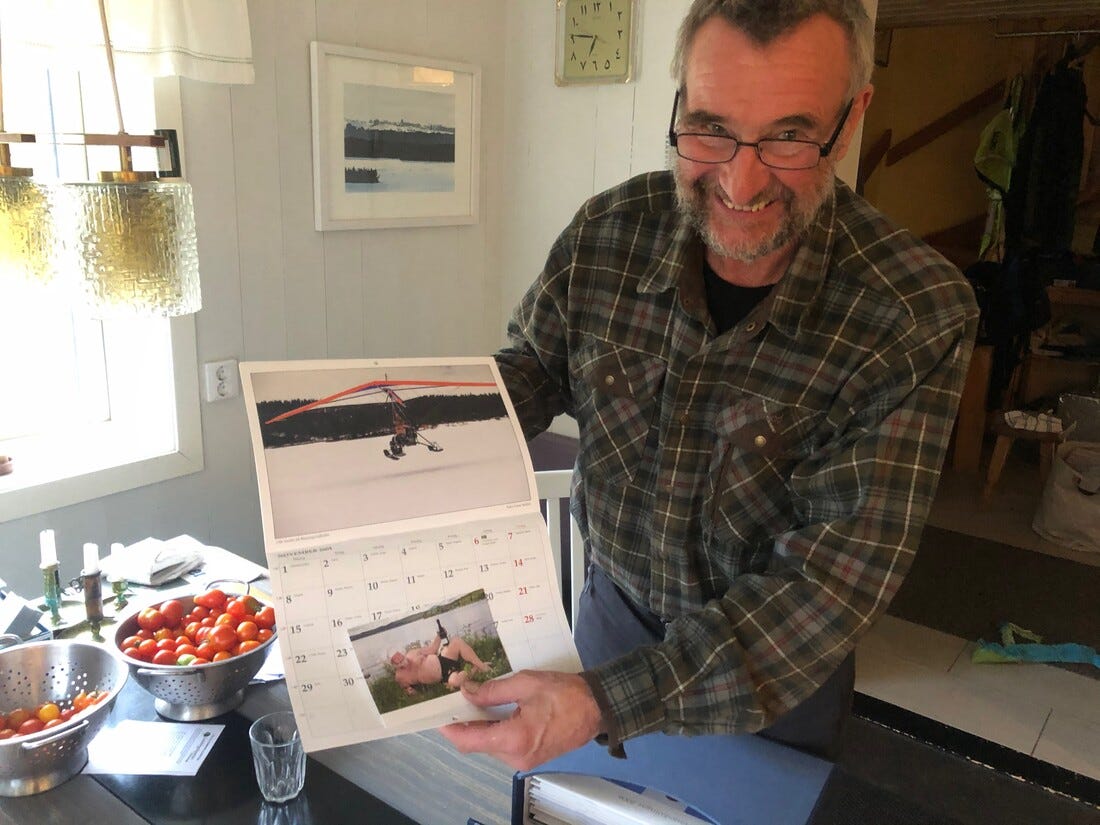
On my way out to the cabin, I noticed a calendar lying on a table. Härjedalingar 2004 read the title page. It began to dawn on me.
The cover showed men in the second half of their lives, posing in typical Norrland activities: ice fishing, welding, riding snow scooters, or leaning against snowy stacks of wood – all bare-chested.
“Is this what the sign at entrance to the village is about?”
“Yes. We’re the proud village of the kalendergubbarna.
I raised an eyebrow.
“We were looking for a way to raise some money for a local association back in the 2000s”, she explained. “That was about the time when the movie ‘Calendar Girls’ came out. All the gubbar (old men) of the village jumped on board when we came up with the idea of trying something similar.”
“Was it successful?”
“Quite so!”, she said. Indicating that I should wait a moment, Åsa walked into the other room. She returned with a heavy folder under her arm.
“We produced the gubbkalender every year, for more than a decade,” she said. “This is the archive.”
“The calendar was a huge hit all across Sweden”, she continued as I began to browse randomly. “Some years we sold around 7000 copies. One year, a lady from German television even came up here,” Åsa added as I fished some copies from the folder.
Joining me at the table, Olle picked up one of calendars, flipping through the pages. He eventually tapped on a half-naked man on a snow glider, taking off from a frozen lake. “That’s me!” he announced with a proud smile.
Carrying the eggs with one hand, I peeped towards the archive folder on the way out.
“Can I take that with me, too?”, I asked.
Lakeside View
Two hours after I had taken a seat on the trash can at the side of the road, I found myself in a floating cabin. Some time ago, Olle had lifted it into dry dock at the shore of the nearby lake.
Placing my tired feet on a footrest, I leaned back in a comfy chair, a fire crackling in the iron stove behind.
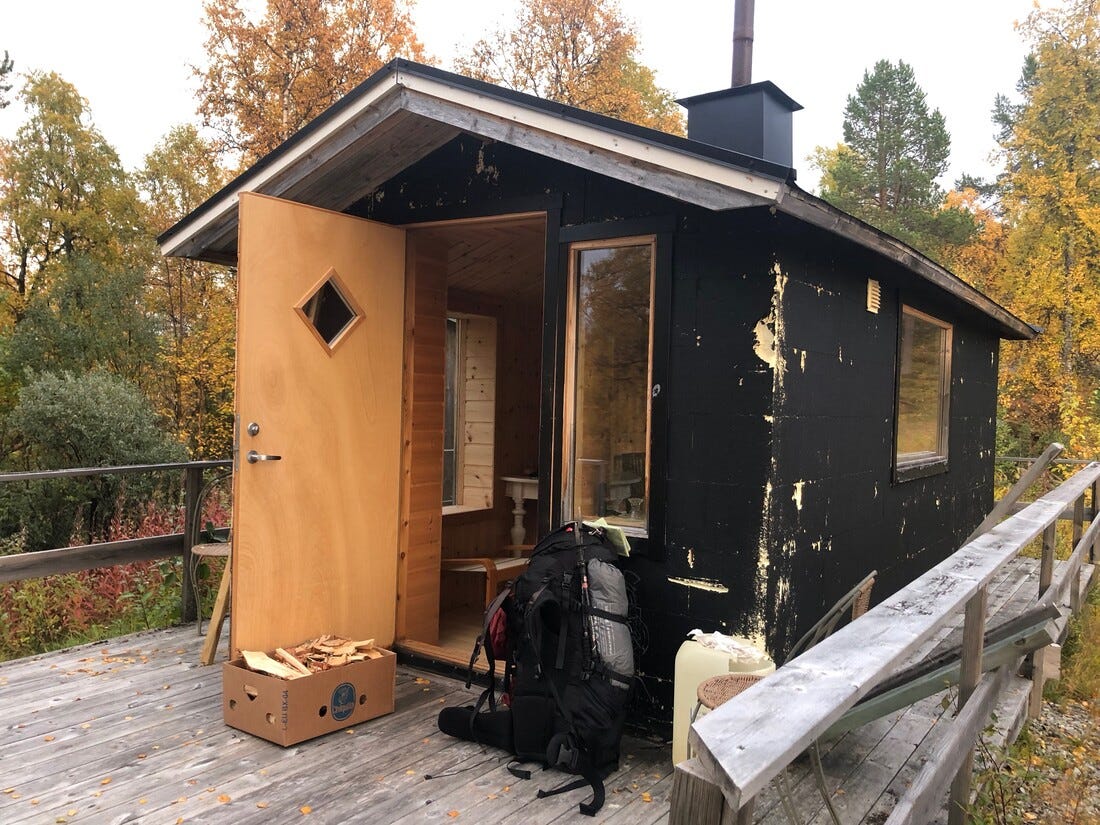
Through a window in the panelled walls, I watched birch trees around the lake shiver in the wind, a tail of leaves blowing towards the water. On the wooden floor, another tail was beating.
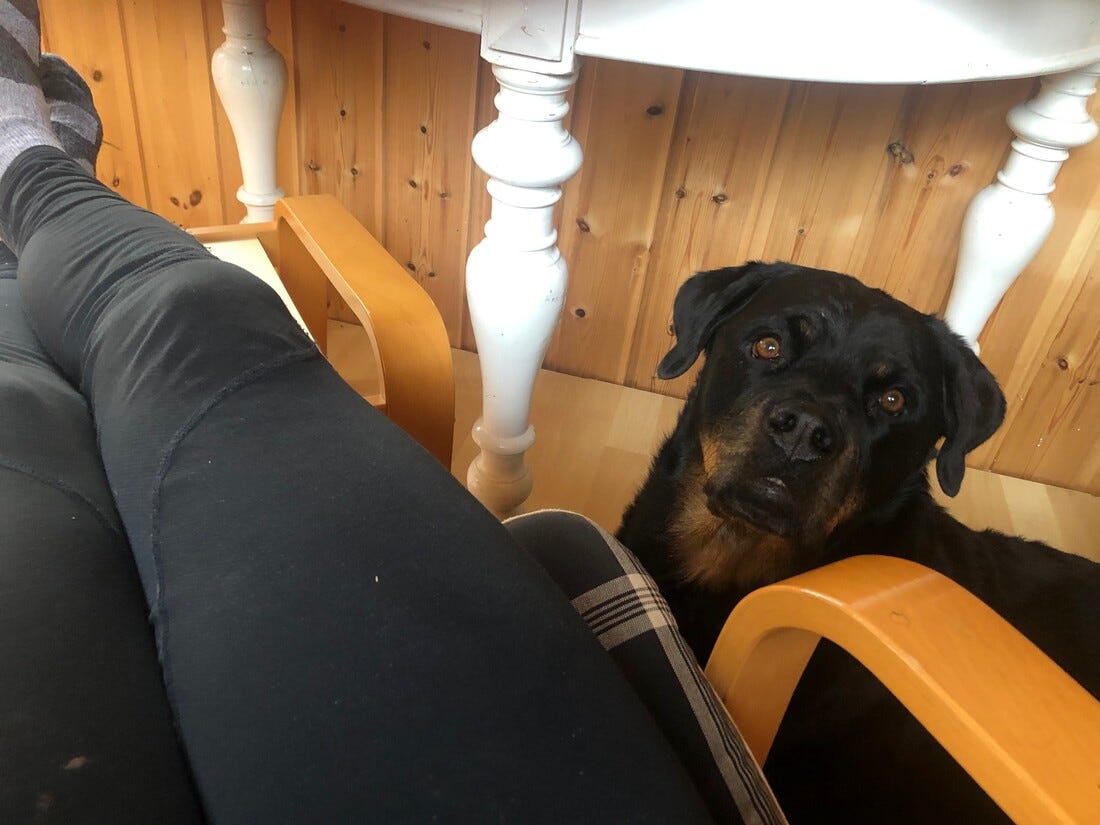
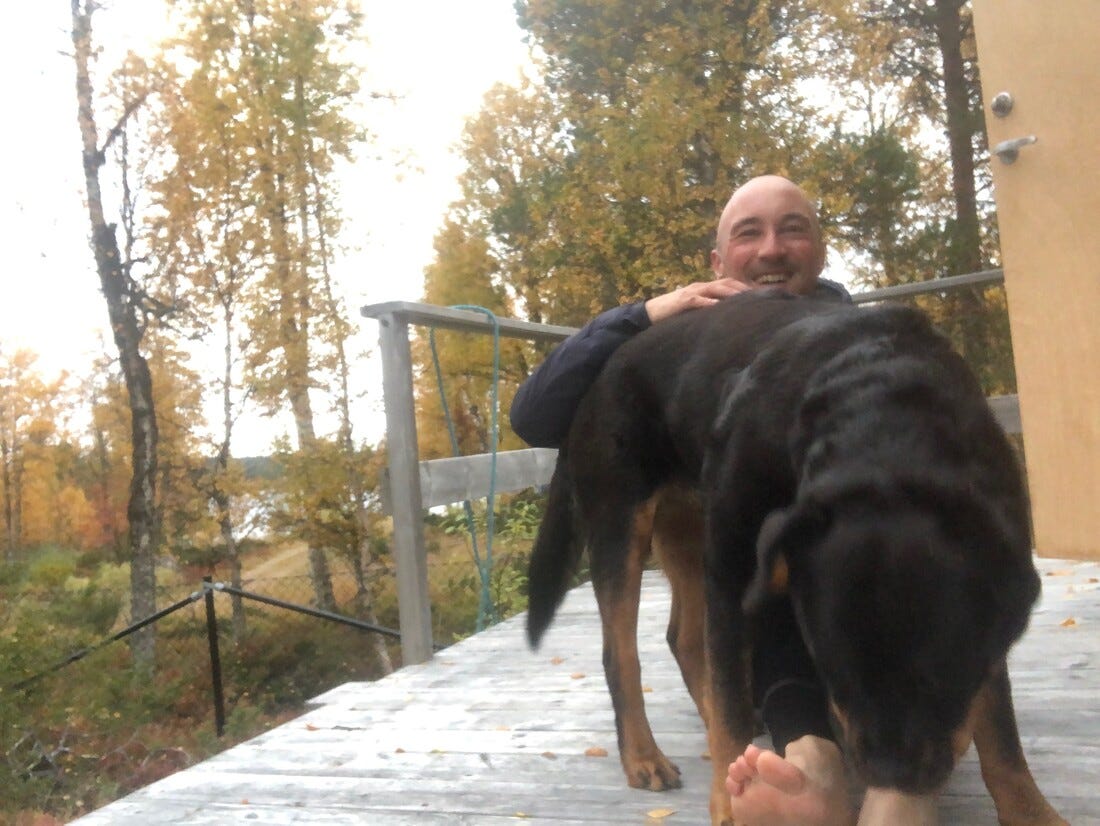
One of the dogs had curled up next to the footrest. Placing her chin on my thigh, Semla beat her tail in anticipation. One hand patting her head, I began flipping through the calendars, their pages quivering with the contented sighs of the Rottweiler.
It was only later that I noticed that there were also photographs on the back. When I placed one of the calendars on the growing pile of copies studied, it suddenly struck me.
I know that face.
Three boys in swimming trunks, posing with upright oars as they floated out onto a lake on a self-made raft. He was the youngest in the picture. The man who had dropped me off here.
Most of his face had been hidden behind a red beard now. But the skin beneath had still retained some of the softness on the photograph in my hands.
I turned the calendar over and check the year. 2004.
He must have been close to his teenage years back then, I guessed.
From the raft photograph, my view wandered from the calendar out to the lake again. Like the birch leaves settling on the shore, it all seemed to fall into place.
This is the lake. This where they took the picture.
I picked up another calendar. Over all the years, the boys reappeared in the final picture on the back. Browsing through the calendars, I watched Gustaf and the village kids grow up.
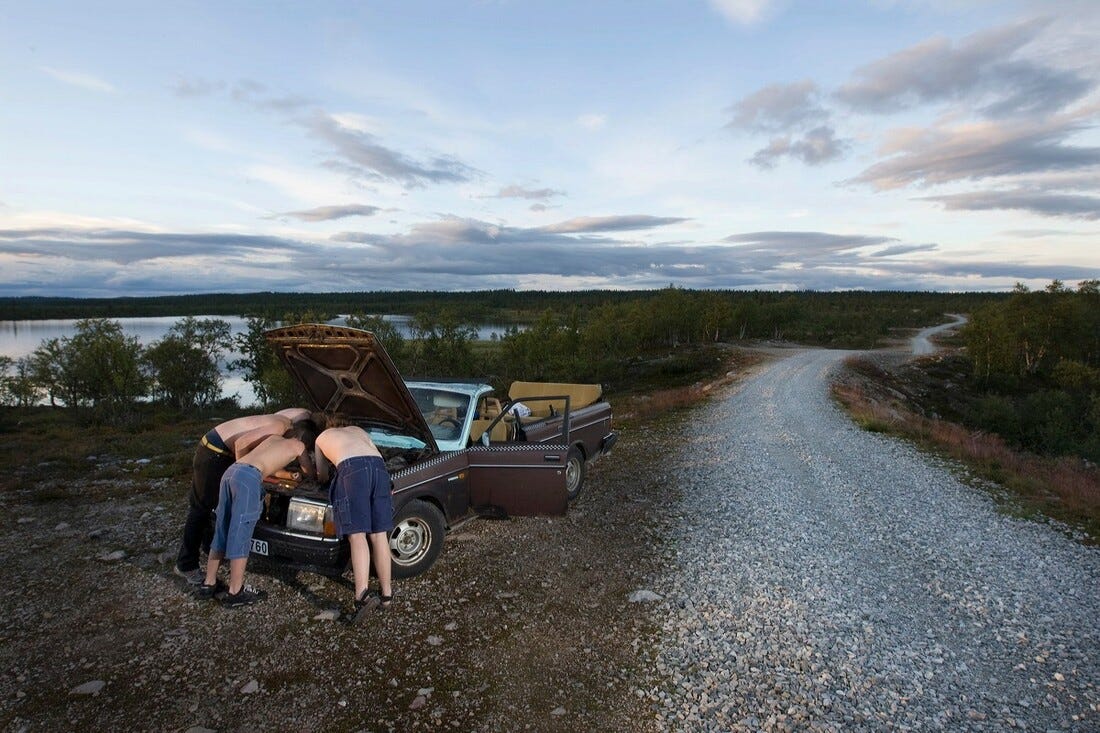
Kids in rubber boots posing next to highland cattle. Boys tinkering with the orange snow scooter that I had spotted as the figurehead on the barn. Teenagers poring over the engine of an EPA-traktor.
No Country for Young Men, it ran through my mind.
Spinning the Wheel
After a few days in the cabin, I took leave of Kalendergubbarnas By again.
At the break of dawn, I left with Olle and the dog for the vet at Hede. One of the Rottweilers needed a check-up. From there, a Dutch couple in a camper van gave me the next lift.
Hede 12 km, the road sign at the junction read where the couple had dropped me. By the time they did, we hadn’t even made it through the story of how I ended up there in the first place.
Later that morning, I watched the thumping EPA-traktor creep by, listening to its stereo as it faded into the distance. Feeling the final pages of the book in my hands, I pondered about the past days and the unlikely trajectory they had taken.
This crossroads was one among many. Yet it felt as if a line had emerged among them, from a myriad of possible encounters and coincidences along the way, and that now connected them to a story.
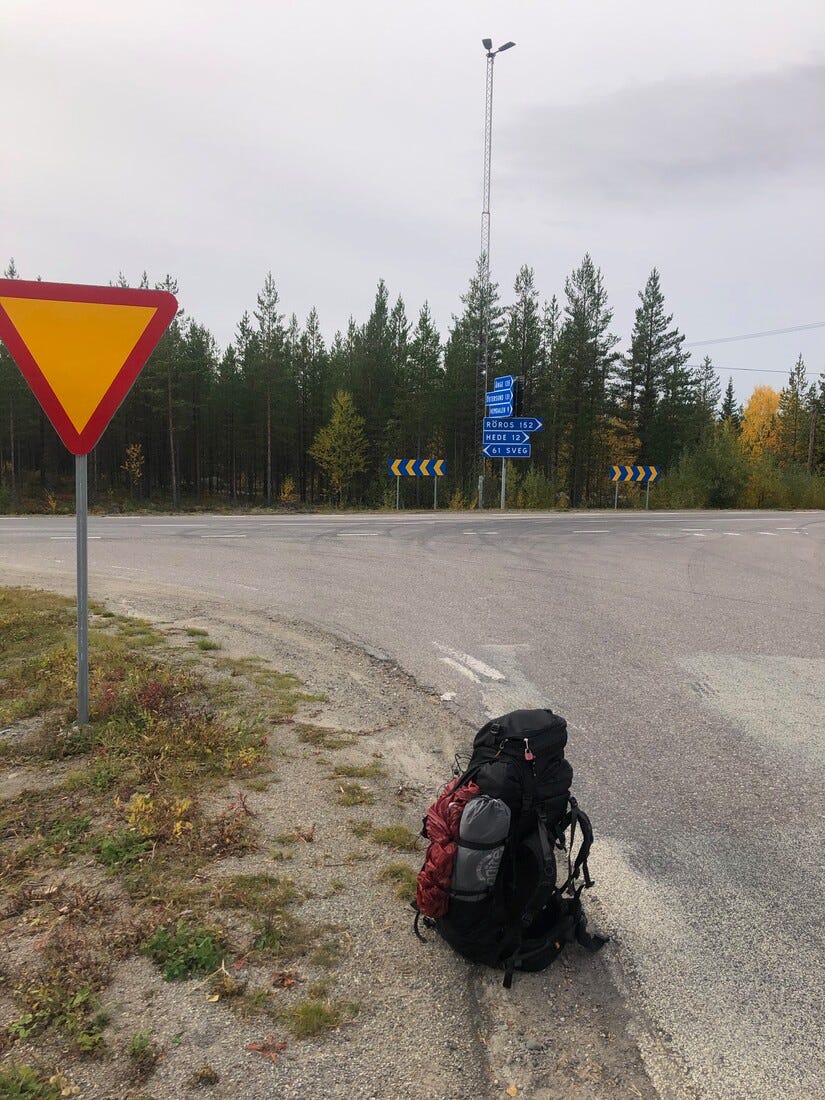
For a short time or for longer, I had entered into the orbit of people who themselves moved according to their own volition and circumstances. Like a pinball, propelled around a mechanism where a fraction of a second or a millimetre influences the ultimate path through a labyrinth of interlocking wheels, plungers, bumpers, and flippers, I had landed here, at a signpost in the middle of the Swedish province on an autumn morning – waiting for the next ride to take me forward in my antiquarian quest.
Ancient poets had spoken of the universe in similar terms, describing it as the result of falling atoms that a swerve – an unforeseen deviation from their direct lines – had made collide.3
In such a world materialising from microscopic spin and chance encounter, fate or meaning were but words we use to name the storylines into which we, in hindsight, connect the dots. If all this was just a game of the mind, it was still a most curious one to play, I thought, watching the wind blow birch leaves across the country road.
My eyes wandered down the tarmac, towards the signpost that marked the junction. And as I watched the blue and white signs indicating different routes and destinations; possibilities that lay all fanned out like spokes on a wheel, I began to wonder:
Where would the next spin take me?
Further Reading and References
All translations and photographs are my own unless stated otherwise.
A previous version of this article was first published on Too Long, Didn’t Read, an online platform we launched to explore alternative forms of storytelling. It is reposted here together with minor modifications to content and layout.
Acknowledgments
My thanks go to Åsa Evertsdotter, two wonderful dogs, Amy Lee for her help with an earlier version of this text, Peter Sjökvist, and a dozen of drivers who bothered to slow down on those days in autumn.
The volume contains several historical dissertations in Swedish translation; see Nytryck av äldre skrifter om Jämtlands län, eds. Per Nilsson-Tannér and Johannes Sparrman, Tandsbyn 1953.
You can explore the further illustrations connected to the 1675 expedition on our database Reaching for Atlantis.
E.g. the Roman poet Lucretius in his De rerum natura (‘On the Nature of Things’). For an introduction to the poet, his work, its rediscovery, and reception in the Renaissance see Stephen Greenblatt, The Swerve. How the World Became Modern, London, 2011.