

The Phantom Amulet
From the paper echoes of lost artefacts to the dream of the primordial alphabet.

The King’s Question
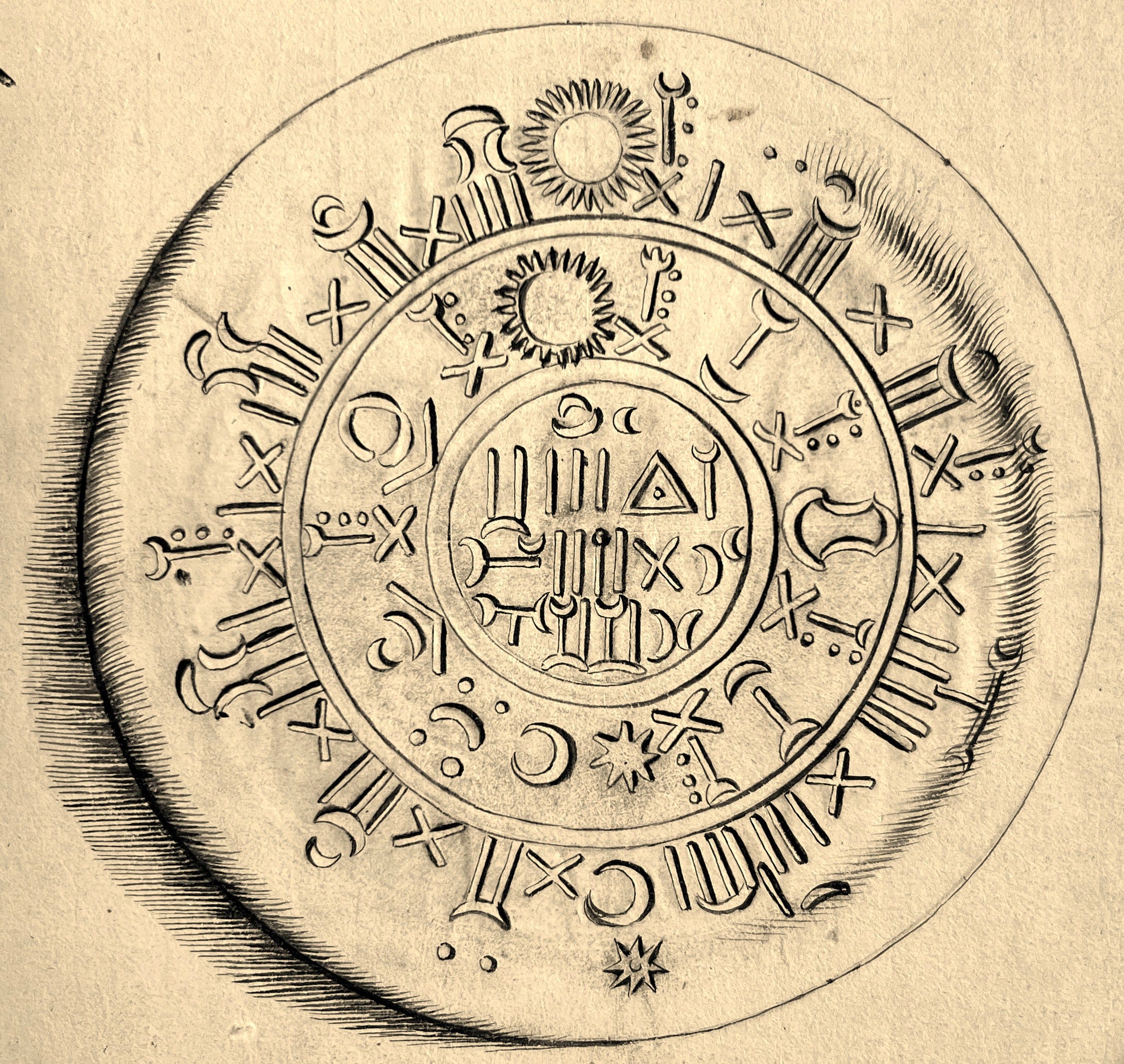
The characters on the sheet seemed like a kind of code. Crosses and dots, staffs and triangles, suns and stars and crescent moons scattered in between.
I had seen this before – not in an archive, but in a book printed more than three centuries ago. Years earlier I had come across this pattern while building Reaching for Atlantis, the database for illustrations printed in Olof Rudbeck’s Atlantica.
In the third volume of the work (1698), I had seen a disk-like object covered in these signs. One of the woodcuts Rudbeck printed but never discussed in the text.
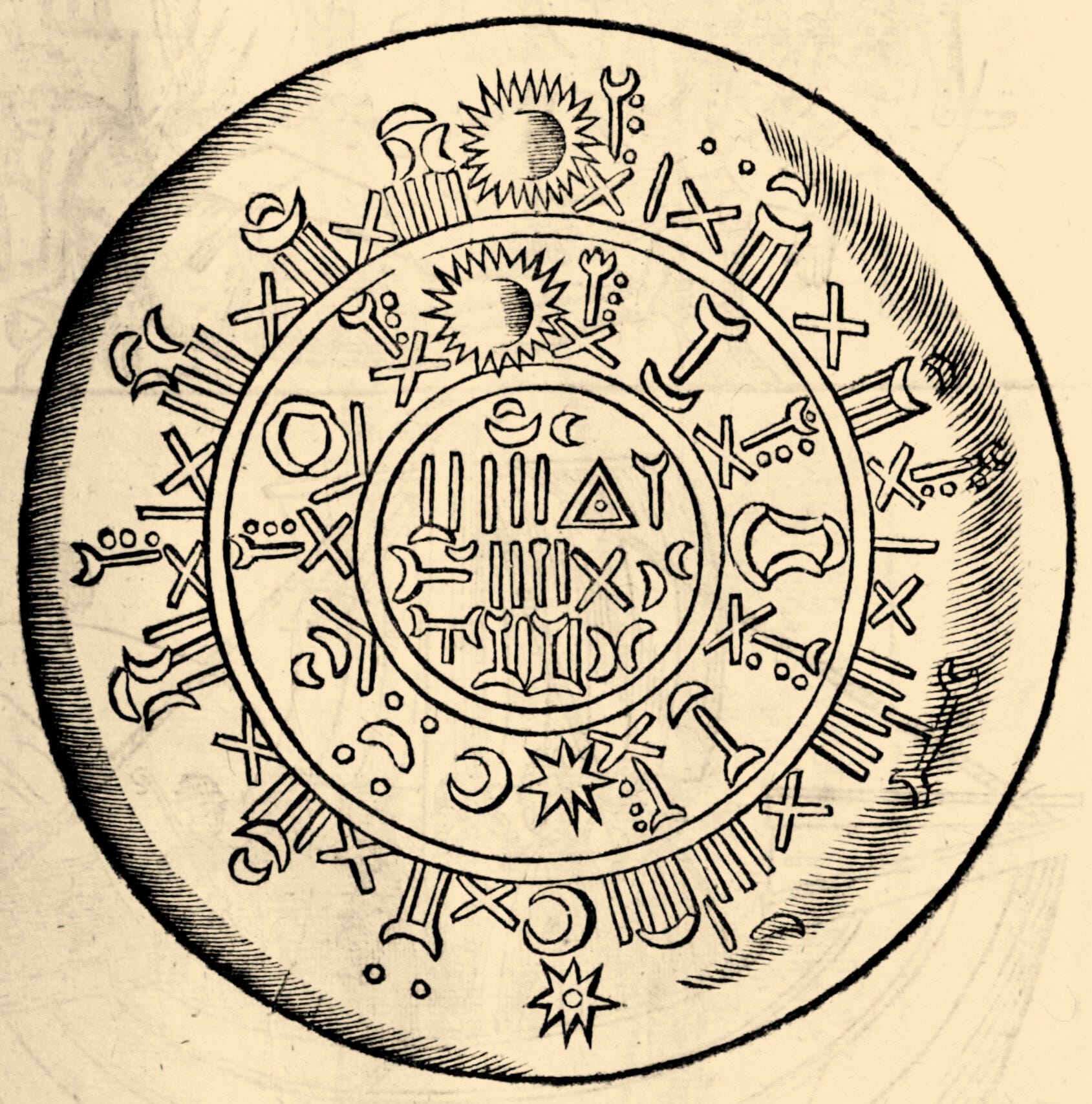
Among the hundreds of illustrations in the Atlantica, there are dozens of this kind, woodcuts that remained unexplained, haunting the book detached from their material past.
I call them “the phantoms” – yet even phantoms sometimes leave traces.
When Rudbeck finished the third volume in 1698, he dedicated it to Charles XII, presenting the Swedish king with the sequel in person.
The young king opened the book at random. It showed a disk-like object, inscribed with curious signs.
What do these letters mean? the king asked Rudbeck.
The nation’s leading antiquarian had to admit that their meaning was unknown.1
The Box in the Archive
The disk remained a phantom ever since – until I had opened the box in the Swedish National Archives.2
The embarrassing confession in front of the king left a mark on Rudbeck. The incident spurred him to focus on antiquities to further illustrate the early history of languages and signs.3
The bundle that had arrived at my desk in Stockholm reflected this interest. It came with a sender’s note – a handwritten slip left on top of the bundle some 250 years ago. It identified the material as notes Rudbeck had collected for the fourth volume of his Atlantica.
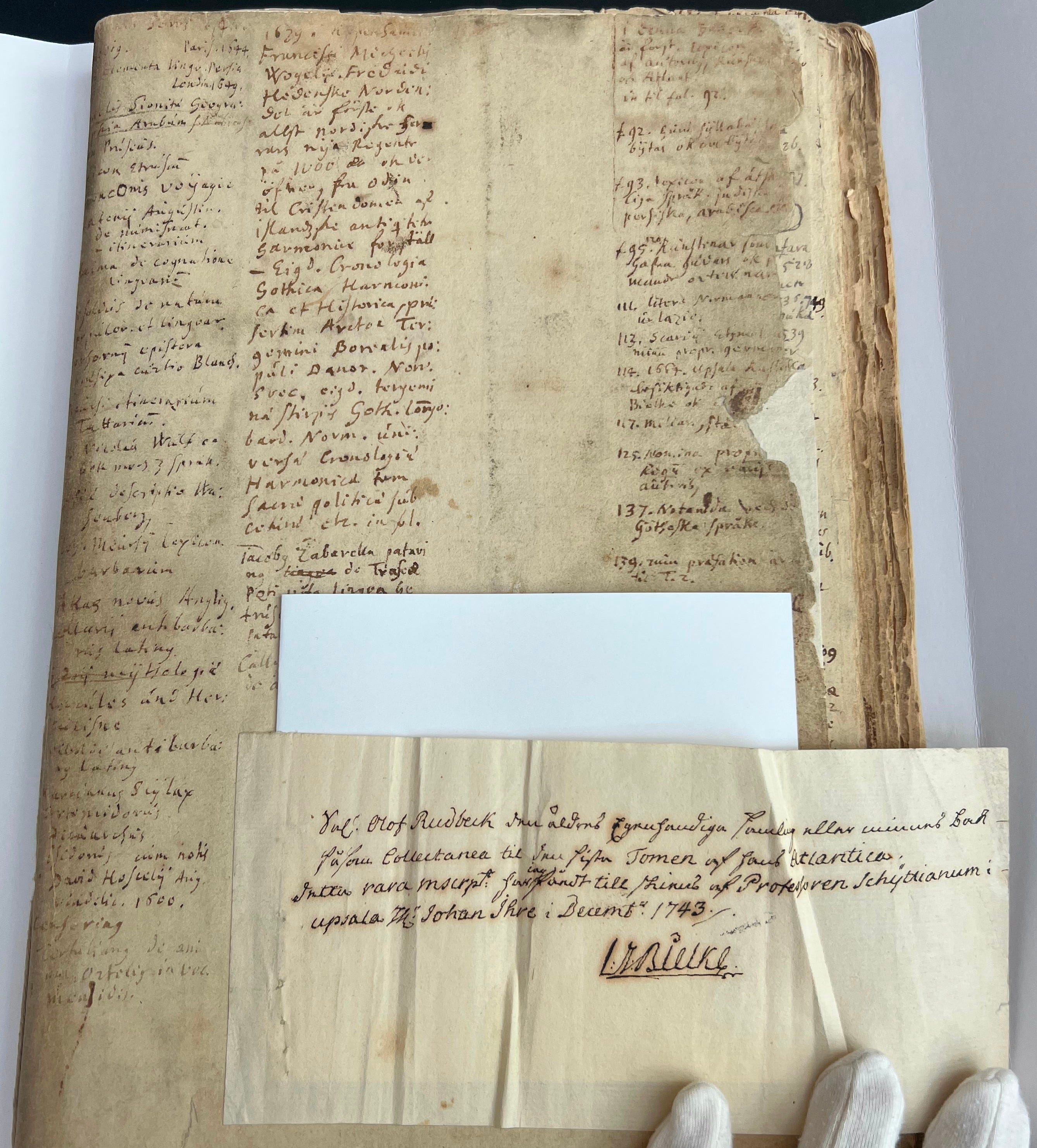
The Great Fire of Uppsala left the volume unfinished. When disaster struck in 1702, only a few sheets had been printed, covering some 200 pages. What remained from Rudbeck’s notes, the paper slip revealed, attracted the interest of Sweden’s foremost linguist, ending up in the library of Johan Ihre (1707–1780).
The papers in the archive at Stockholm are the scaffolding to a work cut short. Across their pages, Rudbeck had collected evidence for arguments he never came to unfold.
Copies of runic inscriptions. Indices for passages in classical and contemporary authors. Sheet after sheet collecting words in densely written columns.
Column by column, I browsed through the word lists Rudbeck had prepared – testimony to the rigour behind a work later decried as far-fetched speculation.
Among these pages, there were objects, too.
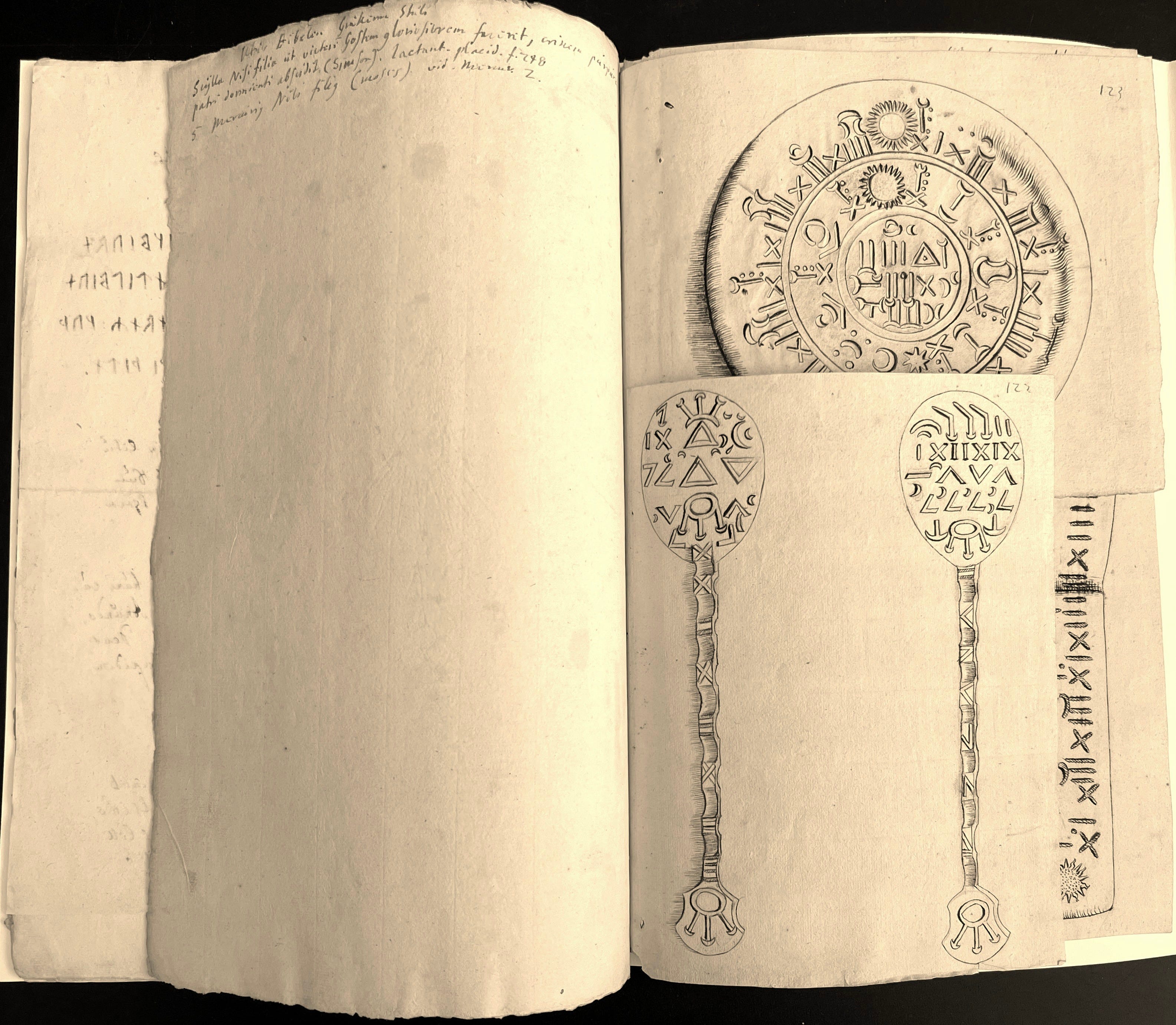
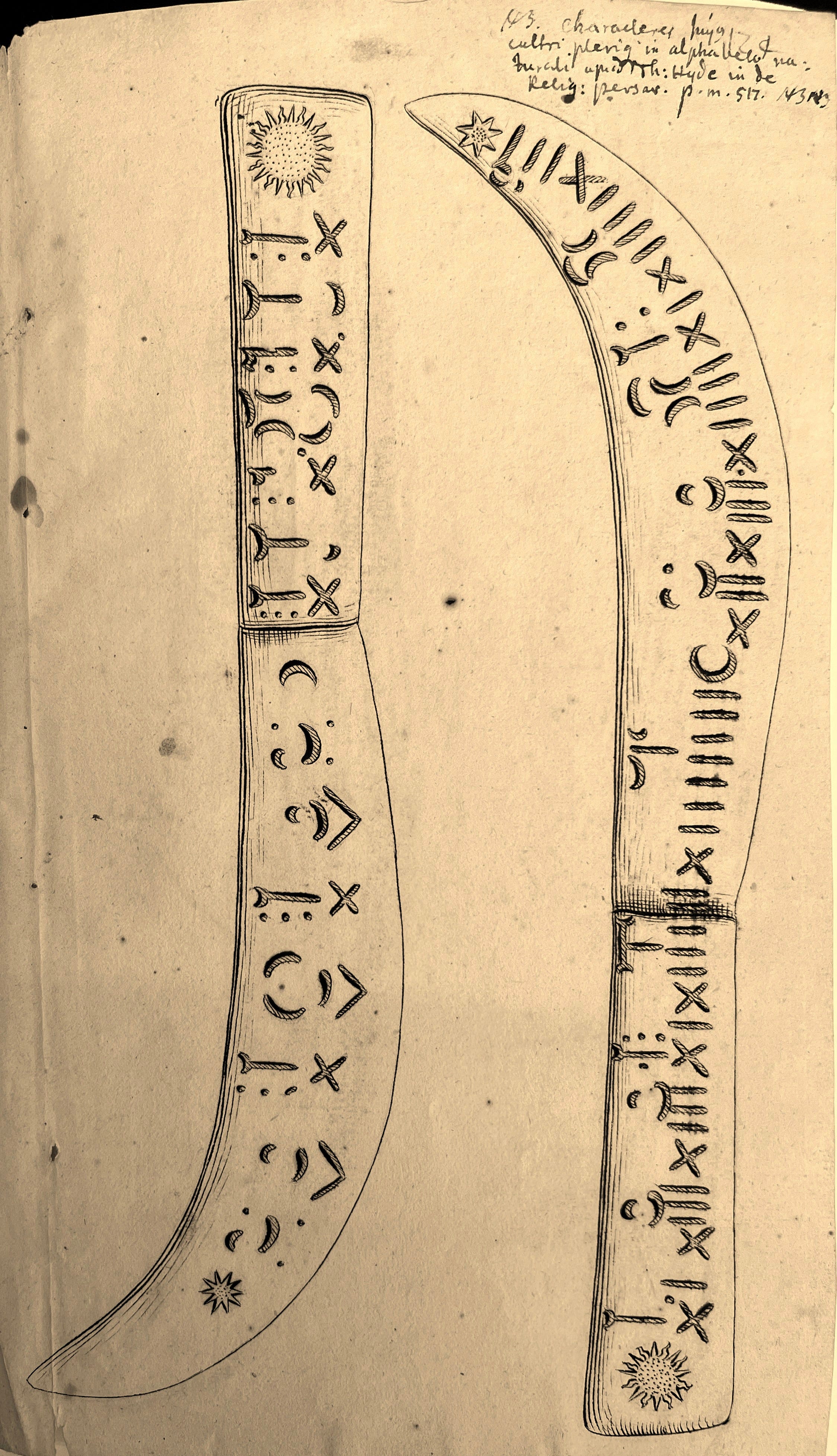
A spoon. A knife.
And the disk.
Paper Echoes
All three were drawings that Rudbeck printed in the third volume. Each was marked with similar patterns of crosses and staffs, triangles and hooks, crescents and suns – signs reminding of grimoires and magical alphabets, of the talismans and amulets circulating in the Early Modern Period.
Yet the drawings on the paper were larger than the woodcuts printed in the Atlantica.
At first I assumed these were preparatory sketches. But something about the paper felt unusual.
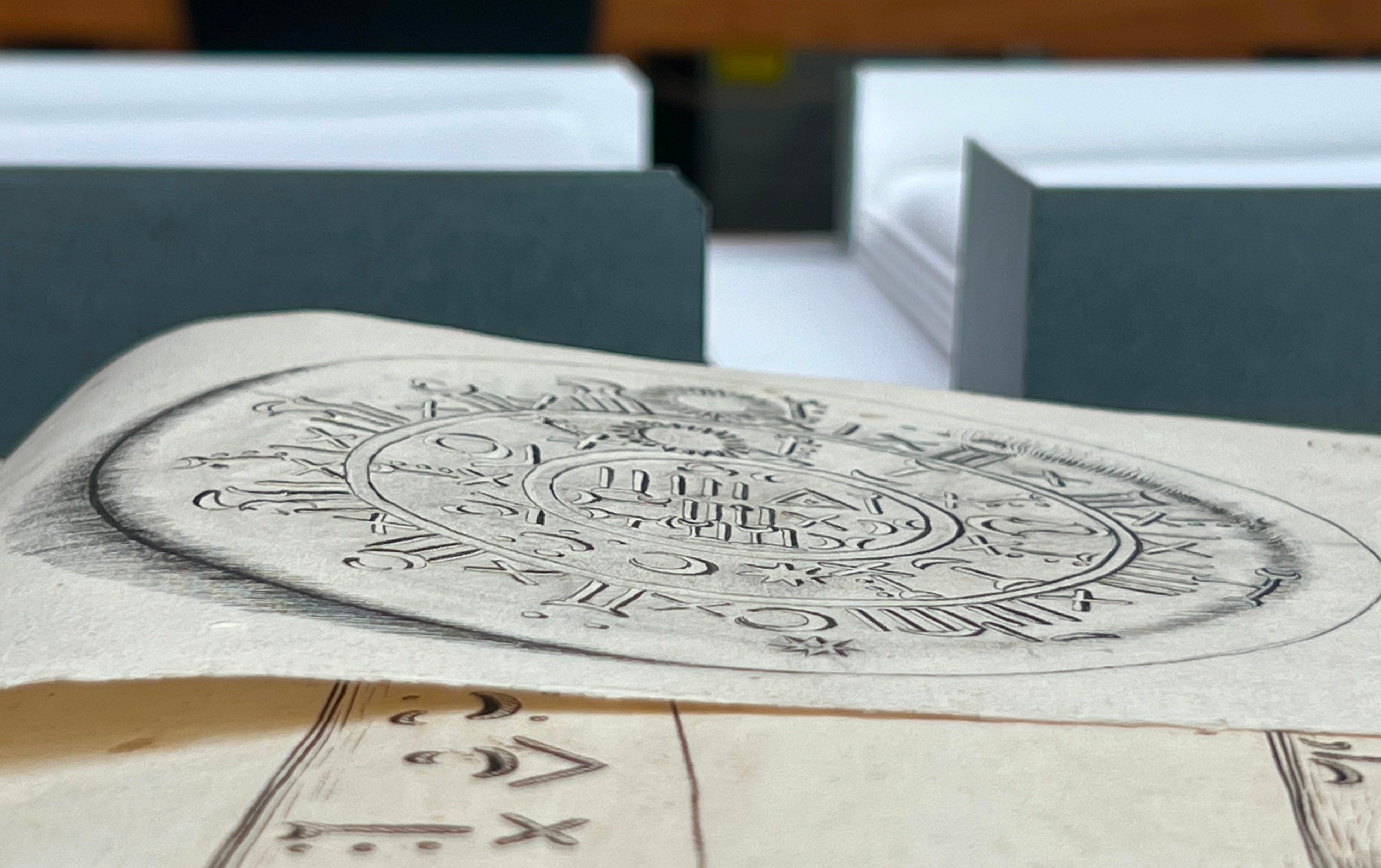
The ink highlighted contours pressed into the page. The lines did not sit on the surface of the paper – they followed shallow grooves.
Through the gloves, I traced where pressure had been applied. Whoever created these images had pressed the paper onto solid objects and rubbed their surface onto the page.
The artefacts behind these images seemed to once have existed.
Collecting Lunatics
The presence of these objects in the Atlantica points to a larger ambition Rudbeck pursued.
In the years after its third volume had appeared, he and his son increasingly turned to the antiquities of language. This was, as Rudbeck the Younger later noted, related to the incident that had occurred at the audience with Charles XII.4
For scholars of the seventeenth century, language promised access to the origins of humanity. Many believed that traces of the language in which God spoke to Adam in the Garden of Eden might still survive – the language in which each part of creation had first been named in divine harmony.5
The search for the Adamitic language took many forms. One of them was the Alphabeti veri naturalis Hebraici brevissima delineatio (‘Concise Outline of the True Natural Hebrew Alphabet’) by Franciscus Mercurius van Helmont.
In this treatise, the Flemish alchemist claimed the Hebrew alphabet mirrored the logic that the creator inscribed into nature herself. Each letter represented a position of the human voice apparatus required to pronounce it. The result was a treatise by which Helmont claimed to have even made mute persons speak.6
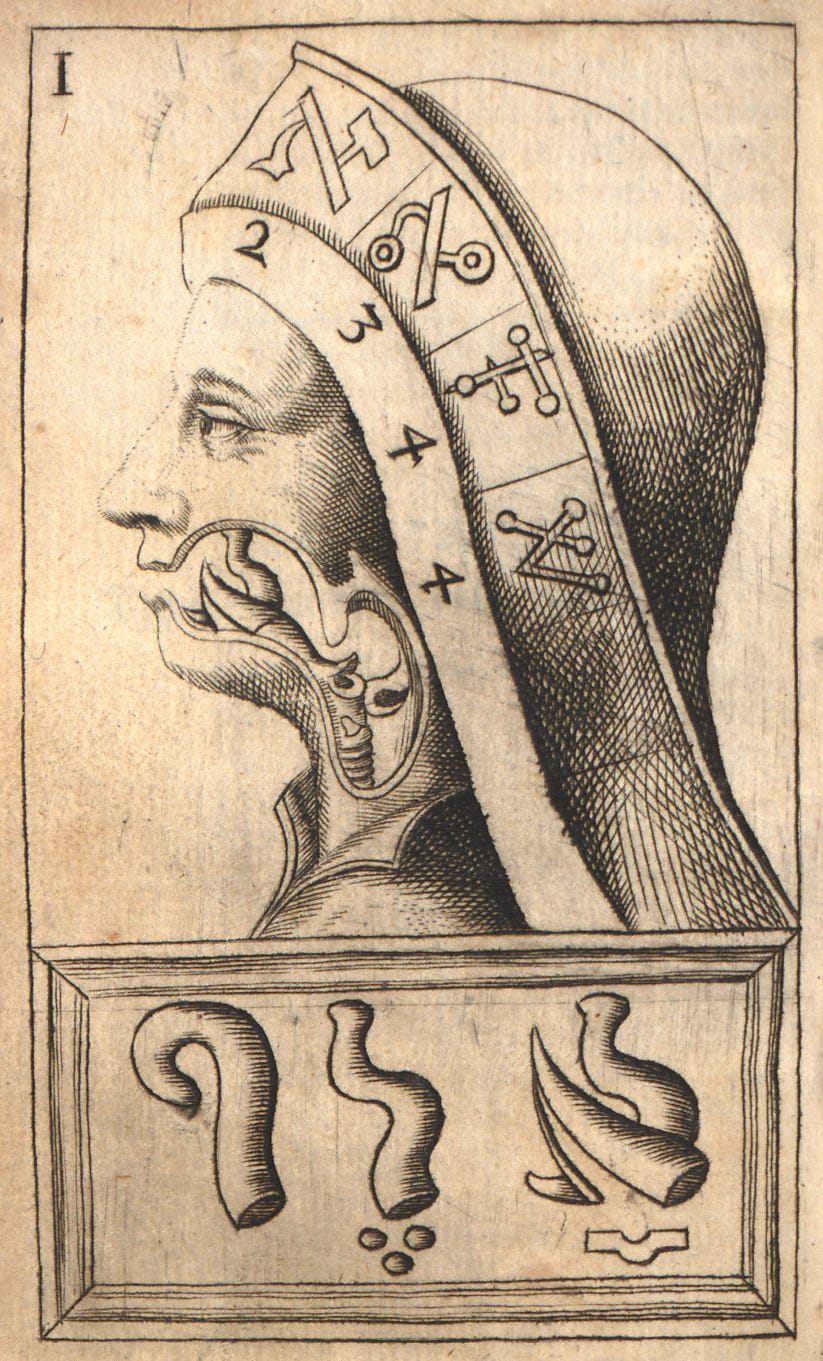
While many 17th-century scholars focussed on Hebrew as the likely candidate, already Swedes such as Georg Stiernhielm (1598–1672) began to look elsewhere.7
According to Stiernhielm, the confusion of tongues at the Tower of Babel (Gen 11) had produced several ancestral languages, of which Hebrew only was one. Another one – the language he called “Scythian” – had spread across Europe with Japhet. From Scythian, he believed, languages such as Swedish, Greek and Latin had descended.8
Rudbeck later adopted this view in his Atlantica. Objects such as the rune stones or the manuscript of the Silver Bible – brought to Sweden during the Thirty Years’ War and edited by Stiernhielm – he interpreted as witnesses to the oldest layer of Scythian, synonymous with ancient Gothic or Old Swedish.
The search for the first language fascinated early modern scholars. It has fascinated historians ever since. For the Italian scholar Umberto Eco, they became a life-long passion.
Accepting an honorary doctorate in Uppsala, he once admitted to a peculiar hobby: he collected lunatics. Not stamps, nor butterflies – no, Eco collected lunatics: scholars who had gone astray building vast cathedrals of knowledge that later generations regarded as dead ends.
Among his favourite specimens, Eco claimed, Olof Rudbeck’s Atlantica stood unrivalled.
Only in one detail, he joked, did he disagree with the greatest of Uppsala’s scholars: the primordial language had not been Swedish, but Italian.9
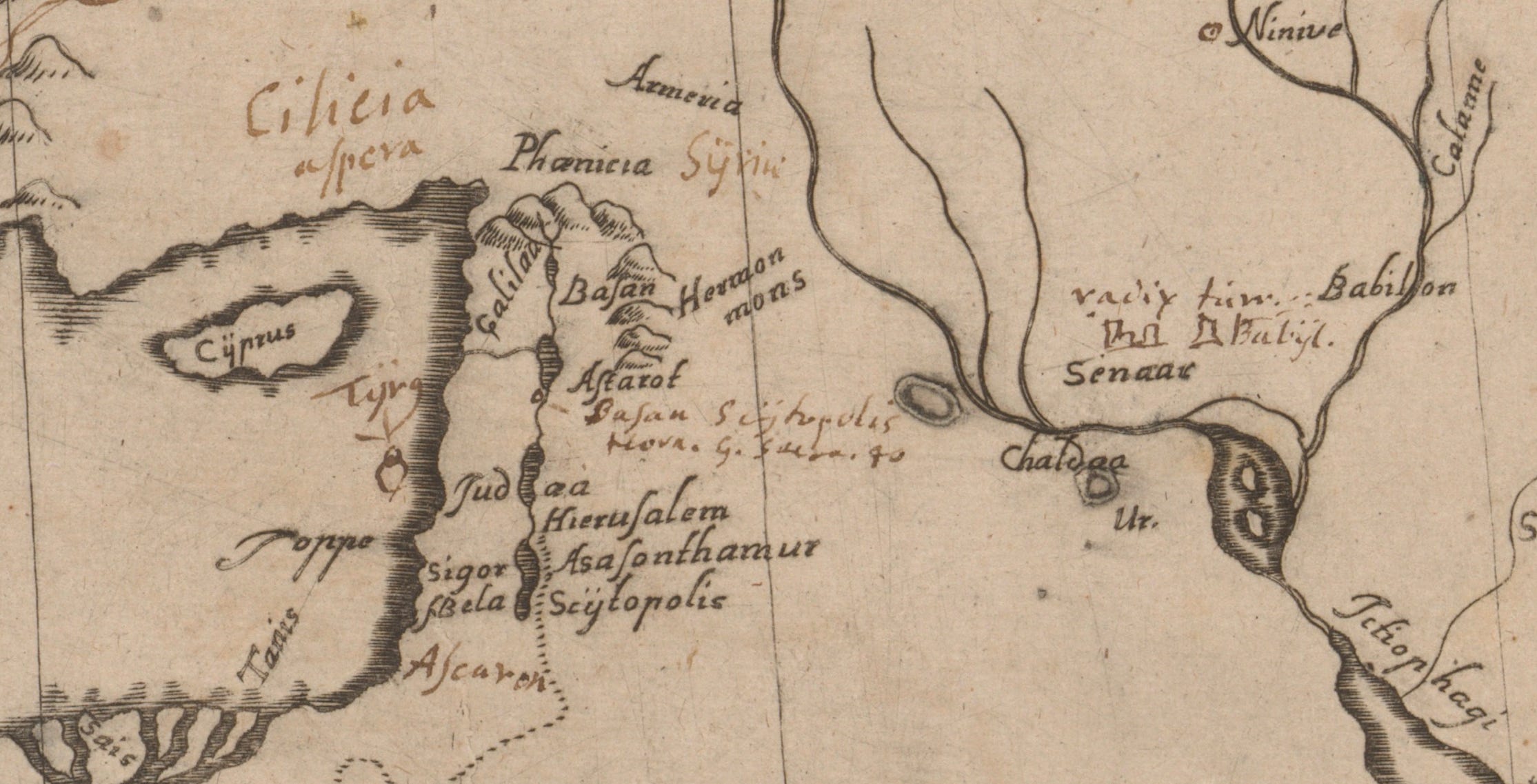
Heureka!
The objects impressed on the sheets were witness to the process in which Rudbeck sought to illuminate the beginnings of languages. From collections as well as the margins of the kingdom, he brought together material evidence whose history still had to be deciphered – pieces of a puzzle he continued assembling across the volumes of his Atlantica.
Yet the sheets at Stockholm carried more than the impressions of artefacts today lost without a trace. Next to the drawing of the knife, Rudbeck had left a note in Latin, framed by three emphatic marks: NB, NB, NB.
Nota bene – the strange signs engraved along the blade – similar to the ones that appeared on the spoon and the disk – had reminded him of something. Next to them, Rudbeck placed a reference to a book by the English scholar Thomas Hyde.
“Most of the characters on this knife [appear] in the natural alphabet in Thomas Hyde in his ‘On the religion of the Persians’, page 517” 10
Hyde and Seek
On the Religion of the Persians and their Mages appeared in 1700. Possibly, the book travelled from England to Uppsala by Rudbeck the Younger after a stay in 1701 in Oxford.
On his father’s desk, it appears On the Religion nudged his thinking into a new direction. As part of his work, Hyde assembled alphabets from across the known world: scripts gathered from travellers’ reports, antiquarian collections, and the study of oriental manuscripts.
On the page Rudbeck indicated, Hyde had arranged them in a comparative table.
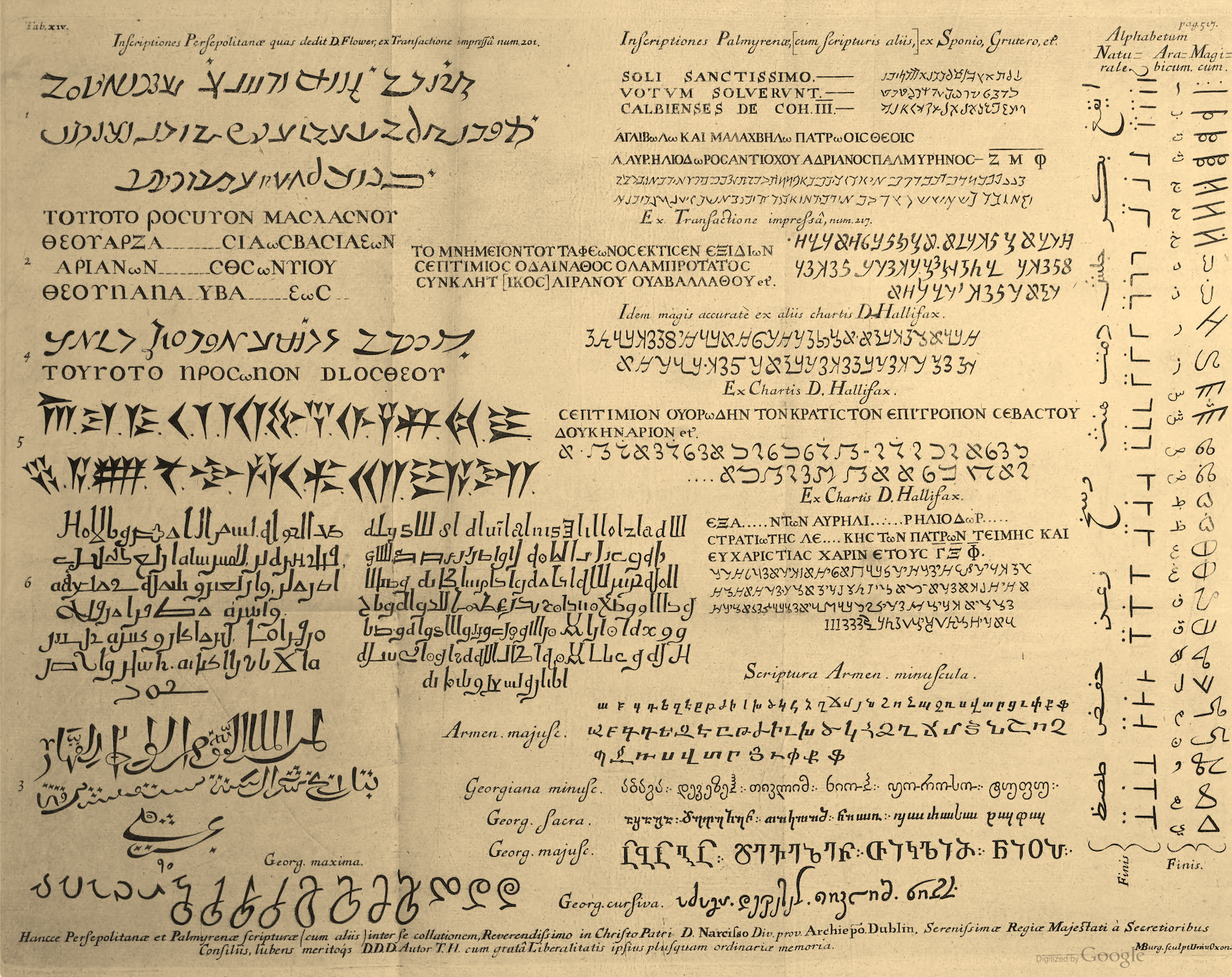
One column bears the title Alphabetum Naturale.
The signs listed there consisted of simple forms: staffs, dots, angles, and hooks: geometric figures that resembled the marks engraved on the objects Rudbeck had copied.
To him, the resemblance must have seemed striking.
Could it be that the artefacts might preserve traces of a pristine alphabet whose origins led back deeply into time, close to the moment in time when language, letters, and nature lost the divine harmony they once possessed?

The Persisting Riddle
The note next to the knife may be a waymark the later Olof Rudbeck left along the a path. It ties back to earlier explorations in which he suggested the crystalline structure of ice to have informed the runes, which he considered the first of alphabets.
The beginning of writing and languages lay at the core of Rudbeck’s Atlantica. The bundle preserved at Stockholm suggests that in its coming volumes, Rudbeck planned to open new tangents to the topic. This overlaps with linguistic approaches that his son pursued as he prepared a major work of his own – a ‘history of everything there is in the north’.

Yet the thoughts Rudbeck the Elder had laid out in the printer’s copy for the fourth volume never reached publication. In May 1702 the Great Fire of Uppsala swept through the university town.
Coping with the loss of the family’s collections and – a few months after – his father, Rudbeck the Younger carried the linguistic strand of their enterprise forward, embarking on a decade-long journey into speculations untethered from objects.
If the antiquities with the strange marks were still in Rudbeck the Elder’s possession in 1702, they likely vanished in the flames. Only their impressions remained – pressed into paper, surviving in the depths of the archive.
More than three centuries later, the question the king asked when he opened the Atlantica still lingers over the page:
What do these letters mean?
Further reading and references
All translations and photographs are my own unless stated otherwise.
For exchange on the signs I have to thank Charles Burnett.
When quoting from Latin sources, abbreviations were silently expanded and orthography lightly adapted to current standards.
Please note the general bibliography available here.
Rudbeck the Younger mentioned this episode in 1705 in a conflict with Lundius in the Academic Consistorium at Uppsala; see Claes Annerstedt, Upsala Universitets Historia, pt. 2: 1655–1718, Uppsala 1908, p. 358.
Stockholm, Riksarkivet, Skoklostersamlingen I, manuskript i fol. Nr 65.
Annerstedt, Upsala Universitets Historia, pt. 2, p. 358.
Annerstedt, Upsala Universitets Historia, pt. 2, p. 358.
On this see the classical study by Umberto Eco, La ricerca della lingua perfetta nella cultura europea, 4th edition, Rome 1993.
See Grace B. Sherrer (1938). “Francis Mercury van Helmont: A Neglected Seventeenth-Century Contribution to the Science of Language”, The Review of English Studies 14 (56), 420–427. See also Eco, La ricerca, pp. 93f.
For an overview see Stefan Bauhaus, Olof Rudbeck der Jüngere und die Sprachen des Nordens. Zwischen Gotizismus und Orthodoxie, Berlin-Boston 2019, pp. 26-55.
See Rudbeck, Atlantica, vol. 1, cap. 3. Cf. Bauhaus, Rudbeck der Jüngere, p. 25.
See the press statement on the homepage of Uppsala University (22 January 2008). For Eco’s speech I rely on an oral report through Peter Sjökvist, who attended the ceremony in 2008.
“NB characteres huius cultri plerique in alphabeto naturali apud Thomas Hyde in de Religione Persarum p.m. 517 NB NB”.